
Newsboy- Now We Are Getting There!
January 3-10, 2005
Sculptor Bridgette Mongeon has documented the entire process of creating a figurine of a newsboy and a life-size bronze sculpture. Watch the artist work through these posts. In this blog, she has also included information for students and teachers. In the previous post, we learned a little about making huge strides in the creation of the life-size newsboy
If you are lost and want to go back to the chronological running list of posts, follow this link.
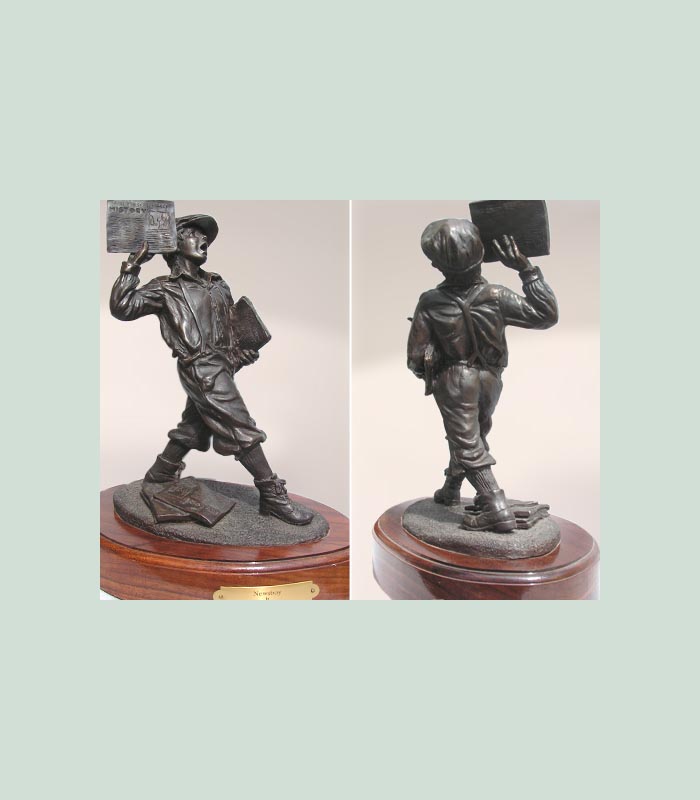
I was so excited to pick up the first small bronze newsboy sculptures from the foundry. The foundry did take photos of the process, but I will wait and post those later.
The life-size sculpture is coming along well. It feels so good to have the head attached. We put a rod through the head and into the torso to secure it. You can still see the rod in the photo. Now that the head is attached, he is coming to life. I can hardly wait to get the arms more refined and add the hands. The excitement continues.
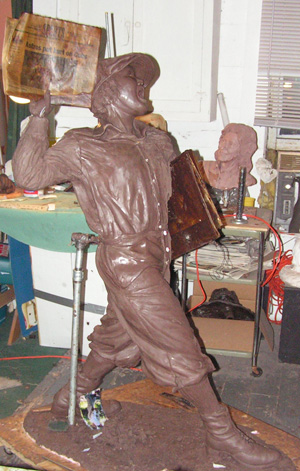
will soon be approved.
I have, however, lost one assistant to be replaced by another. My daughter, Christina, worked with me over the holidays, and I think that Miguel, who is now helping, is probably as frustrated with me as she was. No sooner does my assistant get done smoothing the sculpture, which is quite a bit of physical work, and I take one look at the sculpture and the changes needing to done jump out at me. Then, there I go again, carving and adding clay. The assistant comes in the next day and has to smooth it all over again.
THE DETAILS
I had to stop sculpting the shoes, because of the old fashion brads on the shoes. I could not figure out how to fabricate them, so I have opted for trying to find real brads for the shoes. Houston Leather says they carry them.
It looks like I will have a few “real” things on the sculpture. The buttons are staying, and because I am running out of time, I will most likely cast real suspenders. The white suspenders that I have now are not really what I want. I would prefer the ones with the leather at the buttons.
My deadline of getting this life size sculpture completely sculpted is quickly approaching. I want to leave myself plenty of time for foundry work, including mold making and working the waxes.
I can hardly wait to get going on the hands.
I attached his unfinished hand and put a paper in it just to see how it might look all put together. I had to snap the picture very quickly because the hand was not secure.
It is moving along, now let’s go see the Details on A Life Size Sculpture.
Newsboy-Huge Strides In The Life-Size Sculpture
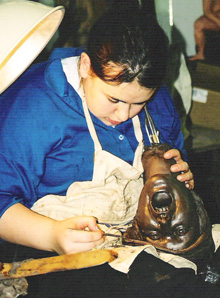
me in the studio.
December 28, 2004- January 3, 2005
Sculptor Bridgette Mongeon has documented the entire process of creating a figurine of a newsboy and a life-size bronze sculpture. Watch the artist work through these posts. In this blog, she has also included information for students and teachers. In the previous post, there was a lot of working through the holidays.
If you are lost and want to go back to the chronological running list of posts, follow this link.
What an exciting week it has been. We have made tremendous progress on the sculpture this week. It started with the shoes. They are defined, and now we are just getting to the fine detail. We are moving up the leg to the socks and pants.

Throughout the week, Christina and I have taken turns working on the head, adding clay, taking away, smoothing and then adding clay, taking away, smoothing. The last day of the week I asked Christina to finalize her work on the face and then hand it over to me. I just wanted to spend an hour or so with it before securing it to the body. Doing any of the detail work on Dusty’s face after it is on the body is a job for an acrobat. It is much easier to work on his face when I can hold it in my own hands.
When we are not working on the head, we spend a lot of time working on the floor, lying on pillows and blankets, making ourselves as comfortable as possible as we refined and defined the shoes, the socks, and under the knickers. There is still much to do in that area. The last day of the week, Chris was beginning the long process of cutting shoelaces and threading them into the clay, like we did with the small sculpture. We also must spend a great deal of time closing up any undercuts in this area. An undercut is an area that you can pass something through or a deep grove. So we fill the little areas under each shoelace with clay. If we did not do this, the rubber would get stuck around the shoelace when we start making the mold and would tear the rubber.

Before we entered the New Year I wanted to attach the head, a milestone of the process. I had to hold off with defining the upper torso until the head was attached. Though I did surprise myself. I “eyed” the space between the buttons on his shirt by using the photos. Then I remembered I had the shirt to look at, and don’t you know I was right on with my measurements! The head was added on the last day of the year.

To attach the head we had to be very careful of placement, a very tricky thing. You don’t want too much neck or too little, and then we had to make sure it was secure to the torso. We did so by hammering a threaded rod through the head, neck and deep into the torso. It was such a great satisfaction to see him put together. It is also exciting to know I am getting to a new stage in the process. It renews the creative energy inside. I am hoping to have the sculpture finished within the next three weeks and ready for approval by the client.
Monday, January 3rd, I am picking up the first small bronze sculptures from the foundry. I can hardly wait to see them.
Stay tuned next week to see the sculpture complete with head and torso and photos of the small bronze in the blog post, Now We Are Getting There.
Newsboy- Working Through The Holiday
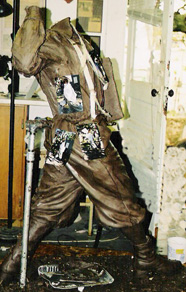
checking the design.
December 22-27, 2004
Sculptor Bridgette Mongeon has documented the entire process of creating a figurine of a newsboy and a life-size bronze sculpture. Watch the artist work through these posts. In this blog, she has also included information for students and teachers. In the previous post, we got to see the morphing of a sculpture.
If you are lost and want to go back to the chronological running list of posts, follow this link.
My, it was cold in the studio this week! We were thankful for the torches, but sitting on the ground and working on the shoes was something that neither my assistant nor myself wanted to do.
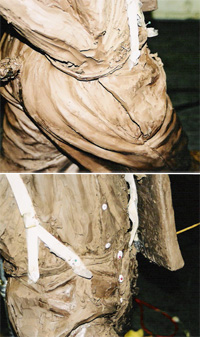
Last week I had wooden skewers in the place of the buttons. This helped me to be able to get my proportions correct and also greatly affected the folds. This week I have replaced them with buttons. Now I can really see what needs to be defined.
I also added a “fake” newspaper in Dusty’s left arm. It helped me to be able to see the arm and upper torso better. I also wrapped some Saran wrap around the suspenders and put them on Dusty. The wrap was to keep the suspenders clean. I put them in place with buttons and pins. Previous photos show strips of cloth for suspenders. I know the suspenders have not changed in size since Dusty wore them. Using them helps with proportions. Having them in place plays a great role in the folds of the shirt and pants.
Sometimes I will pin the photos directly to the sculpture. When I’m working I’m usually holding several of my favorite tools and a hand full of photos and then there is the torch. I wish I had an extra appendage to hold some things.
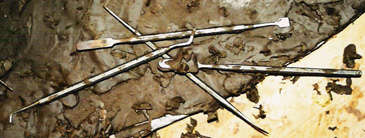
Some of my favorite tools are dental tools. They are very sturdy and can handle the stiff clay. They also can be heated up. As I understand it, dentists will often toss their old dental tools. If you are a dentist please don’t toss them, send them to me. My favorite two tools are the “hockey stick” looking tool and the one that looks like an ice chopper. Chris and I often fight over the tools.
Artists do get used to the feel of a tool, and you get so used to how it feels that it works like a part of your own hand. Change that tool and it throws your production off.
The blog will get back to student and teacher posts, but for now, let’s move on to see some Huge Strides in the Life-Size Sculpture.
For the Love of God and Your Health
I have attended church for many years. There are many benefits to belonging to a church, for those non-churchgoers let me explain. I live very far from my family. My mother, father, sister and brother live over 1,500 miles from me. When going through life, it is often difficult to not have the support of a family that lives nearby. In many ways the church, and those people that I have met at church, have become my family. Whenever I have gone through milestones in my life, they were there. When life became difficult, I knew I always had a support group of people who would be there for me and encourage me and help in any way possible. And, when I had wonderful milestones; they were there then as well.
Getting up on Sunday morning and committing to going to church is not easy. It is not even easy for those who do it regularly. Many mornings I wake up and think, “Ahh to sit in bed with a cup of tea and watch Sunday Morning with Charles Osgood.” As difficult as it is to get myself motivated to go to church, upon returning home, I am always glad I went.
Church is an investment and you do get out of it what you put into it, but over the many years of attending church, I have come to realize that the investment is a very important one. I have tried to instill this same investment within my daughter. When she was young there were plenty of times she would whine about the idea of getting up and getting dressed and going to church. Sometimes, as she sat fidgeting in the pew next to me while coloring on the pew sheet, I would wonder, “What is she getting out of this?” As she matured, I realized what I gave her was the knowledge that she too had the support base of a church family and a strong faith in God. No matter what happens to me, she would have God and the relationships that she would establish as she grew up and moved away and attended another church.
GOOD FOR YOUR HEALTH
According to recent studies, going to church has more benefits than we knew. In recent years psychologists and those in medicine have conducted research on the idea that having a spiritual relationship with God and a spiritual relationship with a group can actually be good for your health. Some of the ideas and research are quite basic and easy to understand. For example when people are anxious or irritated for long periods of time, it will suppress their immune system, which in turn makes them susceptible to illness and disease. Psychologists have studied the idea that developing close relationships can have a positive effect on your health in several ways: First, by physically in creating your immune system. I also affect you emotionally as it helps with coping skills and offers those individuals in the relationship a place to vent and receive direction. Of course, close relationships can be found through other groups, but they are most often found within a spiritual family such as a church or synagogue.
Religious involvement can also playa part in the health of individuals because it encourages individuals to have a healthier life style, avoiding such things as alcohol, drugs, promiscuous sex, etc. Relationships that are found in a spiritual setting also offer a place where an individual can confide feelings. Dr. James Pennebaker discovered that the expression of your feelings can have a positive affect on your health, increasing your white blood cell count.
There are over a thousand studies that work with the relationship between spirituality and health. In a report sited by David Myers, “A National Health Interview Survey (Hummer & others 1999) followed 21,404 people over 8 years. After controlling for age, sex, race, and region, researchers found that nonattendees were 1.87 times more likely to have died than were those attending more than weekly. This translated into a life expectancy at age 20 of 83 years for frequent attenders and 75 years for infrequent attenders.”
POWER OF PRAYER
It is easy to see the biological effects of faith and service attendance on the immune system, but what about things that are not so easily detected through science, things like praying for others?
There have been studies conducted on the effects of prayer and health. In one study 990 patients were sorted into two categories, one group received intercessory prayer, the other did not. Those that were praying never met the patients but prayed for 28 days for a speedy recovery and no complications. None of the patients knew about the study. The results were reported that those who were prayed for did 11 % better than those who were not prayed for.
Indeed, the emotional benefits of my going to church have been numerous. The support group and family that I have acquired through my attendance has been invaluable to me and to my daughter. Church attendance and involvement have been good for me spiritually, and I continue to go because I love God. It is interesting, for me, to discover that by committing to a spiritual relationship and church attendance, I might just have the added blessing of health.
Bridgette Mongeon is a writer and artist residing in the Heights area and a regular member of St. Alban’s Episcopal
Newsboy- The Morphing Of A Sculpture

on the sculpture.
December 14-21, 2004
Sculptor Bridgette Mongeon has documented the entire process of creating a figurine of a newsboy and a life-size bronze sculpture. Watch the artist work through these posts. In this blog, she has also included information for students and teachers. In the previous post, we learned a little about the frustration in the creative process
If you are lost and want to go back to the chronological running list of posts, follow this link.
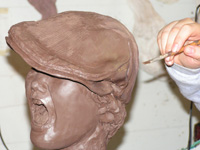
I have had assistance with the sculpture, this week. My daughter, Christina, is home from college and is helping smooth out the clay on the sculpture.
Remember that this clay is very difficult to smooth. You have to heat it up with a torch or brush it with warm brushes. I spend time putting clay on and taking it off and Chris comes behind me and smoothes out the clay. I have always liked smooth clay and I can see the errors better if the sculpture is smoothed out. Many times I come right after her, add and take away and she smoothes all over again. I guess we have a system going.
coming to life.
I have had assistance with the sculpture, this week. My daughter, Christina, is home from college and is helping smooth out the clay on the sculpture.
Remember that this clay is very difficult to smooth. You have to heat it up with a torch or brush it with warm brushes. I spend time putting clay on and taking it off and Chris comes behind me and smoothes out the clay. I have always liked smooth clay and I can see the errors better if the sculpture is smoothed out. Many times I come right after her, add and take away and she smoothes all over again. I guess we have a system going.

After such a frustrating series of days, last week, the sculpture is finally becoming more friendly. At least that is the way it feels to this artist.
I had a sitting with Dusty to take photos of his teeth. Before I met with him, I printed out all the pages of this journal and some of the articles that have been printed about the sculpture. I put them in a photo album and gave them to him, a scrapbook of sorts. He was thrilled. I can only imagine what it must be like to be 12 years old and to have your image created in bronze and put at the State Capitol building.

the small ones.
I have many measurements that I took of Dusty, but because I am actually starting from the ground up, I was very interested in getting his calf measurements.
He also gave me his mom’s boots, with her permission of course. These boots were used in the initial photo sitting. I was so thrilled to get the teeth photos, boots, and calf measurement. I felt renewed creatively
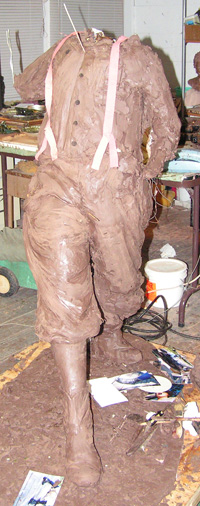
Having the boots really has been a tremendous help. I spent a day, laying on the floor and roughing in the right boot. Then handed it off to Christina who spent another entire day smoothing the clay and defining the details that I indicated. We still have not finished it, but it has come a long way.From the boot I am moving my way up the leg, and those calf measurements sure are coming in handy, then on to the left leg. By the end of the week it looked as if the sculpture is morphing from the ground up. It is so cool to see.
Now let’s keep going. Working hard and to the next post –Working Through The Holidays.
Mind and Body Matters: Ballroom Dancing may Prevent Dementia
Houston Tribune
December © 2004
The New England Journal of Medicine, June 19,2003 suggests that ballroom dancing may prevent dementia. A group of men and women participated in six hobbies that were considered brain stimulating activities, such as writing, reading, discussions, playing games, crosswords and playing instruments. There were also eleven physical activities like ballroom dancing, and different sports; the 469 participants were studied for 21 years.
During the course of the study, 124 people developed dementia, 61 developed Alzheimer’s, 30 had strokes, and 25 mixed dementia, 8 had other types of dementia.
It was reported that those who took part in the brain stimulating activities had a reduced risk of developing dementia. The only physical activity that showed a reduced risk was ballroom dancing. In fact ballroom dancing scored the highest in both brain stimulating and physically ,stimulating group. It is thought that the old saying, “use it or lose it” applies to the brain stimulating activities. Ballroom dancing has so many brain stimulating elements such as remembering steps, reacting to the partner and hearing the beat that it is mentally challenging.
Because physical activity is important at any age, and brain stimulation may playa part in preventing dementia, ballroom dancing is proven to be a great exercise for both the body and mind.
All written work is copyrighted and cannot be used, whole or impart,
without the written consent of the author.
Newsboy-Frustration Of The Creative Process
December 7-13, 2004
Sculptor Bridgette Mongeon has documented the entire process of creating a figurine of a newsboy and a life-size bronze sculpture. Watch the artist work through these posts. In this blog, she has also included information for students and teachers. In the previous post, we learned a little about the possible history of the this newsboy sculpture.
If you are lost and want to go back to the chronological running list of posts, follow this link.
I have a hard time actually seeing my progress at this point of the project. The work is progressing very slowly. I just keep working and working, and working, moving around the sculpture, taking clay off and putting clay on, comparing it from all directions, looking at the many photos. It is very frustrating. I wonder if anyone else can see the progress?
In many different art projects there is a point of frustration. Sometimes it is a feeling of being overwhelmed; sometimes it just doesn’t seem to come together quick enough and you end up frustrated with the process. All artists go through this. It is important to push past the frustration, stay motivated keep pushing to greatness. I have told this to my own children as they have worked with their creativity. I’m not sure if they understand totally. I think the more you push past the frustration and then finally see the finished art, the easier it is to continue in this difficult part of the creative process.
As artists, my husband and I have many years of creativity between us, and the frustration with our art still comes. The most welcoming part of the frustration is that you know there is a wonderful feeling on the other side of it.
TEETH
This is the first time that I have ever had to sculpt the inside of someone’s mouth. I need to set up another sitting with Dusty to get more reference photos.
BOOTS
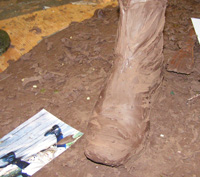
The boots that Dusty wore in the photo sitting were his mothers. She collects antique clothing. I plan on getting the real boots to work from next week, while at the photo shoot for Dusty’s teeth.Being able to work from life, even if it is a boot, will be a tremendous help. I can hardly wait.
Let’s move on to the Morphing of a Sculpture.
STUDENTS AND TEACHERS
History
• There was a sales campaign for the zipper in children’s clothing in 1939. Can you search the history of the zipper link above, and tell me what items the zipper was used for before it was used on pants?
• There is a copy of the newsboy strike printed in the New York Times, July 21, 1899. Kids your age were able to change the minds of very powerful people.
“Friens and feller workers. Dis is a time which tries de hearts of men. Dis is de time when we’se got to stick together like glue…. We know wot we wants and we’ll git it even if we is blind.”
The New York Tribune quoted Kid Blink’s speech to 2,000 strikers:
Newsboy-The Future Journey Of The Newsboy
November 29-December 6, 2004
Sculptor Bridgette Mongeon has documented the entire process of creating a figurine of a newsboy and a life-size bronze sculpture. Watch the artist work through these posts. In this blog, she has also included information for students and teachers. In the previous post, we were watching the process of the beginning of sculpting the life-size newsboy
If you are lost and want to go back to the chronological running list of posts, follow this link.
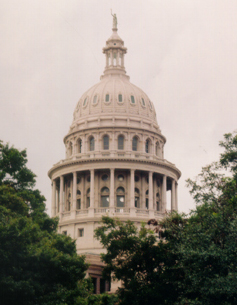
Remember that this sculpture is intended for the State Capital. I thought that this might be a good time to look at the road that the newsboy will have to travel to get there.
Our destination is the Texas State Preservation Board. “The State Preservation Board was established in 1983 by the 68th Legislature for the purpose of preserving, maintaining and restoring the State Capitol and the General Land Office building, and their contents and ground for the benefit of the citizens of Texas”
You can read about the State Preservation Board on their web site. According to this web site “the Texas Capitol building was designated a National Historic Landmark in 1986 for its significant contribution to American History.” The state preservation board will determine the future of our newsboy.
What road do you take to get to the State Preservation Board? It is a long journey. To be put on the agenda for the State Preservation Board the project must be brought as a resolution before the state senate.

The Legislature meets every odd-numbered year for 140 days. The 79th regular legislative session begins Jan. 11, 2005. If you would like to find out more about the legislature processes the Texas Legislature site Online web site is excellent.
There is also quite a bit of information at the Association of Texas Professional Educators.
WHO IS MY REPRESENTATIVE?
I am very proud to report that John Whitmire, the state senator who represents my district will file the bill supporting the Texas Press Association’s statue request.
If you live in Texas and you are interested in finding out whom your own state representative is, you can do so by going to the capitol state web site and typing in your address.

If you would like to learn about the Texas Senate you can play games and collect senator trading cards, like the one above, at Texas Senate Kids web site.
There is a section for preschool children as well as a special section for parents and teachers. You can also take a capitol tour. When take the tour you will see the sculptures of Elizabet Ney that we spoke about in the October 26th journal. I love the Texas Senate Kids web site, it is so much fun!
THE JOURNEY’S END
We really will not know the standing and destination of our newsboy until next year. The designated date of placement for the sculpture is May 19th 2005. This is the 125th anniversary date of the Texas Press Association.
If for some reason the newsboy should not make it through the legislation process, with favor, the sculpture will be placed at the Texas Press Association’s office building in Austin, Texas.
As we follow this legislative process it will be a wonderful educational adventure. I am hopeful about the placement at the State Capitol building and I look forward to uniting with many people at the unveiling. My job, right now, is to keep sculpting. The rest will be history.
Now let’s move on with the sculpting process in the Frustration of the Creative Process.
Newsboy- Beginning Of The Large Newsboy Sculpture Cont.
November 12-21, 2004
Sculptor Bridgette Mongeon has documented the entire process of creating a figurine of a newsboy and a life-size bronze sculpture. Watch the artist work through these posts. In this blog, she has also included information for students and teachers. In the previous post, started the sculpting of the life size newsboy.
If you are lost and want to go back to the chronological running list of posts, follow this link.
from the body.
Headless
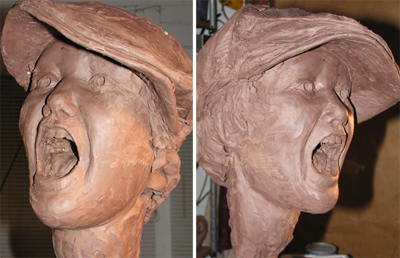
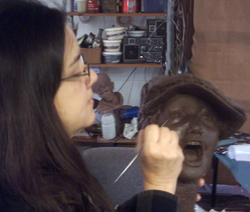
The sculpture is coming along. I am working on the head separately from the body. This enables me to work on it from all directions. Sometimes turning a head upside down helps me to get the details and proportions correct. For the brim of the hat I have used the pattern that I purchased and cut it out in cardboard and then covered it with clay, pinned it to the head, and added the top of the hat. I have to be careful; I don’t want to add these details too soon, because I need to be able to reach the eyes.
Torch
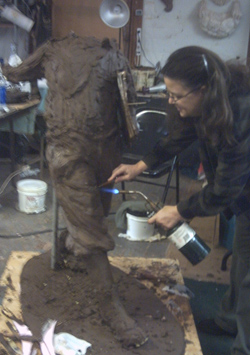
This clay is very hard. After heating it up and putting it on the armature it cools down and hardens. To put more detail in the sculpture I have to heat it up. The torch is my best friend. The process of doing the life size sculpture is very physical. This is where my Popeye forearms come from. During this process I’ll sculpt for two days and then let my arms and hands rest. In between I spend a lot of time cleaning up. This processes is messy, messy, messy.
Paper
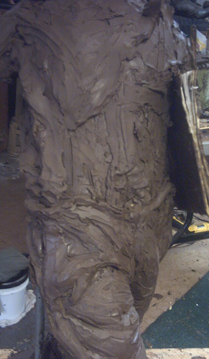
I have taken real newspapers and coated them with wax. They are just pinned in place for now. Putting them in place helps me with proportions. Later I’ll carve the headline in the paper.I am really counting on the small wax sculpture. I spend a lot of time holding it up, in line with the large sculpture, to see how it is progressing.
Next week I’ll take some time off to spend some time with my family for Thanksgiving.
Happy Thanksgiving to all of you.
Time to continue on with the process, but first, let’s learn about the possible future journey of this newsboy.
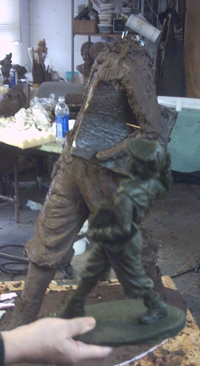
small newsboy wax to the
large newsboy in clay.
STUDENTS AND TEACHERS
Learning how to enlarge a sculpture
There are several ways to enlarge a sculpture. There is a method called pointing up that is described by Christopher Pardell in his article.This You Tube Video by Joe McCluskey shows the pointing up process with a pantograph. might help you to understand the process. A new way of enlarging sculpture is done by a company called Synappsys. They scan artwork and then take the image into a computer and enlarge it. Foam is cut out by another machine. The pieces are then secured with rods through them, to keep them together. And then she put clay on top of the foam. Now that is quite a bit of hot wax to put on a sculpture! The artist’s Alice in Wonderland Sculpture was created this way. Watch her video to see how it is done.
Newsboy-Beginning Of The Large Newsboy Sculpture
November 8th-12th, 2004
Sculptor Bridgette Mongeon documents the creating of a limited edition, bronze figurine and life-size Newsboy sculpture for the Texas Press Association. Bronzes are available for purchase in both sizes.
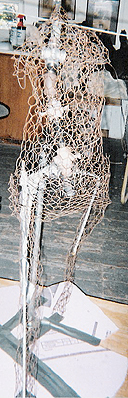
the armature that will
hold the clay.
This week I started on the life size sculpture of the newsboy. As with the small newsboy, an armature needs to be built. Wire is not strong enough to hold the amount of clay that will be on the sculpture, and weight is often a problem, so the goal in making an armature for the large piece is strength and not too much weight.
The large wooden platform was first constructed. It was necessary to make this strong enough so that if necessary I could stand right on top of it. Next I examined the small wax sculpture. I decided I wanted the pipe to enter the body in the lower back, behind the right leg. It will be a little difficult sculpting on the left leg as it will be close to the pole but I have opted for this placement anyway.
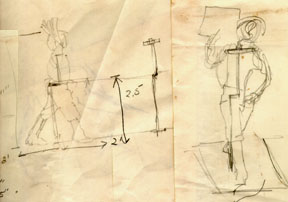
The armature in this large piece consists mainly of 3/4-inch plumbing pipe. I worked with the angles and pipe to configure the torso. If I had a welding machine in the studio I would have preferred to weld the armature together, using the angles that I need.
After figuring out the plumbing pipe I then added wire and chicken wire. In the chicken wire I added spray foam insulation. This stuff is very messy to work with but it really does a great job of adding volume without adding weight. After it dries I cut it away in the shape of the newsboy. I’ll be adding on about an inch or two of clay to this armature. I study the small wax and the large sculpture to be sure I have the correct size and shape.
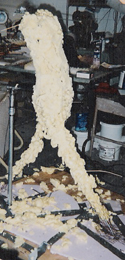
help to give the sculpture
mass without weight.
I have also added some flat foam pieces to the base of the sculpture. I am unsure if this life size piece will have a large base or sit flush with the ground. I would prefer it sit flush with the ground, so that it looks like the newsboy is walking in the grass, but that will depend on the client and the placement and many other variables. I have decided to put the base on the sculpture and if it is not needed I can cut it off in the wax. These flat foam pieces, which are really foam that you use to insulate, work like the spray foam. They add a little volume to the base. I could do the base with the clay but it would take more clay.
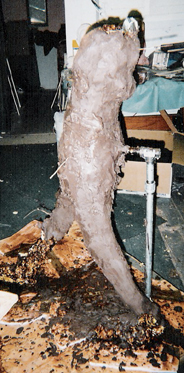
After the foam is cured I carve it to the correct shape. Then my assistant, Miguel, adds a thin layer of wax. This is an extra step that I take to prevent the little pieces of foam shavings from getting into the clay. I am a very tactile sculptor and I hate bits of things in the clay.
Now it is time to put on the clay. It is done the same way as the small sculpture. I heat the clay up in crackpots and add it to the armature in a frosting like manner. I usually have an apprentice do this work. They add the clay enough for me to come in and do the final detail. Working in this wax base clay at this scale is often very physical work. When it is cold the clay gets very stiff. Sometimes I will work with a hair dryer or even a torch to soften it to enable me to work.
I’m working on the head separately and will report on that next week. I have made quite a bit of progress.
STUDENTS AND TEACHERS
I often will continue to do research as I proceed with the project. It helps to keep me motivated and interested, it keeps the passion alive.
When trying to research the amount of money that the young boy would be carrying in his pockets I tried to find out about the cost of a newspaper. Here is an article that introduced to the “Penny Press” The penny press offered lower income citizens an opportunity to read the news.
PBS has a link to a very interesting subject called yellow journalism.
Here is a source that states that the Sun was not the first newspaper to utilize newsboys.
History Buff also had a nice article about newspaper production 1892-1992
And if you do float around on the History Buff web site and read about newspapers, then try their newspaper-collecting quiz.