
A Small Booker T. Washington- The Beginning

I must first create a wire armature similar to the ones in the picture. But what size?
FROM THE ARTIST’S STUDIO
With many of my small sculptures, I start with a simple metal armature. I will put clay on top of this wire armature. Eventually, you will see that I’ll be reverting to my Alice In Wonderland sculpting days, and it will be “OFF WITH HIS HEAD!” It is just easier to work on a head that is not attached. I’ll also cut off the hands and the feet. But first, how big should we make the wire armature? There are lots of proportions that I need to take into consideration. First, we have the photographs of Dr. Phillips in the chair. I know the sculpture will be approximately 10 inches tall. I’m very visual. So, I xeroxed down a photograph of Dr. Phillips at 10 inches tall. I have to be careful here. The image must be taken perpendicular to the subject, or it will change everything. Once there, I used string to see approximately how tall a man would be that is just 10 inches tall when he is seated. I ran the string from his head through his shoulders. Then I went down to his hips up a leg and down to his feet. Once I had a measurement, I found images of a standing Booker T. Washington. Thank God for the Internet. It makes my job so much easier.

Sculptor Bridgette Mongeon searched the internet for standing images of Booker T. Washington. She would use these to be able to get the proportions for a small sculpture.
Even though these images are of a Booker T. Washington at different ages, it still helps. I lined them up next to each other. I wanted his navel, head, and feet to align. This would help me with the general proportions of the man. I also use Pinterest on my projects. I created a Booker T. Washington Pinterest page with the images that I found of Booker T. I will refer to it often. Sometimes so much that I have to cover my lap top with something so clay does not get in the keyboard. You will also notice there are images on my Pinterest that are not of my subject. Sometimes, I’m just looking for clothing, or a fold or something of that nature, and it gets pinned to my Booker T. Pinterest page. I am chomping at the bit to get started. While I’m finishing up other jobs I instruct my assistant to put clay on the wire armature. Now the magic begins!

Sculptor Bridgette Mongeon begins a Pinterest Page so she can have reference. She uses this along with a Google Drive folder that holds the pictures of the principal.
TEACHERS AND STUDENTS
Proportion is just one thing that Artist Bridgette Mongeon uses in her art that are STEAM related. There are many types of math in a traditional artist’s studio. Here are some to explore.
What is the Golden Ratio? How have artists used it in their art?
Goldennumber.net has some information on Golden Ratio.

A sample page of Leonardo Da Vinci’s Books. With highlights from sculptor Bridgette Mongeon.
If you want to get really excited, look at the Fibonacci number in nature. When you are looking at these things, it is interesting to know there is something called Sacred Geometry? What does that mean? Where does this term originate?
Do you know other artists who worked with math, proportion in their artwork?
Check out the math in Escher’s work. Here is a video lecture from Gresham College And another from Oxford Mathematics on the work of Escher.
Leonardo DaVinci was not only a great artist, but he loved to document things like proportions and science. Someone took his notebooks and translated them. You can see his original drawings in his notebooks here. You can also see the translations and images in the book called The Notebooks of Leanardo Da Vinci Volume 1 and 2.
Author Sculptor Bridgette Mongeon
https://www.instagram.com/bridgettemongeon/
https://www.facebook.com/BridgetteMongeonSculptor/
https://twitter.com/sculptorwriter
A Tiny Chair

A tiny replica of the chair.
FROM THE ARTIST’S STUDIO
As we said, we need to make a little sculpture to have something to go big. The entire small sculpture of Booker T. Washington is going to be 10 inches high without a base. It was the task of Bridgette’s assistant to take every measurement off of the large chair and figure out what proportion she needed to reduce it down.
Bridgette found a great deal of wood from Texas Art and taxed the assistant to replicate the chair. Bridgette knew some modifications would be needed. They would never be able to find the exact size of wood, but that is alright. They will add clay to the wooden chair to make it work.
Teachers and Students
Do you think you could replicate a piece of furniture you have in your school or home? What math would you need to be able to do this? What is the proportion of reduction.
Author Sculptor Bridgette Mongeon
https://www.instagram.com/bridgettemongeon/
https://www.facebook.com/BridgetteMongeonSculptor/
https://twitter.com/sculptorwriter
The Size of a Sculpture
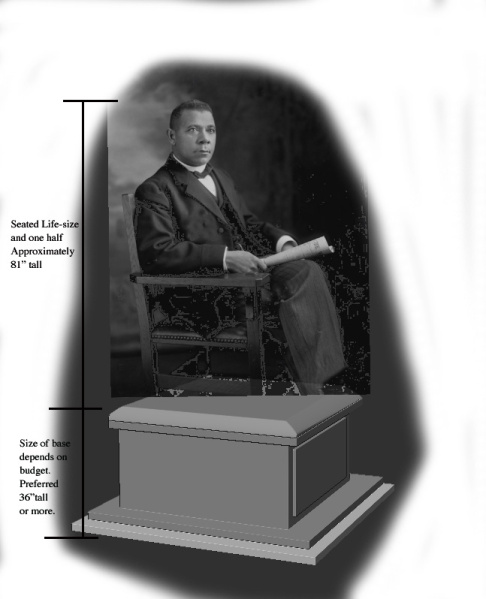 FROM THE ARTIST’S STUDIO
The team decide that the artist will make two sculptures. One will be a small table top version of the sculpture. These can be made into limited edition bronzes and may help the team raise additional funds. They can give them to those donating large sums of money or they can sell the outright. Stay tuned for information on this.
The other sculpture is the one for the campus. It will look very similar to the small sculpture but it will be 1 and 1/2 life size and will rest on a pedestal. Bridgette will also use the small one to help to create the large one.
Author Sculptor Bridgette Mongeon
https://www.instagram.com/bridgettemongeon/
https://www.facebook.com/BridgetteMongeonSculptor/
https://twitter.com/sculptorwriter
Booker T. Washington Quotes
Few things can help an individual more than to place responsibility on him, and to let him know that you trust him.
Booker T. Washington
Out in a Field
FROM THE ARTIST’S STUDIO
 Having reference is very important. Sculptor Bridgette Mongeon figured that Dr. Phillips was about the same Height as Booker T. Washington. So she took the chair to the school and asked him to pose like Booker T. Apparently, Booker T. was a bit more flexible because the pose is not the same. But what this pose does, is it helps the artist to see a relationship. She can see the chair that she has in her possession and how it compares to a real man. It gives her visual information that she might not otherwise have. It would be great if Dr. Phillips was clothed in the exact waistcoat and coattails as Booker T. in the photographs. But this will do.
Author Sculptor Bridgette Mongeon
https://www.instagram.com/bridgettemongeon/
https://www.facebook.com/BridgetteMongeonSculptor/
https://twitter.com/sculptorwriter
The Clothes of The Man and What They Say.

A pin stripe is a bold fashion statement
FROM THE ARTIST’S STUDIO
When searching through the images of Booker T. Washington, I must focus on the clothes. I do this for a couple of reasons. First, I’m sculpting them. I must know more about them. The one thing I like about all of my sculpture commissions is that there is a historical aspect to them.
When I sculpted the Newsboy for The Texas Press Association, I had to research the clothes that a Newsboy would wear. I learned so much. Interestingly, this is the same period as this Booker T. Washington sculpture. (As a side note: there was a big newsboy strike of 1899. Children everywhere made a considerable difference in the world because of this. )
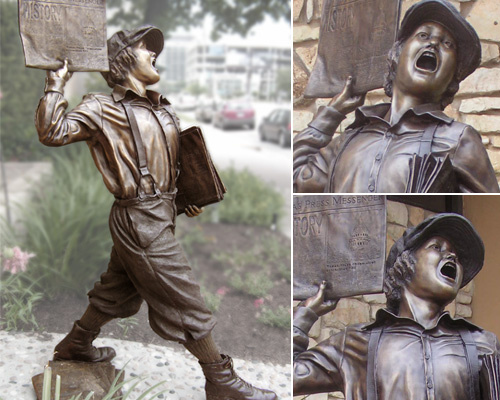
Bridgette Mongeon’s Newsboy created for the Texas Press Association. Limited edition bronze.
Clothes can tell us a lot about the person, the period, the stature, social norms, etc. With my Newsboy, I learned that as the boys aged, their length of pants was an indication of maturity. In the production of The Music Man, which was set in 1912, there is a song titled “You Got Trouble”, with a line that says “the minute your son leaves the house does he unbuckled his knickerbockers below the knee?” Boys wanted their knickers long to show that they were grown up, so they would buckle them below the knee. I learned a lot about that time period by studying the clothes. I found an old pattern and sewed a reference outfit from that pattern for my sculpture.
Sculptor Bridgette Mongeon searched the internet for standing images of Booker T. Washington. She will use these to be able to get the proportions for a small sculpture.
When I watched the show Downton Abbey I learned that you could tell how wealthy a man was by the size of his top hat. Understanding clothing and textiles teach us about history, technology, and social aspects of the time.
Let’s see what we can find out about the clothes that Booker T. Washington wore.
First, let’s put this in context.
- Booker T Washington lived 1856 – 1915
- The Emancipation Proclamation 1863 (Booker T. would have been six or seven years old.)
- The civil war 1861 –1865 ( Booker T. was nine years old when it ended.)
- The sewing machine was invented in September 1846. They went into productions in the the 1850’s. At this point a foot petal moved these machines.
- The electric-powered sewing machine did arrive until about 1905.
- The modern zipper came about around 1917 So, Booker T. had a button fly.
- First Sears catalog was in 1889. Booker T. would have been 33.
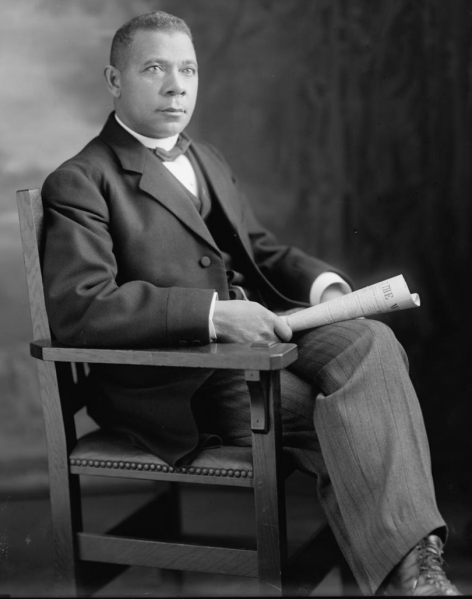 Knowing these things, I can assume that most of his clothes would have been hand made. He may have purchased a few things off the rack, but you must know it is not like it is now. You could not just walk into a large department store. Perhaps he purchased his clothes from an old Sears catalog? Sears had a catalog from which you could purchase anything, including a house.
When wanting to know more about this subject. I had to do what I always do when approached with the history of which I am not sure. I consult those who know more than I. My sources were my friends from college.
Elizabeth has an MFA in fashion and costume and is a costume designer, and a costume historian.
Christine is a textile and a prototype designer at an engineering company.
I learned that clothing changes depending on the period and stature. For example, a man’s tie, before this period would have been more like a fancy scarf called a cravat. Did they become smaller because of the cost of the material? Booker T’s tie is more like a very small bow tie.
The material in the suit was probably wool. I had always thought wool was hot, but my informed friends tell me that it is not necessarily hot; in fact, it breaths. But how was that cleaned? They didn’t have a dry cleaner. One of my sources said that they often had many shirts, but not many suits. Brushing the suit off was one way to clean it.
You have heard the term “dress the part.” Booker T. had to be around a lot of important people. He had to try to win them over, and often, he would be fundraising for his projects. He had to “dress the part”. Booker T. would try to mimic high society, but not be too flamboyant.
The vests we see him wearing are referred to as a waistcoats. The neckline of the waistcoat changed, as you can see in these pictures, so did the size of the lapel. The size of the lapel on the jacket could be indicative of a man’s wealth, but so was the type of material and how well the suit was made. The coat that he wears over this waistcoat is called the morning coat, often longer in the back. We might think it looks more like coattails. As one source said, “Men at this point, were not dressing up to show their wealth, they were dressing up to show their character. If they wanted to show their wealth, one needed to look at how the wife dressed.” I thought this was a fascinating statement, and we could do much more research on the wife of Booker T. Washington and what she was wearing in photographs. Booker T. was also dressing to show his equality with others.
One resource commented on the pinstripe suit. In this pinstripe which is probably grey or brown, it was a fashion-forward decision, because it is a bolder choice. “I would guess Booker T. knows he is a celebrity and is always trying to look good. He is trying to promote his people.”
I have learned a lot about clothes. Now I must sculpt them. But I have some other details to work out first.
Teachers and Students
- Read more about the Newsies Strike of 1899. What did the kids do to make a difference?
- Would Booker T. Washington be featured in the newspapers? What was his influence with newspapers?
- Students can extend their research to the wife of Booker T. Washington and her clothes. What did she wear? What does it mean?
- What other things can you find out about clothing manufacturing and when it began. What types of machines were invented, and when?
- We learned about copyright a bit, patent is similar, but has to do with inventions. Do you know what happened with the patent of the sewing machine?
- What prices surprises you the most when you look up old photographs of the Sears Catalogue?
Author Sculptor Bridgette Mongeon
https://www.instagram.com/bridgettemongeon/
https://www.facebook.com/BridgetteMongeonSculptor/
https://twitter.com/sculptorwriter
The Chair

A friend has a similar chair. It is original, it is old, but it is a good resource.
FROM THE ARTIST’S STUDIO
Sculptor Bridgette Mongeon counts on her social media followers to help her find information and resources. She has located everything from old teapots to models, and a trampoline needed for photos for reference. Once again, her social media friends come through. She posts the image of Booker T. and asks everyone what type of chair it is. A friend responds. “It appears to be an early 1900s Arts & Crafts style chair. (corbels under the arms, mortise and tendon construction). There were a number of arts & crafts (sometimes also referred to as mission) furniture and chair-makers in the early 1900s: Gustave Stickley, L&JG Stickley, Stickley Brothers, Roycroft, Limbert, Hardin, and others. From the seat bottom on this chair, my guess is early early 1900s. (No springs in the seat bottom). Many of the chairs from that period were made out of white oak and fumed. If the chair has flecking in it, then it was made with quarter-sawn oak. Some chair makers marked or “signed” their pieces either with a stamp, paper label, metal label, etc. Some Chairs can also be identified to the maker by finding the chair in an old Catalog, and some of those catalogs have been reprinted for purchase today.”
She has hit the jackpot in the information. Her friend guess in furniture also fits the time period— Booker T. Washington lived (1856-1915).
The artists searched further and discovered in Booker T Washington’s writing that the students had to make their own furniture. One can’t help but wonder how their skills improved over time.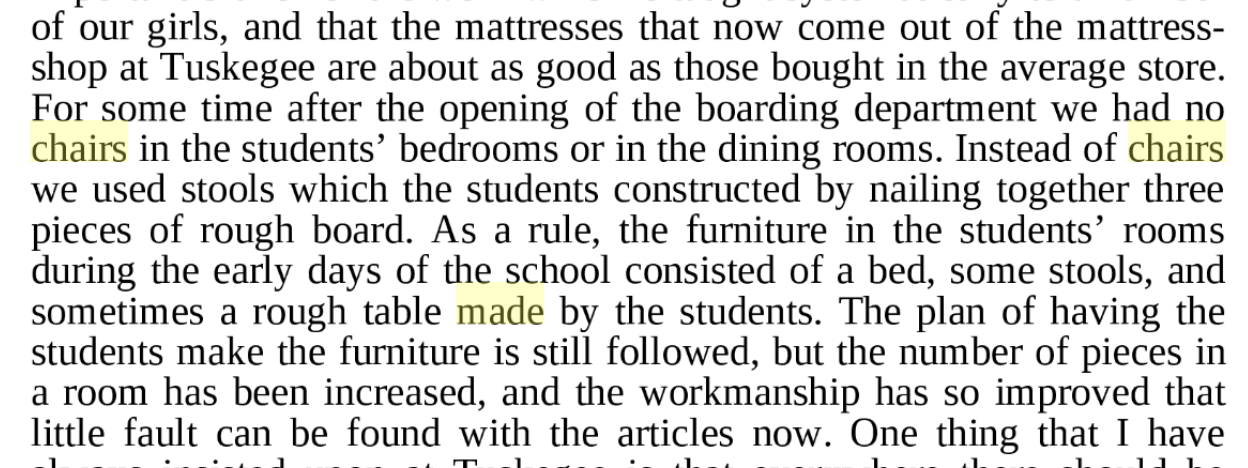
- Teachers and students
What did the term “mission style” come from? What period is it, and what type of furniture did it replace? - What is the “Art’s and Craft’s” period?
Author Sculptor Bridgette Mongeon
https://www.instagram.com/bridgettemongeon/
https://www.facebook.com/BridgetteMongeonSculptor/
https://twitter.com/sculptorwriter
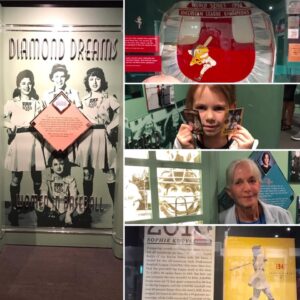
It is hard to believe but I’m a part of the AAGPBL with Penny Marshall!

When the phone rang in my studio while I was working on my sculpture of the matriarch Eve, I could hardly believe my ears. Did you know that less than 8% of bronze sculptures in the United States depict real women? I had just finished sculpting Norma, a strong female singer from Houston who bravely fought breast cancer, when I was asked by the All American Girls Professional Baseball League (AAGPBL) to sculpt Penny Marshall. You may know Penny Marshall from Laverne and Shirley, but to me, she was a trailblazer—one of the first female producers. I’m continually inspired by women who push boundaries and make a difference, just like all the players of the AAGPBL. If you haven’t seen the movie, A League of Their Own, you truly should.
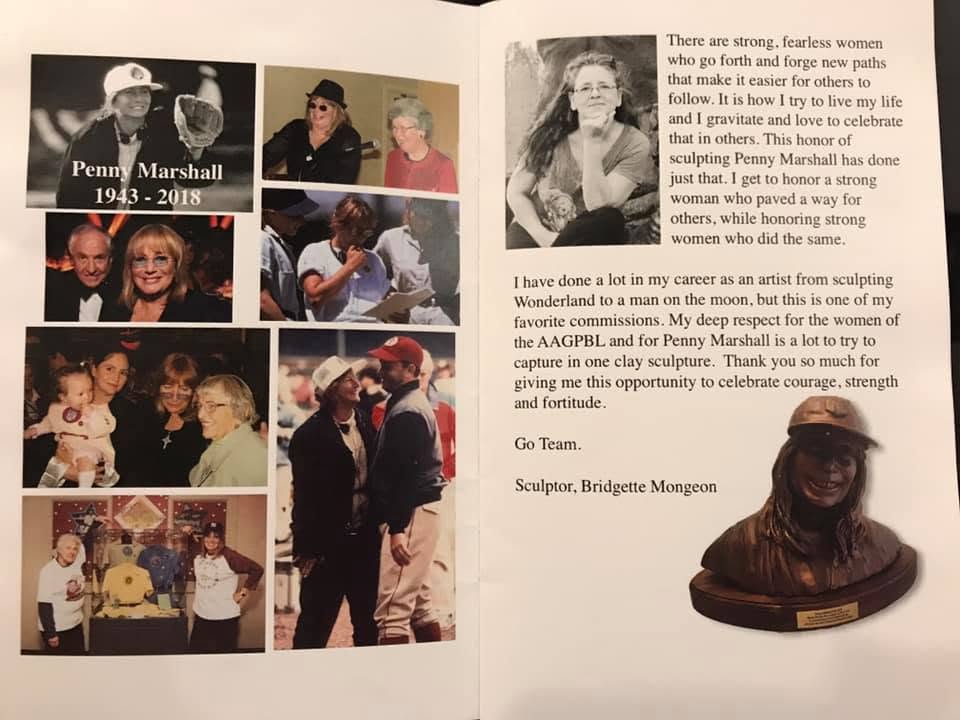
Since they couldn’t afford a bronze, I created a clay bust finished to resemble bronze, which now sits at Tropicana Field. As part of this commission, I was invited to the Baseball Hall of Fame for the AAGPBL reunion in Cooperstown, New York.
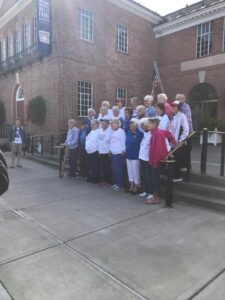
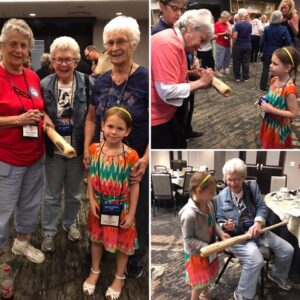
My daughter and my son-in-law are huge baseball fans—they actually met at college baseball games. Naturally, I asked if they, along with my then seven-year-old granddaughter, would like to join me for this special occasion. All I can say is that this is one of the greatest memories of my career, and I have had some incredible ones. My entire family got to meet all of the players. I watched my granddaughter toot around and collect baseball cards from these legends. Being there with my family was so incredibly cool. Remember, many of the remaining team were in their 80’s and more, but those who could make it came and signed things. We got a baseball bat and a baseball signed. I sat with my family for the dinner in the back. Penny Marshall’s daughter, Tracy Reiner, who was also in the movie, was in the front. They unveiled my sculpture, then presented me with a home plate signed the year before by many of the players that were no longer with us. I cried; Tracy reminded me that these women adopted me as they adopted her, and on the way back to my table someone shouted, “There is no crying in baseball!”

Does a Chair Have A Personality?
FROM THE ARTIST’S STUDIO
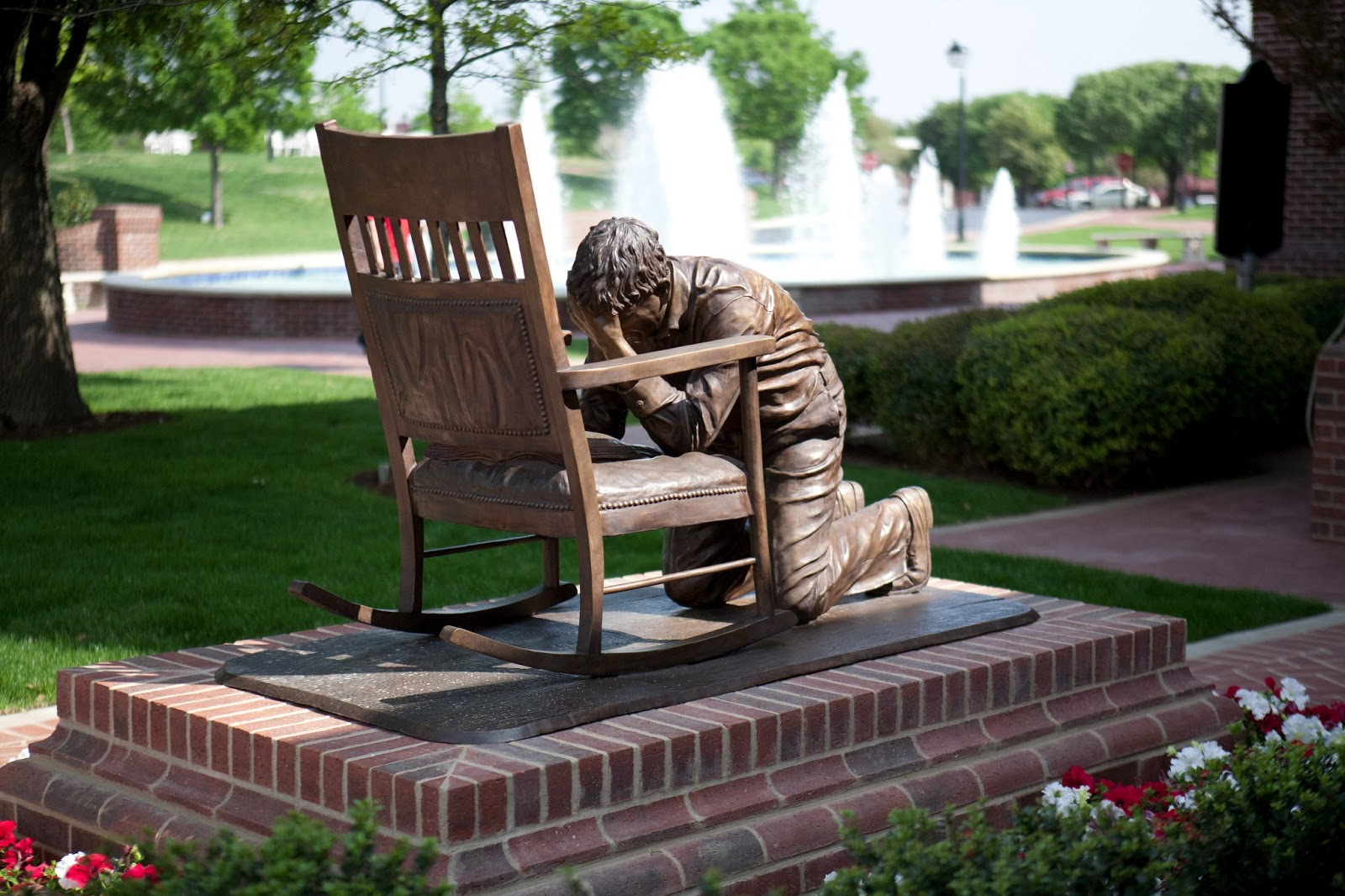
The sculpture “Called to Pray.” The chair developed its own personality.
As sculptor Bridgette Mongeon began to research images of a seated Booker T. Washington, she found quite a few. The one that the team at Booker T. Washington High School liked was the one of Booker T on the stool. Further investigation brought the artist to another similar image of Booker T. in a chair with arms.

The artists favorite view of the sculpture depicts the intensity of prayer. This exact view will never be seen by anyone after the back is added.
An artist must look at all aspects of the piece of art. What “feel” do people get from a seated figure of booker T. Washington on a stool compared to having him in a chair with arms? This project reminded the artist of another project. Dallas Baptist University commissioned Bridgette to do a sculpture of a praying man. The school wanted a man on his knees praying. The bible would be either in his hands or on a chair. After much deliberation, a rocking chair in the Dean’s office caught her eye. She wondered how many hours he had sat praying over the school, in this chair. The more she thought about it, the more the chair began to have its own personality. She replicated this chair in the Dallas Baptist sculpture “Called to Pray.” The more the artist began to think about the project for Booker T. Washington High School, the more she was leaning toward the chair with the handles and strong back. It depicted strength, stability, assuredness. Now, to find that chair.
TEACHERS AND STUDENTS
What other famous sculptures depict a man in a chair? How does the chair make you feel? What do you think the artist was trying to make you feel? Is there a chair or an object in your home that has a personality? What is it? Why do you think it has a personality and what would it be?
Author Sculptor Bridgette Mongeon
https://www.instagram.com/bridgettemongeon/
https://www.facebook.com/BridgetteMongeonSculptor/
https://twitter.com/sculptorwriter
How Tall Was Booker T. Washington?
FROM THE ARTIST’S STUDIO
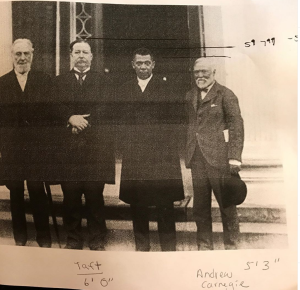
When you are trying to do a sculpture, you need proportions. Art is a lot of times about comparison. I am comparing this shape to this shape or this proportion to this proportion. Often I will try to find a subject that is the same height and stature as my subject matter. Dress them up in the appropriate close and photograph them. But how do you find out how tall someone is that lived over 100 years ago? In the case of this image, I have hit the jackpot. Taft was 6’, and Andrew Carnegie was 5’ 3”. Booker T Washington was about 5’ 7” tall.
(Left to right) Robert C. Ogden, Senator William Howard Taft, Booker T. Washington and Andrew Carnegie, standing on the steps of a building, at the Tuskegee Institute’s 25th anniversary celebration
Questions
In this picture that I found on the internet, Booker T stands with three other men. What do these men do that are so important? Why would Booker T Washington be photographed with these men? How did he meet each of these men?
I would love to know what you find out. It helps me with my inspiration for the piece. Thanks for your participation.
Author Sculptor Bridgette Mongeon
https://www.instagram.com/bridgettemongeon/
https://www.facebook.com/BridgetteMongeonSculptor/
https://twitter.com/sculptorwriter