
Change of Artistic Direction
 After careful consideration, the team at Booker T. Washington High school decided to change the direction of the design of the sculpture. They liked the photograph of Booker T. on a stool looking at a book. There are several photographs with a similar look. In some photographs, he is sitting in a chair instead of a stool. The sculptor will now change directions to see about recreating this look. Bridgette will no longer need to look at 3D scanning and enlarging using 3D printing to bronze casting. But she will be using digital technology in the sculpture. Will the final sculpture be life-size or larger than life? It’s back to the drawing board.
Author Sculptor Bridgette Mongeon
https://www.instagram.com/bridgettemongeon/
https://www.facebook.com/BridgetteMongeonSculptor/
https://twitter.com/sculptorwriter
3D Scanning and 3D Printing Artwork and Synchronicity.

The Smithsonian has an entire section filled with 3D models that students can look at. 3D scanning our precious artifacts insures that we will have record of them for a long time.
FROM THE ARTIST’S STUDIO
3D scanning 3D printing, artwork and synchronicity.
As sculptor Bridgette Mongeon was on her educational journey of recreating “Lifting the Veil of Ignorance” for Booker T. Washington High School, she has also been on another journey for another “out of this world project” that would use the same processes. Kindness Without Limits commissioned her to create a sculpture of Neil Armstrong walking on the moon. She will create one sculpture, but she will make two casts from the mold. If you read the post that showed the sculpture casting process of the Grambling tiger, you will see that there are many steps in the casting process. If you go directly from 3D printing to investment casting, what is lost is the opportunity to make multiples. Usually, an artist will make a limited edition of a sculpture. They have a mold, and they can cast more from that mold. But, if you go directly from the art in the computer to 3D printing in investment casting, there is no mold. Each time another sculpture would be made, the sculptor would have to order another 3D print. Creating a bronze from a 3D print is usually not advised in a sculpture where the artist will make multiples, as it would not be cost-effective. However, you could have the 3D print made and make a mold of that 3D print.
In the cast of Neil Armstrong, one in the edition would go to Space Center Houston, and the second in the edition is going to Russia. Reference material for creating a sculpture is so important. In the case of Neil Armstrong’s spacesuit, it did not take the artist very long to realize that there are many different space suits with many details. It would be very easy to put Neil Armstrong in the wrong spacesuit accidentally. In comes 3D technology- in2015 there was a Kickstarter campaign to 3D scan Neil Armstrong’s spacesuit. The Smithsonian did these 3d scans because No one created the spacesuit to go to the moon, come back, and last 50 years. It was deteriorating. If a 3D scan is made, the suit can be documented and that digital data is preserved, even if the spacesuit continues to deteriorate.
Many museums are doing this now. You can even get 3D models of things to 3D print or examine online. The artist is desperate to get that digital data, but you can imagine. It is under lock and key. Who owns the copyright? We learned a little about copyright and artwork. Copyright concerning 3D files is another thing entirely. How can the artist get permission to use these 3D files? This is still something with which she is working. However, the 3D data of the suit was taken and 3D printed at life-size using the technology mentioned in the previous posts. The spacesuits will be on display at different ball fields throughout the United States. Houston is supposed to get one. At the very least, having access to this spacesuit display will be an incredible resource for Bridgette to be able to sculpt the correct suit with the exact details. There is synchronicity in how things work. You work on one project, and the information you learn can be used on another project. Who would ever have thought that Booker T. Washington and Neil Armstrong would have something in common?
To watch how this was done check out this video
[youtube https://www.youtube.com/watch?v=sNeou5p5f5s]
Teachers
- Here is a a link to see Neil Armstrongs Suit in 3D.
- If you are interested in other 3D models with the subject of space check out NASA’s free list of STL files for printing STL files are the file format needed for 3D Printing.
Author Sculptor Bridgette Mongeon
https://www.instagram.com/bridgettemongeon/
https://www.facebook.com/BridgetteMongeonSculptor/
https://twitter.com/sculptorwriter
Types of 3D Printing.

Fused Deposition Modeling 3D Printing
FROM THE ARTIST’S STUDIO
We will be looking at 3D technology quite a bit through this process of creating the sculpture of Booker T. Washington. Let’s familiarize ourselves with the different kinds of 3D printing. There are many different types of 3D printers. We will look at three.
Fused deposition Modeling or FDM
FDM 3D printing is the type that most schools or libraries have. They use a filament that lays layer upon layer like a glue gun and don’t usually have a high resolution or can capture great detail.

Selective Laser Sintering 3D Printing
Selective Laser Sintering
Selective Laser Sintering or SLS is another type of 3D printing. It uses a laser that sinters a powder. Again it is done layer by layer. The resolution can be very good.
Stereolithography
Stereolithography or (SLA) is yet another kind of 3D printing. In this case, a laser hits resin and solidifies it layer by layer.

Stereolithography 3D Printing
3D printing is older than you think. Here is an excellent article about the history of 3D Printing. The reason why so many machines are available now is that the patents on the machines have run out. This leaves them open for others to expand on and modify.
Sculptor Bridgette Mongeon speaks about 3D printing and was, a few years back, awarded the honor of one of 30 most influential women in 3D printing. She loves to share resources. Here are a few of her favorite videos that she shares when she speaks.
Laika is a production company that has made movies like Coroline, Box Trolls, and ParaNorman. They use something called replacement animation, combined with stop motion animation in creating the work. Here is how it is done.
[youtube https://www.youtube.com/watch?v=vu62AzWPTDs]
In 2009 as Bridgette was researching different 3D printers for her graduate study she became curious about 3D printing of organs. She has written several blog posts about it and even created a podcast with one artist about technology and organs. Here is an old video about 3D printing of organs. This topic is one worth a discussion. Being able to print an organ would be great for those who need a kidney, lung or heart and are on a transplant list. But Bridgette talks about how disassociated we are from things in the lab in this podcast with Oron Catts.
[youtube https://www.youtube.com/watch?v=80DhBLEhdzk]
Questions
What do you think about 3D printing used in medical procedures? Do you think just because we can do things, like printing organs or other technology that we should? What kind should we not do? When has technology gotten out of hand?
How has 3D printing of organs changed since the 2009 video shown above? What were the challenges in 3D printing organs?
Author Sculptor Bridgette Mongeon
https://www.instagram.com/bridgettemongeon/
https://www.facebook.com/BridgetteMongeonSculptor/
https://twitter.com/sculptorwriter
How to Copy a Monumental Sculpture Using 3D Technology- Part 2
FROM THE ARTIST’S STUDIO

Bridgette and her interns paint rubber on the many pieces of the Grambling Tiger. Over all the rubber they create a mother mold. This mother mold is made with fiberglass.
For Bridgette Mongeon, who is working on the sculpture of Booker T. Washington, finding ways to reproduce large and small pieces using digital technology and traditional fine art was the inspiration for her book. The thing about working with technology is that it is always changing. Going to bronze casting from 3D print is trickier than it seems. Bridgette documents her process and, in her book, focuses on recreating the Grambling State University Tiger. To understand how tricky going to 3D printing to bronze casting can be, let’s look at the bronze process. You will see this in more detail later as she works on the sculpture of Booker T Washington. But here is a quick primer.

Inside each of the pieces of mold the foundry will paint or pour wax. When you see a bronze it is only as thick as this wax- usually about 1/8- 1/4″ thick.
Lost Wax Method of Bronze Casting
When a sculpture is completed and approved by the client, it must go through many parts of a process that is called “investment casting” or “lost wax bronze casting.” Bronze casting is an ancient process that has changed little over the years. Here are the steps.
1 Mold
First, she will make a mold. A mold can have many parts. For example, Alice In Wonderland sitting in her chair was approximately 20 mold pieces. When making a mold, the artwork is normally destroyed. Sometimes the artist does the mold other times the foundry does this step. It is often difficult to ship a large clay sculpture to a foundry. In that case, the artist or foundry will create the mold in the artist’s studio, and they ship the mold pieces to the foundry.

The clay of the Grambling tiger head and the wax. The artist removed the fangs to be able to pour make the mold.
2 Wax
The artist sends the mold to a foundry where they will pour or paint a thin layer of wax and gate or sprue up each wax. The gating of the wax helps air and gasses to move out and metal to move into a piece when the pieces get to pouring.
3 Slurry
Then, the wax goes through a slurry where the pieces are dipped in vats covering each piece with a layer of ceramic shell both inside and out.

The foundry creates a pour cup as well as gates or sprues. These will help the gasses escape and allow the metal to pour.
4 Burn out
The shell is then baked and the wax is removed.
5 Pour
The metal is poured into the shell.
6 Chasing or finishing
Once the metal cools, the shell is broken away, and the many pieces are welded together.
7 Patina – This is the coloring of the metal
What is mentioned above is the “traditional process of investment bronze casting.” But what if a sculpture could be 3D printed and go directly to investment casting? That means that step 1 and 2, could be avoided all together. These are costly steps, but at the same time so is 3D printing something at a large scale.

Each of the pieces is dipped to create a ceramic shell both on the inside and outside.
Bridgette has vendors that are like herself. They have risen to the challenge of exploration in the combination of traditional and digital processes. She does have a vendor who can 3D print “Lifting the Veil” in detail with high resolution at the size that Booker T. Washington High School would like, and she also has a vendor who already has been 3D printing FDM. (See description of FDM in post about 3D Printing.) This foundry has been printing 3D pieces and burning them out (step 4.) The vendor she has to 3D print will be doing so using SLS and a high resolution print that is then dipped in wax. (See description of SLS in post about 3D Printing.)

The wax is burned out of the ceramic shell in a very hot oven.
The Booker T. Washington project prompted a wonderful conversation between each vendor and the artist. They had to discuss details like the temperature of the burn out for the 3D print, residue leftover in the investment from the material, safety issues cost, and more. But, now her “go-to foundry” and her vendor for 3D printing are recreating artwork using SLS, all because of the possibilities and challenges that presented itself in the possibilities of recreating the sculpture “Lifting the Veil of Ignorance” using digital technologies.
Note: you can 3D print in many different substances, including glass, paper, and ceramic. You can find many of them on service bureaus like Shapeways or i.materialize. In the past, Bridgette has printed directly to bronze. This means the 3D printer prints in bronze. Printing directly in bronze is very costly and not done on larger pieces.

Pouring bronze in the shell.
Questions
Do you know what metals are in the traditional bronze?
What percentage of each metal is in a bronze?
How old is the lost wax method of bronze casting?
Have you heard of “The Bronze Age”? When was that? Why did they call it that and what does it have to do with bronze?
Author Sculptor Bridgette Mongeon
https://www.instagram.com/bridgettemongeon/
https://www.facebook.com/BridgetteMongeonSculptor/
https://twitter.com/sculptorwriter
How to Copy a Monumental Sculpture Using 3D Technology- Part 1
FROM THE ARTIST’S STUDIO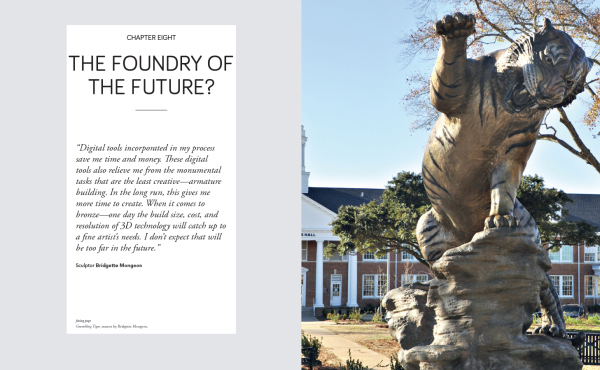
It occurred to sculptor Bridgette Mongeon that one way of copying the sculpture at Tuskegee and making a replica is to 3D Scan it and 3D print it to size for bronze casting.
Is it possible to 3D print something at a large size? Yes, and the artist mentions this in a previous post. First, a sculpture is 3D scanned. Then it has to be made into a physical form again. Many times Bridgette enlarges small sculptures and later has them milled out using a CNC milling machine. CNC stands for Computer Numerically Controlled Milling. The scanner has what we call G-code. G-code is the height, depth, width of every area. The G-code tells a 3D printer or a CNC machine what to do. 3D printing is an additive process as the printer adds material. CNC is a subtractive process as the machine takes away material.
Mongeon has written about these processes in her book 3D Technology in Fine Art and Craft: Exploring 3D Printing, Scanning, Sculpting, and Milling. Going to bronze from 3d printing is something she focused on in her 2015 version of the book. She was updating the book, upon request from her publisher when this sculpture of Booker T. Washington came into her studio.
Some of the problems with 3D printing direct to bronze casting are as follows.
- Ability to print at a large scale.
There are many 3D printers on the market, and there are many different types of 3D printing. When referring to 3D printing and the size that a 3D printer prints, we call it the “Build Envelope.” Many 3D printers do not have a large enough build envelope to accommodate printing for bronze casting.
- Cost for 3D printing for bronze casting.
The cost of 3D printing is prohibitive, especially with life-size or more substantial pieces. Many times an artist will make a sculpture as a limited edition. For example, the monumental sculpture that Bridgette Mongeon is creating for Booker T. Washington High School in Houston, Texas, is a limited edition of 10. Even though you will see that bronze casting from 3D printing can save time and materials, the costs do not weigh out for limited editions. If an artist were to create a “one-up” sculpture- A one-up means that it is the only copy available then 3D printing direct to bronze casting may be an option.
- Foundries capabilities for casting from 3D printing.
Sometimes a 3D print has to be created differently for bronze casting. Also, there are certain modifications and things that must take place during the casting of the 3D print. As we learn about the bronze casting process, you will soon see what we mean.
4. Resolution
Another thing to think about is resolution. Resolution is how detailed the print will be when it is off of the 3D printer. 3D printers, no matter what kind, print in layers. In many cases, you can see those lines on the 3D printed art. That would not work for recreating, “Lifting the Veil of Ignorance.” So a machine that creates in a very fine resolution is essential.
5. Material
We will look at this more in our next post. But material and 3D printing for bronze casting is important.
As Bridgette was meeting with Booker T. Washington High school, a new vendor called her. They had read her book and wanted to share their system of 3D printing for bronze casting. She was able to introduce this new vendor to her foundry, who is also into technology and was already 3D printing some things for investment casting. The three of them agreed, they could do it. It was a great learning experience and opened up many possibilities for the artist, but first, they would need permission from Tuskegee.
Author Sculptor Bridgette Mongeon
https://www.instagram.com/bridgettemongeon/
https://www.facebook.com/BridgetteMongeonSculptor/
https://twitter.com/sculptorwriter
Monumental Sculpture and 3D Scanning
FROM THE ARTIST’S STUDIO
Is it possible to recreate the exact sculpture without the artist having to sculpt it physically? This process could be done with laser scanning of the art and 3D printing the sculpture to size for direct casting. The artist wrote about this in her book, but more than that, she has used these processes to create her artwork. In September of 2018, Intertek scanning services came to sculptor Bridgette Mongeon’s sculpture of Alice in Wonderland’s Mad Hatter tea party in Evelyn’s Park and did this very thing. Lots of dots were put on the sculpture. These dots are used as registration. The blue light scanner sends light from the scanner to the art and measures the distance. She explains the process in this blog post. http://alicesculpture.com/scanning-in-the-park-part-1/ The reason the artist needed these scans is that Alice and her friends are going to get small. Just like in the stories of Alice in Wonderland, however, in Mongeon’s studio, they do so with digital technology. Of course, permission would need to be received from the university to 3D scan the sculpture at Tuskegee, and we have to know if the sculpture is copyrighted. (See post on copyright.) Here is a video on the Alice in Wonderland project and you can fast forward to 5:00 to see the parts on 3D scanning.
[youtube https://www.youtube.com/watch?v=axtRhxhEZvk]
 QUESTIONS
Have you seen 3D printing or 3D scanning?
TEACHER RESOURCES
Teachers who are interested can find educational resources on 3D scanning and lessons plans at CyArk. “CyArk is a non profit organization founded in 2003 to digitally record, archive and share the world’s most significant cultural heritage and ensure that these places continue to inspire wonder and curiosity for decades to come.”
Author Sculptor Bridgette Mongeon
https://www.instagram.com/bridgettemongeon/
https://www.facebook.com/BridgetteMongeonSculptor/
https://twitter.com/sculptorwriter
What is Copyright?
 FROM THE ARTIST’S STUDIO
If you remember though Booker T. Washington High school would like sculptor Bridgette Mongeon to recreate the sculpture at Tuskegee we must first find out if there would be copyright infringement. Let’s learn a little about copyright.
Here is a bit from the artists book 3D Technology in Fine Art and Craft: Exploring 3D Printing, Scanning, Sculpting, and Milling on the subject of copyright.
Intellectual property or IP refers to many different aspects of law that governments put into place to protect literature, artworks, music, discoveries, inventions, etc. Though many countries recognize IP rights, there are some differences between countries. The World Intellectual Property Organization (WIPO) tries “to promote innovation and creativity for the economic, social and cultural development of all countries, through a balanced and effective international intellectual property system.”
There are several different kinds of intellectual property rights; copyright is one of
them. Sparked by the invention of the printing press, copyrights were invented to
protect those making creative works. A creative person, whether they are a
musician, a writer or an artist, owns the rights to the work that they have created for
a designated amount of time.
In the United States copyright began in 1790, the total duration of protection was
only for 14 years, and individuals needed to apply for a copyright. After a copyright
expired, the creator could extend it for another 14 years before it went into the public
domain. Works entering the public domain are those having expired copyrights or
where an individual gives their works to the public domain. When works enter the
public domain, no one else can claim ownership. They are available to the public.
For example, Lewis Carroll wrote Alice In Wonderland, and Sir John Tenniel created
the illustrations for publication in 1865. Many companies, including Disney, have
recreated the story of Alice. They cannot claim copyright to the story because they
recreated it.
According to the copyright law of 1976 (USA), the copyright law protects everything
that you create from the moment you create it, even if you have not registered it.
This is the way copyright is handled throughout the world. It was defined by the
Berne convention, an international agreement concerning copyrights. The duration of
copyright, changed in 1988 from the creator’s life plus 50 years, to the creator’s life
plus 70 years as it is today (USA). Having a piece of artwork protected by the very
act of creating it is good for an artist. They don’t have to register every piece of work
they make. Once something is in a tangible form, it is copyrighted. Many artists put
their name on art along with the copyright symbol © and the year. It is surprising how
many people do not realize that even if artwork does not have a copyright notice, the
copyright law still protects it. Traditional sculptors have been fighting copyright
infringement for years. Individuals think that they can copy a sculpture if a sculptor
has not marked it with ©, the year and name of the artist. Sculpture is often
recreated and sold as a reproduction without the permission of the artist.
Under the current copyright law, you do need to register your work with the copyright
office if you want to collect for statutory damages for infringement. If you discover
someone has stolen your work and you file suit, statutory damages are punitive and
can be quite severe for those infringing on someone’s rights. Financial penalties for
infringement keep many people honest about “taking” other people’s creations.
Many creative people make a living from their creativity. Authors make a living from
the books they write, artists from the artwork they create, musicians from the songs
they write and record. If there were no regulations to how others use these works of
inspiration, it would be devastating for those who make a living creating.
Read on to find how copyright plays into copying the sculpture of Booker T. Washington at Tuskegee University.
Author Sculptor Bridgette Mongeon
https://www.instagram.com/bridgettemongeon/
https://www.facebook.com/BridgetteMongeonSculptor/
https://twitter.com/sculptorwriter
About the Sculpture “Lifting the Veil of Ignorance”
 FROM THE ARTIST’S STUDIO
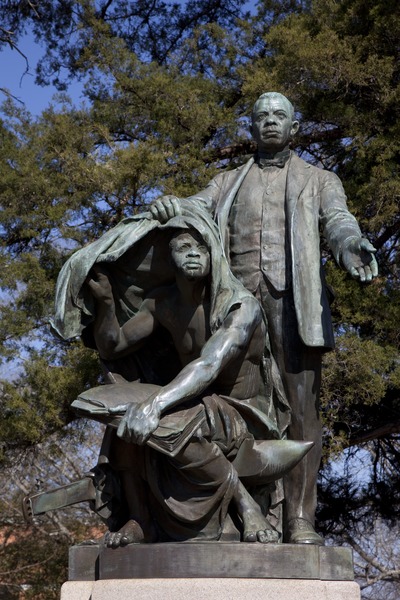
The original intent of the sculpture project for Booker T. Washington High School was for the artist to recreate the sculpture “Lifting the Veil of Ignorance.” This sculpture is very large and resides on campus at Tuskegee University in Alabama. There is a smaller version of the sculpture, often referred to as a maquette. An artist creates a maquette to work out the design. The original maquette was damaged and needed repair.
There were several concerns when copying art. The first concern is copyright. We will go into this in another post. The second concern is that it takes a very long time to create a bronze sculpture. An artist wants their work to be original, and spending a year copying someone else’s work is not enticing. However, it can be done digitally, as we will see.
Let’s take a closer look at the art. The sculpture was created by Charles Keck (1875-1951) and dedicated in 1922.
The artist was very prolific, creating pieces of Washington, Lincoln, and many other famous people. This link provides some beautiful photographs of the sculpture from all sides.
Questions for teachers and students
What do you think the sculpture means? What does it represent? Why do you think the artist portrayed the subject this way? What is he holding? What is he sitting on and why? Do you like the work? What feeling do you get from the two subjects? Do you think the size of the sculpture makes a difference?
Why was this sculpture installed here?
What is the relationship between Booker T. Washington to Tuskegee?
Author Sculptor Bridgette Mongeon
https://www.instagram.com/bridgettemongeon/
https://www.facebook.com/BridgetteMongeonSculptor/
https://twitter.com/sculptorwriter
Who Was Booker T. Washington?
FROM THE ARTIST’S STUDIO
I spend a lot of time getting to know my subject. Some say, “You develop a relationship with the deceased.” This statement is true, but most historians probably do the same. Dr. Phillips gave me Booker T. Washington’s book Up From Slavery, and I spent a lot of time on the internet getting to know this man. I soon learned there were two trains of thought in education during this period, one from Booker T, and another from W.E. B Dubois. I was intrigued at how radically different these two men were in their approach to education. I found this great article from a teacher today and how he has been influenced in his present-day teaching by these men.
TEACHERS AND STUDENTS
- What are the differences between the philosophy of these men?
- What is the difference between their upbringings?
- What do you like about each?
- What do you dislike?
Author Sculptor Bridgette Mongeon
https://www.instagram.com/bridgettemongeon/
https://www.facebook.com/BridgetteMongeonSculptor/
Tweets by sculptorwriter
About the Artist
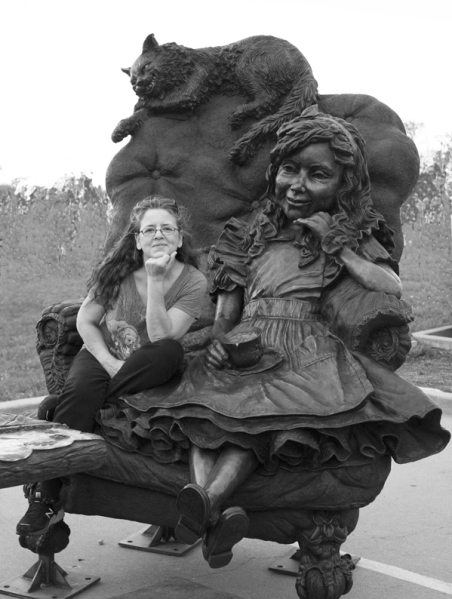 Bridgette Mongeon is a sculptor/author and public speaker. She has worked on various monumental sculptures over her 30+ years of creating. You may see her work in the Grambling Tiger in Grambling State University or the Prairie View Panther for Prairie View A & M. She has also been commissioned by Kindness Without Limits to create a sculpture of Neil Armstrong for Space Center Houston and Russia. She is most known for her monumental sculpture of Alice in Wonderland’s Mad Hatter Tea Party in Houston, Texas.
Added to her credits are the author of 3D Technology in Fine Art and Craft: Exploring 3D Printing, Scanning, Sculpting, and Milling and co-author of Digital Sculpting with Mudbox: Essential Tools and Techniques for Artists.
She was nominated as 30 most influential women in 3D Printing and enjoys lecturing to students and adults on the subject of STEAM- the interdisciplinary educational initiative encouraging Science, Technology, Engineering, Art and Math. If you are an art teacher in Texas, you may recognize her as the keynote speaker at the Texas Art Educators Conference 2017.
As part of her sculpting the Booker T. Washington sculpture for Booker T. Washington High School, she has offered to create blog posts documenting her work with educational materials for teachers and students. Please follow along and share your thoughts.
Below Expanding Your Horizons in Math and Science Key note Speaker Bridgette Mongeon.
[youtube https://www.youtube.com/watch?v=7qhaP_GUmHM]
Author Sculptor Bridgette Mongeon
https://www.instagram.com/bridgettemongeon/
https://www.facebook.com/BridgetteMongeonSculptor/
https://twitter.com/sculptorwriter