Posts by Bridgette
ENLARGEMENT BEGINS!
The file is off to my vendor in Oklahoma- introducing Synappsys Digital Services. They will take my digital file and enlarge it using foam and a milling machine. I wrote an article about this process in the Winter 2007 issue of Sculpture Review.Here is a pdf should you like to read the article and see the process.
This is from the Prairie View A&M Blog created for this project.
Is There A Prairie View Cheer Someone Can Send My Way?
Trying to catch up! We are behind on our deadline which means that I will be working my tail off to try and recover. I could use a little cheering on. Certainly there must be a PVAM cheer. Can someone please send it my way?
You may not see many posts between The 25th of August and the 16th of September. That is because we will be working night and day to catch up. But… I will be documenting it all as we work and posting our progress after that date, or maybe when i need a break. Around the middle of September, if all goes well and my hands hold out, we will be having a visit from the school to approve the sculpture.
I don’t hear any cheering yet. It is awfully quiet out there.
The Process – The Reason For A Digital Model
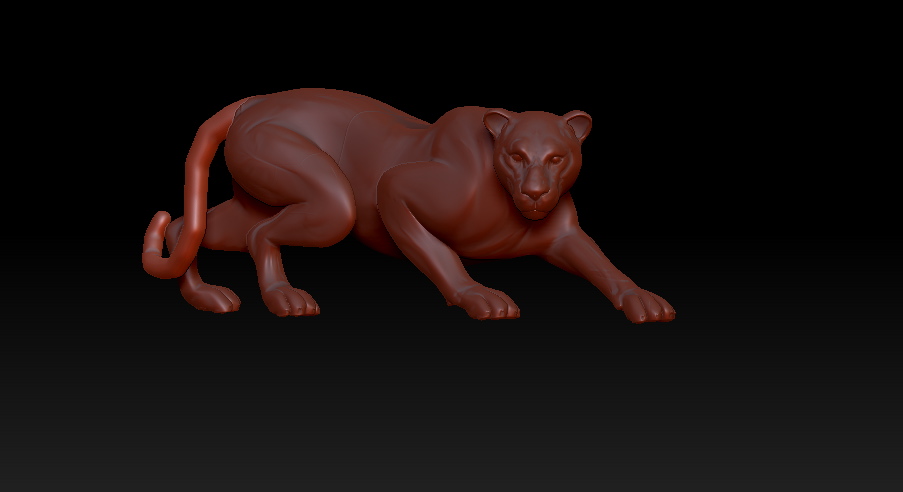
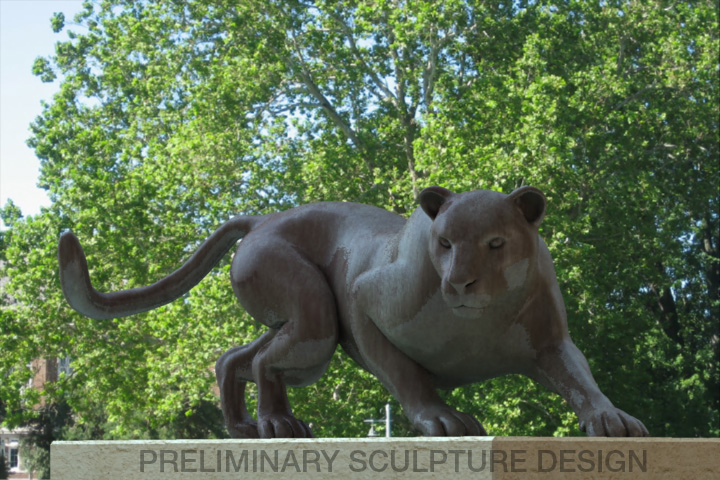
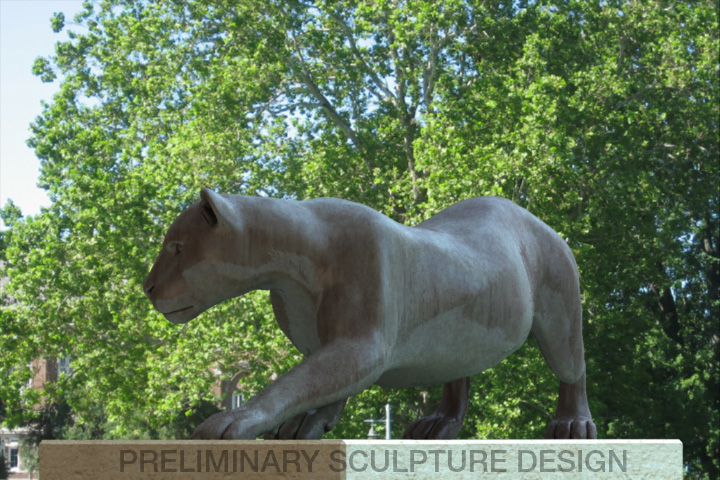
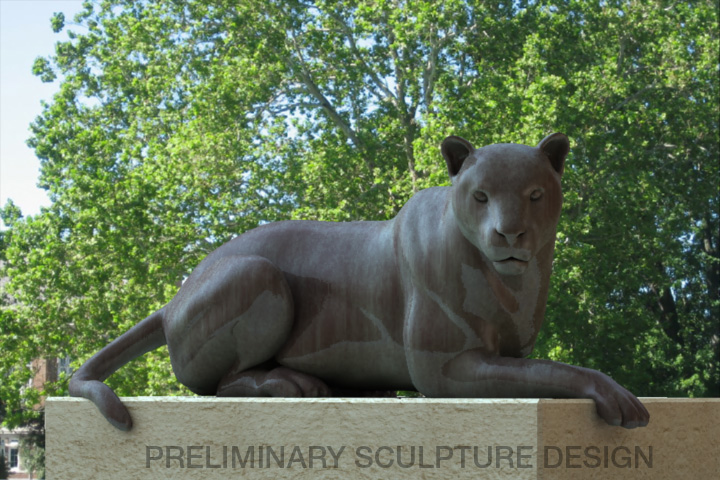
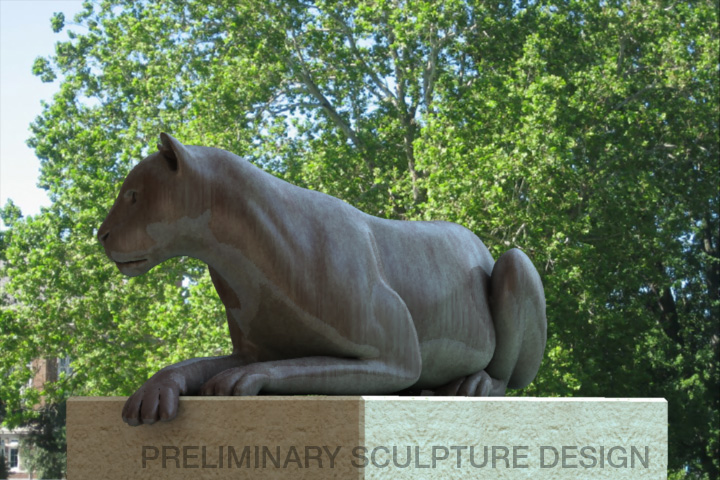
In traditional sculpting process a sculptor might present pencil sketches to a client to approve a design. Instead we sent digital models. The reason for these models are that we can see what a sculpture will look like from all directions. Sculpting is not like painting, you have to walk around the sculpture and have it present well from all sides. Digital models help us to do that. Another aspect of the digital model is that I can sculpt on it in the computer adding some detail before sending it off for enlargement. The digital model will really aid us in enlarging this sculpture as you will soon see. Before sending this off for enlargement the university requested I change the shape of the tail. They are concerned with breakage. We tried different tails with the pose and settled on something similar to this. Of course these are only digital sketches, of the direction we are going.
This is from the Prairie View A&M Blog created for this project.
More Research Big Cat Rescue

I am very indebted to Big Cat Rescue in Florida.Jeff Kremer, Director of Donor Appreciation, has spent a great deal of time with me talking about “panthers.” I have to say theiryou tube channel has been very inspiring and don’t be surprised if you find quite a few of their videos on this blog. They give me feline creativity.I’d like to introduce you to Jamanji. Look real close… can you see the spots?These photographs were taken from TheBig Cat Rescue website with their permission. Besides the 500 zoo photographs I must have another 100 or so photographs on my computer that are downloaded from the web. You can never have too much reference!
I am very indebted to Big Cat Rescue in Florida.

This is from the Prairie View A&M Blog created for this project.
What Is a Panther?
This is a very good question. As the carnivore keeper at the Houston Zoo- Josh Young said, “Saying you are sculpting a panther is like saying you are sculpting a bird.” “Panthera” is basically the genus of large cats, which would include lions, leopards jaguars, tigers cheetahs etc. What is the cat that most people think of when they say panther? It is a melanistic variant of another cat, most likely it is a black leopard or a jaguar. Now here is something really interesting, as the name states above, you can see spots on a “panther” black leopard if you look in the right light. So, for clarification we are looking at black leopards for this sculpture. But…. the black leopard does appear to be a smaller big cat… I went to my sources for this. Here is what Sam at the zoo had to say.
“Thanks for being patient with me as I gathered my facts for you! You were asking about black leopards specifically, so I will try to answer your questions without being too vague. Leopards are an interesting species to study as they are found in so many different habitats from Africa to Asia. Melanistic (or black) phased individuals are primarily found in southeast Asia and nearly all of the leopards on Java are melanistic. That being said, evolutionarily speaking, the black phase seemed to develop in the more densely forested areas as the darker color blends in better and these individuals could be more successful in hunting and avoiding detection. Another trait that develops in densely forested areas is smaller body size. Smaller predators can move more easily through the dense trees than larger ones. The reason I am telling you this is that if you look at leopard sizes they have a varied range (even among melanistic). Male Leopards average about 150lbs, but in some regions they can routinely reach 200lbs or more. Our spotted male weighs 130lbs and the black female weighs about 67lbs. Leopards average 3-6 feet from nose to tail, with tails averaging about 23-44 inches. Since you are looking at the melanistic phases, I would use the low end of that scale.”
Just to be safe we made our “panther” much bigger. I mean… it is, after all, a representation of something very big.
This is from the Prairie View A&M Blog created for this project.
More Research At The Zoo
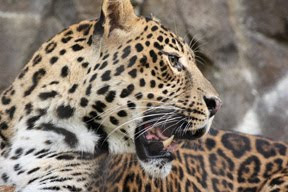
My photographer of choice for any project is Christina Diliberto at Diliberto Photo and Design.Be sure to check out her blog post on the project to see some of her amazing photographs of the cats.We entered the zoo as early as possible in hopes of catching the cats in action before it got too hot. The keepers did everything they could for us, letting the cats out a little at a time and entertaining them to help us to get good reference photographs. The day time temperatures here in Houston have been in the 100’s, making any cat feel a bit lethargic, so coming early was necessary.
Photographic reference is taken of the cats at the Houston Zoo.
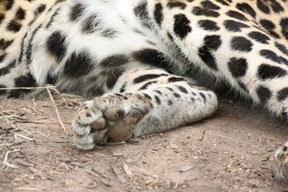
We spent time talking with the keepers. Chris took many photographs. While I paid close attention to the details, anatomy and differences in the cast, all the while picking the brains of the carnivore keepers. I think we have about 500 photographs, and a wealth of information that can be used as reference.Though we are working on a “panther” we spent time taking pictures of all of the cats and not just the black leopard. The anatomy is not that different from cat to cat, and the keepers and I spent a great deal of time in comparisons and discussion. I’ll go into more detail about the term “panther” but first let me share with you some shots from the zoo. Of course, I agree with Christina’s choice, but here are a few more I like.
For me it is in the detail. “take pictures of the bottom of the feet.” Chris has worked with me long enough to know what I want. I hardly have to say anything.I like this last picture because it seems to be so symbolic of life. Sometimes you just have to find your footing! Chris said she was sorry she couldn’t zoom in and focus quick enough. I still love it.
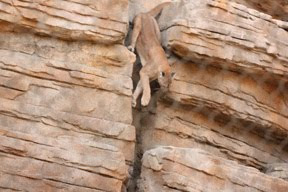
My photographer of choice for any project is Christina Diliberto at Diliberto Photo and Design.
Photographic reference is taken of the cats at the Houston Zoo.
Research- Houston Zoo
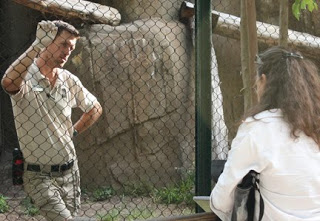
It is amazing how much research goes into each sculpture project. Even if it is of a human, I spend a great deal of time trying to get to know my subjects. You could say I am becoming very intimate with the big cat. I have worked with the Houston Zoo on other projects and was delighted that they would climb on board and assist me in this project as well. They are very excited and hope they are invited to the unveiling.
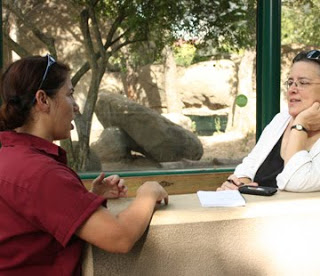
I’d like to introduce to you Josh Young (carnivore keeper) and Samantha ( Sam) Junker (senior keeper carnivores.)
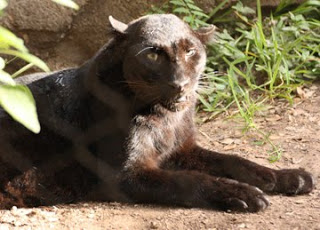
And of course Ivy is their black leopard- see future posts about the term “panther.”
How Big Is It?
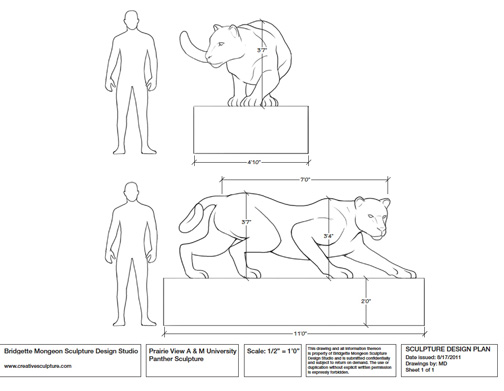
That is a good question. Here is a sketch. Now, B. Mongeon Sculpture Design is not responsible for the pedestal, that would be the landscapers decision. But I’m for having a short pedestal. I am sure there are many students, visitors and alumni who will want to have their picture taken next to this massive sculpture. Hmmm. I wonder who will be the first? I hope you will all send your pictures to me Bridgette ( the at sign) creativesculpture.com. I would love to put them on the blog.
This is from the Prairie View A&M Blog created for this project.
Solar Sintering? Wow, 3D Printing is Even More Cool
Markus Kayser talks about SolarSintering Project on his website.
He states
“In a world increasingly concerned with questions of energy production and raw material shortages, this project explores the potential of desert manufacturing, where energy and material occur in abundance.
In this experiment sunlight and sand are used as raw energy and material to produce glass objects using a 3D printing process, that combines natural energy and material with high-tech production technology.
Solar-sintering aims to raise questions about the future of manufacturing and triggers dreams of the full utilization of the production potential of the world’s most efficient energy resource – the sun. Whilst not providing definitive answers, this experiment aims to provide a point of departure for fresh thinking.”
Markus Kayser – Solar Sinter Project from Markus Kayser on Vimeo.
New Panther Poses For Client
Preliminary Poses for the Prairie View Panther.