
Newsboy- The Sculpting
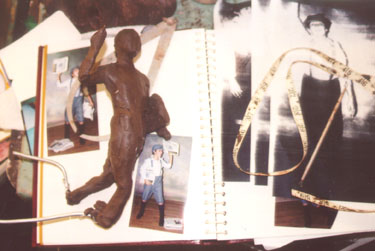
September 8-10, 2004
Sculptor Bridgette Mongeon has documented the entire process of creating a figurine of a newsboy and a life-size bronze sculpture. Watch the artist work through these posts. In this blog, she has also included information for students and teachers. In the previous post, we learned about the beginning of the sculpture.
If you are lost and want to go back to the chronological running list of posts, follow this link.
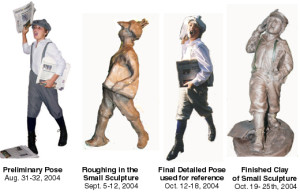
Even without the final photographs with the new outfit, there is enough reference in the first photos to put together a roughed in version of the clay on the small the sculpture. I am excited about doing this because I will be able to see the form in three dimensions.
Sometimes, during different presentations I have a friend create a 3D version of the sculpture in the computer. With a little help from a program called Poser and Photoshop, he can simulate what a sculpture might look like and we can view it from several directions. There is an example of one of this process using 3D models on this YouTube post. You will notice with the Ellie sculpture; however, that the sculpture was modified as we went along. The computer rendition is nice, but there is nothing like seeing it in clay. Then, it is my fingers that manipulate the sculpture, giving a twist here, a turn there. It’s then that the fermenting of the creativity that has been withheld for so long can come forth. There is a tremendous feeling that is associated with creativity.
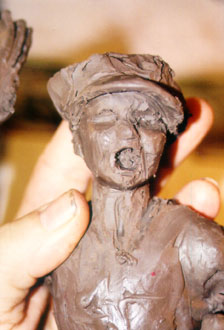
The process of putting the clay to the sculpture is taking some time. Mostly because sculpting the newsboy is my treat. I’ll work on commission A and B for a few hours, and after I do that, I will reward myself by working on the newsboy for a while.
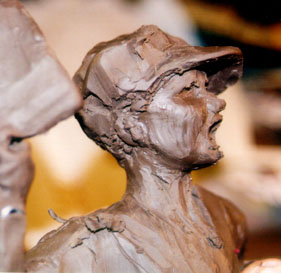
SCULPTING THE FACE
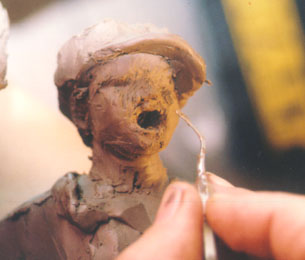
I have the general shape of the body finished, and I am very pleased. Whatever has not been worked out in the design, will work itself out as I proceed. I begin to focus on the face.Working on a one inch face of someone is no easy task. There will be a point when I will work on the face with pins and sharp knife blades, anything that will allow me to get the details that I want. My job today is to get the basic shape and to make sure it is in proportion to the body. This is essential and sometimes can prove to be a difficult undertaking. Once again, a fraction of an inch on something this size translates into something much larger when life-size. It all must look like it goes together. I force myself not to just look at the face but keep looking at the entire sculpture. I remember times when I was first sculpting when I would forget to do this and work on the head as a separate entity. I would have it perfect, and then put it with the body and find that it is off, not by much, but enough to have to start all over.
Let’s go on to the next step and learn about More Research on Clothes and Sculpting of the Newsboy.
STUDENTS AND TEACHERS
Art and Math
• On the previous page I talked about the scale of the sculpture and that the scale was two inches to one foot. The size of the finished small sculpture will be approximately ten inches. Approximately how tall is the real Dusty? If I changed the scale of the small sculpture to be three inches equals one foot how tall will the small figure be?
• What does 3D mean?
• How did the computer generated 3D figure of Ellie, in the link from above, change in comparison with the sculpted figure?
Newsboy-Beginning The Small Sculpture
Sept 5th-7th, 2004—
Sculptor Bridgette Mongeon has documented the entire process of creating a figurine of a newsboy and a life-size bronze sculpture. Watch the artist work through these posts. In this blog, she has also included information for students and teachers. In the previous post, we learned about the meeting with the Texas Press Association.
If you are lost and want to go back to the chronological running list of posts, follow this link.
I stopped by Dusty’s to get the model release form signed by his mom and to take some more measurements. I take measurements of his basic body type, ankle to knee, knee to hip etc. Then I also go ahead and take all the portrait measurements. I don’t often need all of these measurements, but it does help to have them.

SCULPTING
Today I made a wire armature for the small sculpture. I have decided to use the scale of 2 inches equals 1 foot. Basically, Dusty ends up being about 10 inches tall. In sculpting, the armature makes a big deference. They are especially important when I start doing the large piece. This armature is made with flexible wire. I utilize my measurements to help me be sure I have made it correctly. The armature should be slightly smaller so that I can add clay.
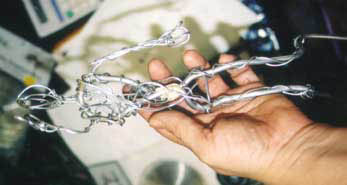
After the armature is complete I will begin adding clay to it. I have two types of clay that I work in consistently. I prefer using wet clay, however, I opt for using a wax based clay on this project. Both have their advantages—the wet clay lets me sculpt differently and adds so much to the sculpting process. The wax based clay is harder to put on and needs to be heated in a crock pot, but I do not have to keep it wet like a sculpture created in wet clay, nor is there any shrinkage. When creating a sculpture that will be around the studio for a while, wax based clay is the choice. Some day I will find the best of both clays, a wet clay that has the good characteristics of wet clay, while retaining the longevity of the wax clay.
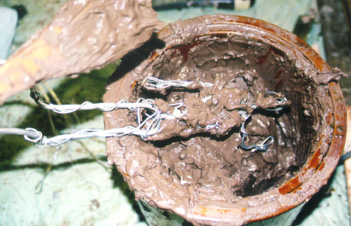
Creating the form over the armature is a lot like frosting a cake. However, you don’t want to drip this cake batter on you. It causes a nasty burn.
Today I alternate between the armature, the small Dusty, and the other commissions that are at my studio and need to be completed.

COSTUME
I am a stickler for detail. I mentioned before that I did not particularly care for the costume that we had for our first photo sitting. The bottom of the pants seems wrong. They should be buckles or buttons and not elastic. I have researched the period clothing and found this wonderful web site totally dedicated to historical boys clothing. There is an entire page about knickers. My interest, once again, was peaked when I read that little boys wore shorts and older boys wore knickers. However, when boys matured to manhood they often put away their knickers in an almost ritualistic manner as a sign of going from boyhood to manhood. I could float around on the Historical Boys Clothing website forever, but I sure wish their photos came up. I have e-mailed the webmaster for help in my research.
There is wonderful story in the page about knickers about a man who immigrated to this country from Greece in 1925. He recounts wearing knickers.
Pockets? There must be pockets. How would the boys collect their money? It would be great if I could somehow show coins in the pocket of the newsboy.
Type of material? Even though this sculpture will be bronze, the type of material does matter. If you think about it, the folds in velvet, as compared to corduroy, silk or wool, all appear to be different. A good sculptor can capture the material by the way the folds are sculpted.
Suspenders? I will have to find the correct suspenders for the project. The search is on.
Sleeves? I sure wish the sleeves had some give to them, so they could either be pushed up or rolled up, if I decided it added to the sculpture. I know all of this sounds like a lot of work to go through, but the preparation for this is important. I could begin the sculpture process without the reference, however, taking time here will make my job easier down the road. It will also add life to the piece.
I am perplexed by not being able to find the absolute correct costume. So I take a trip to Joanne’s fabric shop. I’ll make what I am looking for if I can not find it. But, to my dismay, there are not any patterns for a newsboy costume, not even knickers! Back to the Internet. The women at Joanne’s tells me that you can get all sorts of patterns from e bay on the Internet. My quick search leaves me feeling a little more restless so I decide to sleep on it. Unlike many other commissions, I am not rushed. This gives me time to do what is necessary, and in the mean time the sculpture ferments in the creative intuitive part of my brain.
An artist friend hears about my costume dilemma through e-mail and offers the terrific suggestion of contacting the costume, department of the local university. If they don’t have a costume maybe a student will help me to prepare one.
…Contacting the local university doesn’t seem to be working. They have odd hours and we keep playing telephone tag. An actor friend of mine suggests the Alley Theater, and she said she would see what she could do. I would love to have my reference photos yesterday, but I am forced to wait. So I begin to think…is the other costume that bad? It is only the knickers and the straps that are a problem. I can modify the pants legs in clay, but I must have those suspenders. Having the two button suspenders in the front will create an entirely different pattern of folds and tension. I am counting on the tension, especially in the left leg. The tension of those folds draws the eye up to the hand, the face, and the paper. It is an essential design element. I believe I can find the suspenders and use them with the original costume modifying the pockets and below the knee as necessary. But I must first exhaust all options.
Let’s move onto the next section about sculpting the small newsboy.
STUDENTS AND TEACHERS
History
• What do the Dutch settlers have to do with the pants of the Newsboy? (Hint check out the link above for knickers)
• What was the Knickerbocker Number Nine?
• What happened to the boy that immigrated to the United States. Why couldn’t he wear his knicker any longer? Has that ever happened to you?
Art
• If you had to do this research, where would you look?
Newsboy-The Meeting
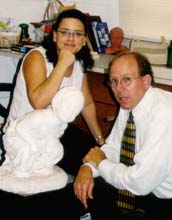
and then we sign the contract
Sculptor Bridgette Mongeon has documented the entire process of creating a figurine of a newsboy and a life-size bronze sculpture. Watch the artist work through these posts. In this blog, she has also included information for students and teachers. In the previous post, we learned how I pick a pose.
If you are lost and want to go back to the chronological running list of posts, follow this link.
Getting Ready for the Meeting
The photos are in the album, the contract is ready, and I have picked up the studio enough to be able to walk around without getting clay stuck to your shoes. I am ready for my meeting with the committee members from the Texas Press.
Visiting the Studio
Mr. Hodges and Ms. Garner Cash spent some time at the studio looking around and then we used the opportunity to shoot some photos. I explained the bronze process by showing them Ellie, a sculpture of a little girl. The first bronze was placed at the cemetery on Washington Avenue in Houston, Texas. The second one is intended for St. Mark’s United Methodist Church in Houston, Texas. After sculpting Ellie, a mold was made of her and then a wax poured in that mold. The wax is hollow and the same thickness that the bronze will be. This ‘lost wax method’ is one that we will be recording here with the sculpture of the newsboy. Oftentimes the sculpture is cut into different pieces to facilitate the foundry process.
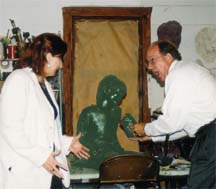
Did he Break it?
Yes, it looks like Mr. Hodges broke Ellie, but real, she is all right.
Lunch and a Review of the Pose!
After the studio, we proceeded to my favorite neighborhood restaurant, Peco’s, to discuss the schedule, the contract, and most importantly to look at the photos of Dusty. Each of us had our favorite photos and we all raised our hands at different times emulating the pose and the raising of the newspaper trying to get a feel for it. In fact we did it so often I think the waitresses, thinking that we were calling them, began to ignore us entirely.

And the Finalist is…
While everyone was eating I pulled all of the photos that were finalists together onto one page. There were about 5. After a careful look at those, it was unanimous. With a little modification to the feet of one pose, we had our newsboy!
“Meeting you, visiting your studio, seeing examples of your artistry heightened my excitement about working with you on this project. It was solid affirmation that TPA made the right choice of a sculptor for our anniversary project. Bridgette’s style perfectly captures the innocence and vitality we hope to portray with our ‘newsboy’ statue.”
Wanda Garner Cash,
President, Texas Press Association
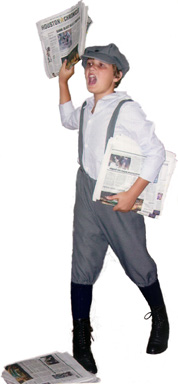
STUDENTS AND TEACHERS
Art and History
The lost wax method of sculpting is very old. We will get to see the documentation of the lost wax method of casting with the newsboy sculpture, however you can read a little more about it under the sculpture process link at the top of this page. There is a bit of information about the history of lost wax on other web sites as well. Following this link will lead you to an animated guide to bronze casting.
Later you will see that as the work progresses, chemistry will also become a part of the artistic process.
Vocabulary
A person who works in the lost wax method and in metal is called a metallurgist.
Let’s move onto the next steps in this process- Beginning the Small Sculpture.
Newsboy-How I Pick A Pose

poses for Dusty
Sculptor Bridgette Mongeon has documented the entire process of creating a figurine of a newsboy and a life-size bronze sculpture. Watch the artist work through these posts. In this blog, she has also included information for students and teachers. In the previous post, we learned a little about the beginning of this project.
If you are lost and want to go back to the chronological running list of posts, follow this link.
I keep thinking about the boys that I have read about. Barney Flaherty, the first paperboy hired by the New York Sun in 1833. That anniversary is coming up September 4th. I never knew that until I started this project. Though Dustin is the name of the boy that I have found for the first preliminary photo shoot, I wonder who I am sculpting? Is it Little Joe, Johnny Waffles, Skinny, Mickey, or any of the other children recounted in Death of a Newsboy? I will be thinking of them all, their entrepreneurial ability, tenacity, their struggle, and their place in history.
The photo sitting was so much fun!
I was able to find a newsboy outfit at a local costume company. It is not exactly what I want. The suspenders are wrong. I’d prefer the old leather ones that button to two buttons in the front. I also don’t like that the sleeves won’t roll up. But what do I want from a costume company? This one will do for this preliminary photo shoot. After all, what I am looking for is a pose. The costume is good enough not to cause distractions when trying to pick a pose. Later I’ll modify this costume, sew my own or find authentic clothing. But I want to have this sitting done before our Thursday meeting so that those attending the meeting can help me narrow down a pose.
I was elated when I first laid eyes on the model, Dustin Lee, in his costume. Dustin is the son of a friend of mine. I have known him since he was born but have not kept up with the family. I thought he would be around 11 years of age. When the Texas Press Association contacted me and said they would like an 11-year-old boy, I drove to my friend’s home to see if his mother would be interested.
Dustin or Dusty, as I have known him all his life, was a natural. His mom, a professional photographer, had groomed him well in the concept of modeling sessions. He was also quite animated. “EXTRA, EXTRA, READ ALL ABOUT IT!” he yelled as we tried pose after pose, paper in the air, holding papers, walking, and pointing. Prior to our sitting, I explained to him the importance of a newsboy and some of the history. I thought it might help him get into his part. “Your mouth is closing too quickly” I stated, “Can you hold the A in extra like your singing? Dusty bellowed “EXTRAAAAAAAAA” as I snapped the camera. When I felt we had exhausted all possibilities, our photo session ended. The outfit went back to the costume rental, and I waited anxiously for the photos to be developed.
September 1, 2004
The photos are back, and as I am looking at them, I am searching for movement, action, something to tell a story. Though I was unsure of the pose when the feet were so far a part, I am beginning to see a hidden meaning behind it-stability, being grounded, which represents the newspaper industry in itself. I am looking at those poses differently. The ones with the twist add motion; some, where the back is arched, add a different movement. I put all the photos in a resources photo album and mark my favorites with post-its, then I hand the photo album to my an artist friend, to get his opinion.
Meanwhile, seeing Dusty, in the outfit looking at the photos and getting closer to a pose, stirs up my creativity. Now the anticipation of actually getting my hands in the clay and working on the piece is beginning to build inside me. I can even feel the little flutters in my chest as I think of it. It is a great feeling! Allowing it to ferment there is a good thing. This stage of the creative process is called saturation.
While speaking to Dusty’s mom I learn that Dusty’s grandfather is elated over the idea of the sculpture of the newsboy and Dusty’s participation. Dusty’s grandfather was a newsboy for many years. These little elements add to the personal excitement of the sculpture, to the fermenting.
Next week I sculpt. But before that, let’s look at the next post about The Meeting.
STUDENTS AND TEACHERS
Art and History
• Why did the newsboys scream, “Extra, Extra Read all About It!”
• The sculpture that I am creating is in honor of the Texas Press Association’s 125th anniversary. Can you think of some big events that happened in the last 125 years that would have been headlines in the newspapers that the newsboys carried? Here is a website that can help you- Digital History.
Newsboy Sculpture-The Beginning.
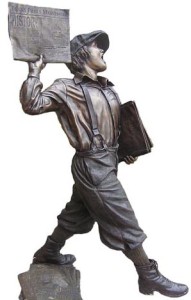
limited edition of 10. The
Newspaper that he holds
changes depending on
what headline the buyer
would like to see.
Sculptor Bridgette Mongeon has documented the entire process of creating a figurine of a newsboy and a life-size bronze sculpture. Watch the artist work through these posts. In this blog, she has also included information for students and teachers. In the previous post, we learned a little about the artists thoughts on the project.
If you are lost and want to go back to the chronological running list of posts, follow this link.
Thank you to the committee members of the Texas Press Association for choosing me as the artist for the newsboy sculpture that is intended for the state capitol. I am honored to participate in your 125th anniversary.
I was thrilled to be awarded the commission and have decided to document not only the artistic process but also the thought process of the entire work of art, an artist’s journal, so to speak. It is a way for the members of the Texas Press Association and others to witness the creative process and share in the personal thoughts of the artist.
I will try to update often, so please check back to see the progress.
I certainly welcome and appreciate newspaper coverage, as well as any other media coverage, and I will help anyone that is interested in getting the elements that they might need to create newsworthy stories. I would also appreciate your help in spreading the news about schools that are evaluating the Texas Press section of this web site as an educational tool.
Students and teachers
At the bottom of each page, you will find information to help you learn. There will be questions, further reading and items to spark your interest. Please feel free to e-mail me with your responses and I will post what I can. Thanks for your involvement.
Bridgette Mongeon
First Paperboy, Sept. 4, 1833:
Newspaper Carrier Day on Sept. 4 marks the anniversary of the hiring of the first paperboy in the United States. In 1833, The New York Sun ran the following ad: “To the Unemployed – – A number of steady men can find employment by vending this paper. A liberal discount is allowed to those who buy to sell again.” Ten-year-old Barney Flaherty, although not a man, was the first to answer the ad.
The small newsboy sculpture is available as a limited edition bronze.
Let’s go to the next page in this chronological order of the creating of a Newsboy Sculpture- How I Pick A Pose.
Newsboy- Thoughts on The Project
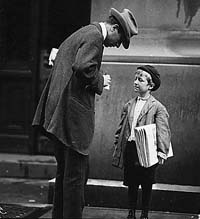
selling papers on the street.
Sculptor Bridgette Mongeon has documented the entire process of creating a figurine of a newsboy and a life-size bronze sculpture. Watch the artist work through these posts. In this blog, she has also included information for students and teachers. In the previous post, we learned a little about the history of the artist and newspapers.
If you are lost in the chronological order and want to go back to the running list of posts, follow this link.
I woke up early with newsboy on my brain. So, I thought I would do some research on them. I googled newsboy to see what came up. As I find information about newsboys I will add it to the Newsboy Links page.
Before I even begin the sculpture I can feel the passion for this piece stirring in me. These newsboys were the delivery system for news. At this time period there was no other form of delivery. I am always thrilled when I find young people who make a difference in the world. Maybe that is why I have such a desire to help youth. They can realize their potential, and, in turn, make a difference.
These young entrepreneurs made a huge difference. In the beginning, they were the only way for news to get to the public. As I google and read about things people wrote about them, I stumbled on the topic of Thomas Edison as a newsboy. He sold papers on the train as a youth. “Certainly,” I thought, “there were probably many famous people who started out as newsboys.”
I couldn’t help but imagine what it was like to be a newsboy. Yes there were newsgirls, a little unknown item of history. Newsboys needed to sell the paper, but how tempting it would be to want to keep one to read. In some cases I am sure the paper was the only source of reading material for these youth, if they could read.
THE POSE
I am waiting on a phone call from someone who has an 11 year old boy, and am hoping that he fits my image of what I think this sculpture should look like. I think I might be able to get my hands on some period clothing, though I am wondering how difficult it will be to find shoes. My plan is to set up a photo shoot to try some different ideas for the sculpture. I’m hoping, by doing this photo shoot, that I can finalize some different poses and present these photos on Thursday Sept 2, when I meet with members of the committee. Once we decide on a pose I’ll set up another photo shoot focusing on that one pose alone, taking many rolls of film. This reference will be necessary to focus on the details.
Sunday August 29, 2004
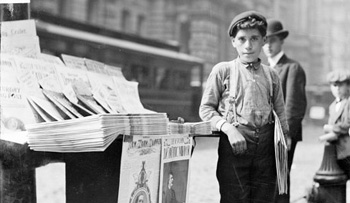
I Googled once again! This time for photos of newsboys. I came up with several different items that I will put in a reference book to refer to while sculpting. I especially love the old photos, but there is nothing new about my loving old photos, I could spend hours looking at old photos. In fact I love the research on a project just as much as I love doing the project. It is also what I love about writing.
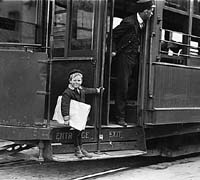
Because this sculpture is a part of history it makes it all the more fascinating for me. Though I will count on the photos from my own photo shoot, these stories and the images inspire me. If I look very closely I can look into the eyes of real children!
August 30, 2004
While pulling together the contract, I stopped at TITLE. I filled in Newsboy but I know that all sculptures tend to find their names as they progress. As I work, I will await those whispers that tell me the secret of what it should be called.
I am continuing to read the stories and history of the newsboys that I find on the Internet. I first struggled about reading Death of a Newsboy, but the massive amounts of information that was in this article written by Vincent DeGirolamo, in the Journal of Social History, is amazing. It has drawn me closer to the meaning behind the newsboys as a whole and this special boy. It will directly affect the personality of the sculpture and its spirit. Maybe this element is something that only I see or feel, or maybe it is part of what others notice and comment on when I hear them say, “Your work is so life like, or it has so much personality, or the faces, there is just something about the faces.”
I wish I had time to research some of the articles mentioned in Death of a Newsboy. I always like to saturate myself with the subject as much as possible.|
I have found a period costume for the photo shoot. Although there are some things about the outfit that I don’t like, I can change these things in the sculpture. Taking these preliminary photos will help me to define a pose. It enables me to look at alternatives that I have not seen and to notice the sculpture pose from other directions. I have found other sculptures of newsboys on the Internet. I certainly don’t want to copy them. I am waiting for this sculpture to unfold itself, though I know that ultimately the scene will come alive within the clay.
STUDENTS AND TEACHERS
Art and History
• What is the difference between a newsboy and a newscarrier?
• Do you know anyone who was a newsboy or newscarrier?
• Which character in Death of a Newsboy is your favorite and why?
• In the article, A History of Newboys in America the Spanish-American war affected the newsboys. How did it affect the newsboys in a positive way, and what affect did the end of the war have on the newsboys?
Let’s go to the next page in this chronological order of the creating of a Newsboy Sculpture and to The Beginning.
The above photos
The top two are by Hines and were found at:
http://web.mala.bc.ca/davies/H132/Hine.newsboy.street.photo.jpg
http://web.mala.bc.ca/davies/H132/Hine.newsboy.streetcar.photo.jpg
http://www.ita.doc.gov/td/oetca/cra2_files/newsboy.jpg
Newsboy-The News
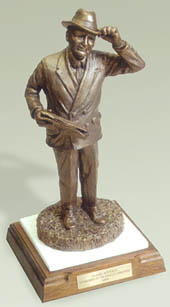
for the Houston Chronicle
Sculptor Bridgette Mongeon has documented the entire process of creating both a figurine of a newsboy and a life-size bronze sculpture. Watch the artist work, through these posts. In this blog she has also included information for students and teachers. In the previous post we learned a little of history of the artist and newspapers.
If you are lost and want to go back to the running list of posts, simply follow this link.
August 26, 2004- The News
The committee met today and Mr. Hodges called me with the good news. I was flattered when he told me what he said to the committee. I believe he said something like…
“There is no doubt that all of the artists that we are looking at are more than qualified to do this sculpture, but if you are looking for a sculptor who has a passion for children then I think you will be pleased with Bridgette Mongeon.”
Passion for Children
Mr. Hodges is correct. I do have a passion, not only for sculpting children but also helping children. I work regularly with organizations like I Have a Dream, who help children with their education and I was thrilled to donate their Dream Maker Award.
I have made it a practice to find one organization a year for which I donate a sculpture . My stipulation is that they work with children, the hungry or poor. That does indeed cover a wide gambit. When I create these sculptures, I give them to the organizations to do whatever they would like. They can produce them for awards or sell them to raise money. (I donate the sculpting and turn the award recipient over to my manufacturer for mold making and manufacturing.) Donating these awards is my way of giving back.
My involvement with children does not end with I Have a Dream. I also have a ministry that I am working with in South Africa. Through this ministry I find school sponsors as well as garden sponsors for the poor children in the squatter’s camps in South Africa.
Years ago I developed a program called Express Yourself that I brought into inner city schools to help children express their emotions through the arts.
Not all my work is of children. This is my second sculpture this year related to the newspaper industry. In the beginning of the year I was contracted by the Houston Chronicle to create their Jesse Award.
I’m looking forward to working with the Texas Press Association and sharing my creative inspiration in this great celebration.
STUDENTS AND TEACHERS
Art and History
• Can you name other artists from the past who sculpted children?
• What was special about the children that they sculpted?
• In the information above you can see a sculpture called the Jesse. Do you know who Jesse Jones was? Why was he so important to Houston and Texas?
Geography
• In the above page it mentions that I work with children in Africa. Look on a map can you find the area of Africa where I work?
You have a bit of history here. Now, let’s look at the next blog post on this journey of creating a newsboy. Here are some thoughts on the project.
Dancing Brains
Houston Tribune
May 2004
Bridgette Mongeon © 2004
Prior to our marrying six years ago, both my husband and liked to dance. Our dancing was of course with different people. Once we married, we tried to dance with each other, but when we did there seemed to be instant tension. I thought, “Maybe a dance class would help.” We signed up for one of those group classes thinking, “This should be fun,” but we both had a mis¬erable time. Though both of us knew how to dance, trying to learn together left us frustrated.
Yvonne, a student who had been taking private instruction for 18 years, introduced me to The Dance Place. I told her about the difficulties that my husband and I were having. I knew we had different ways of learning and that trying to learn together was very frustrating for us both. Maybe we would try to learn just one more time. I wondered if anyone at The Dance Place could help. Yvonne was extremely insightful and understanding. As it turns out, when she first tried to learn to dance, she too had struggled. She recom¬mended Michael Schedler and said he understood learning styles. If anyone could teach us, he could. I would soon find out he had more to teach us than dance.
LEARNING STYLES
Each person has a different learning style, some are auditory learners, some are visual learners, some learn by touch, and others learn intellectually, through patterns. I was aware that the learning styles of my husband and myself were very, very different, but it didn’t really affect us, until it came time to dance. On the dance floor we had to be tolerant of each other’s learning styles, while struggling with our own.
This is probably why we did not do so well in a “group” class. Not only did we have to learn individually but also we had to leave room for the other person. Then there was an entire room of students that would move ahead of us while we were juggling all of the learning.
OUR FIRST CLASS
I was very anxious to try a private class. It was easy to see that Mr. Schedler had a very keen awareness of the learning styles of individuals. He was also able to switch gears throughout our sessions, not only perceiving what one partner was not understanding but redirecting the instructions in a way that each of us could grasp. His talent as a teacher was incredible. At home my husband referred to him as “the mediator, and referee.”
“Most people want to learn to dance, my job is to help them to learn how to overcome their handicap of how they are learning.” States Mr. Schedler. “The teachers job is to find the weakness and to make the partnership work.” I felt a little relieved.
In our first class, Mr. Schedler went over the basics of dance in what seemed like endless detail. I tried to listen to what he was saying, but there seemed to be too many words. A couple of times I thought, “Why is he talking so much? If I don’t move soon he will loose me.” You see my learning style is “feeler.” I learn through the movement. Once I retain the movement in my body, then I have it. These words were not movement. I looked at my husband. He was standing patiently and looked genuinely interested in what the teacher had to say. Later I asked him what he liked about the class; “I like when he went over the basics.” He said, “If I have the parts of things then I can make the connections between the basic parts. I can see it in my head, if I don’t have them I’m lost.” This was the first example of not only how different we are but also of how incompatible our learning styles are of each other. If, in my frustration, I had said something like, “enough, let’s dance” I would have taken away from my husband his opportunity to understand.
I wish I could say I was continually tolerant of my husband’s learning style, but my own learning style kept getting in the way. There was a point in that first class where I did say something. The instructor danced with me demonstrating a part. Then my husband danced with me. The two felt entirely different. I don’t know how they felt different; I just know my body said, “This is different.” I chimed up and said something. I am not sure what the instructor said and he was very polite about it, but my biggest lesson in that first class was “SHUT UP.” Everything inside of me wanted to say, “It is not right, I can feel it’ but I soon learned that the instructor was more than qualified to see the mistakes. As I gave him the opportunity to be the instructor he would very gently guide my husband into the direction and moves that he needed, and he did it using my husband’s way of learning. My husband’s synopsis of the first class and the instruction is that he thought the teacher was very thorough and understanding but most of all, encouraging.
Mr. Schedler said he has never found a student that he couldn’t teach. He did say that he has come across students where their personalities did not mesh with the teachers and he would find another teacher.
In future classes our differences just kept coming out. Both my husband and the instructor chastised me for leading. I didn’t really mean to lead, I knew I shouldn’t, but the desire to do the moves over and over again was so strong. Moving helped me to retain it. Stopping to give my husband time to figure out the pattern fractured my thoughts and seemed to halt my retention. Being reminded to stop moving or leading irritated me, but I tried to be patient. Later Mr. Schedler explained “Intellectual thinkers map out the patterns in their mind. Any kind of doubt in their minds and they get stuck and need to overcome that doubt. They can get stuck on the least little thing. My job is to try and get them to relax and know they can make a mistake. There are no dance police.” My husband later referred to this quote when trying to help me to understand an entirely different aspect of his life, “that’s me,” he said. I have decided I need to remember this about my husband. It may help me to be more patient.
Another aspect of learning to dance is hearing the beats in the music. Sometimes students have a difficult time hearing the rhythm of the music and transferring it into dance. Mr. Schedler explains that with this type of person he will find music with the strongest beat so that the student can learn what to listen for and hear the basic rhythm. He then teaches how to transfer that listening into the movements.
Some students may interpret what the instructor says differently than how he meant it. That is the instructor’s cue to find a different way of saying it. Not louder or more often, as is the case with some instructors, but differently so that the individual can understand it in their own style.
Another learning style is visual learning. Visual learners have an advantage over the feelers and intellectuals. They see what the instructor does and they can transfer it. They may not understand the rhythm but they can copy the patterns.
After our fourth class it was apparent to me that in the past my desire and exuberance about dancing with my husband had added more pressure to him. As Mr. Schedler put it “The one that ‘gets it’ doesn’t mean any harm they just really want to help, however the person on the receiving end just resents it and is frustrated, that is when it is a good idea to have a teacher. The partner on the receiving end won’t want to do it again, they will feel self-conscious and they put up walls of defense. Tearing down those walls can be very difficult, even for a teacher.”
Having our “referee” seemed like the ideal way of learning, but I was concerned about when we were practicing. Mr. Schedler suggests having a controlled environment in which we would practice. And if there are problems, try asking each other “What do you remember him saying?” to see how each remembers it being taught. That did prove to be a little difficult for me; I remembered it in my body. I could tell if it was right or wrong, but to give it a definition in words or remembering what the instructor said was difficult. Mr. Schedler does allow video cameras or tape recorders in his dance class, anything that will help the student learn. He did advise, “If it can’t be worked out then give yourself permission to let it go and seek instruction.” Most of all you must keep it light—dance must be fun.
I couldn’t help but wonder how Mr. Schedler knew so much about learning styles. “I first heard about it after high school. When I began to teach dance I thought about how I could apply learning styles to teaching.” In 22 years of teaching dance he has had some practice. But he says he still tries to figure new ways to teach.
For my husband and I dance class has taught us tolerance and has reinforced the idea that we are very different and that we need to have patience with each other. Our classes have been extremely successful, as our brains are dancing the waltz, foxtrot, swing and salsa, while smiling.
The Dance Place is owned and operated by Michael Schedler and Phillip Stephens. It is located at 3300 Chimney Rock Rd., Suite 500. For more information, call 713-266-0066.
All written work is copyrighted and cannot be used, whole or impart,
without the written consent of the author.
Mind and Body Matters” Traditional Chinese Medicine
Houston Tribune
June © 2004
by Bridgette Mongeon
Acupuncture and acupressure are increasing in popularity in the United States. Until recently it was believed that Traditional Chinese Medicine (TCM), was unscientific, but further research on TCM is resulting in gradual acceptance by the western scientific community. Some insurance companies are also beginning to recognize the value in keeping people healthy through TCM and are paying for treatments.
Some of the practices of TCM have been around for centuries. It is one of the oldest medical practices of the world. Principles behind TCM are very different from western medicine.
MERIDIAN SYSTEM AND QI
Just like western medicine understands different pathways in our body like the lymph, blood or nervous system, TCM has its own invisible pathway based on the meridians. Through these meridians flows the life force of the human body known as qi (pronounced chee). Though scientists have been trying to define qi they can really only study its effects. Sickness comes from qi that cannot flow through meridians because of blockage. Several different things can cause a blockage, for example stored emotions are one form of blockage. TCM understands that anger, fear or any emotion can be stored within organs in the body, and may cause illness. Western doctors are also realizing the effect that emotions play on a person’s health, for example, the discovery in western medicine that anger can raise blood pressure and can cause us to keep high levels of stress hormones in our bodies, may bring on illness. When a patient of TCM is receiving acupuncture or acupressure it is applied to the specific meridian points to induce the flow of qi and release the blockage.
YIN AND YANG
Another principle of TCM is Yin and Yang. Just as a battery needs two poles to work, a positive and a negative, so does the human body. Doctors working in TCM will try to bring harmony and balance to an individual Yin (positive) and Yang (negative.) Too much Yin or Yang and a person will be sick. .’
ORGAN NETWORK
The organ network is another principle of TCM. The five organ networks are Liver, Heart, Spleen, Lung and Kidney. These not only perform the functions that western medicine had discovered but in TCM they have an extension of both physical and psychological aspects to them. For example, the liver affects the storage of blood and ensures the smooth flow of qi in the body. It is also believed that anger is stored in the liver and will affect a person’s even temperedness.
In TCM five elements are related to individual organs, the liver is wood, heart is fire, the spleen is earth, the lungs are metal, and the kidney is water. Symptoms that a patient may be having are not necessarily of the organ that is in trouble. Within this organ network the different organs can have strong effects on each. other. For example the heart (fire) and kidneys (water) influence each other. It is also recognized by western medicine that heart failure is often accompanied by kidney complications and the kidney problems usually induce heart palpitations or symptoms. The heart represents fire and yang and the kidneys represent water and yin; A person with not enough kidney yin, representing water, might not be able to put out the fire and yang of the heart, causing heart problems. Too much of one or not enough of another would cause illness or symptoms for the patient. The TCM doctor works to bring balance.
Doctors of TCM utilize noninvasive treatments using a variety of different methods to restore balance and harmony including herbs, acupuncture, qigong, meditation and diet, among others.
If you are interested in TCM you can read more about it on the Internet. Houston also has many doctors that work with TCM and a College of Acupuncture and Oriental Medicine with a clinic www.acaom.edu.
Scientific documentation is indeed catching up to this age-old form of medicine and the results are something that
is worth looking into.
All written work is copyrighted and cannot be used, whole or impart,
without the written consent of the author.
Vibrant Health on Aisle Seven
Houston Tribune
June © 2004
by Bridgette Mongeon
Recently while shopping at the grocery store with my mother I was distracted by a conversation held by two older women. The first woman was vibrant and appeared to be in her mid to late 70’s. She was discussing the benefits of something she was doing and there was urgency in her voice. The second woman had dark circles under her eyes and looked very unhealthy but I could tell she was very interested.
“It is so good for you.” The vibrant woman continued as I approached walking down the isle past the condiments. “It can improve your health, and memory, is great for high blood pressure, and many other ailments. It isn’t jarring and is so easy to do, and as you get older it will improve your balance.”
My mother was ahead of me in the electric shopping cart. I was taking mother on her first shopping trip in many, many weeks. She was just returning from her third visit to the hospital. She had a broken hip and recovering from too many falls to mention. I stopped to listen; intuitively I knew what this vibrant woman was talking about. The second woman began to question her, “Where did you learn it? Can I do it? Is it difficult to learn?” she asked. As her questions were being answered I joined in on the conversation, “Excuse me for interrupting, I overheard your conversation and I just wanted to say that I have been doing a great deal of research on this subject and have found that everything this woman is saying is true. Scientists are beginning to study the effects and agree that it has incredible potential for people of all ages,” I said.
“Show me what it looks like” the second, sickly woman asked the first. Jokingly I said in a very loud voice, “Tai Chi demonstration on aisle seven.” The vibrant woman began to move so gracefully that she resembled what I would describe as wind through the trees. Then to my surprise this grey-haired woman stood on one leg lifting the other leg high to her chest, she also raised both arms up high in the air. She resembled a crane and she stood as still and firm. I looked with longing at my mom in the electric shopping cart. My mother was at least ten years younger than the woman balancing in the aisle, but mom did not have balance, was not able to breathe correctly and had acquired many other maladies that were descending upon her quickly stealing her vitality, and her life.
My own desire to learn this ethereal dance began from the moment I first saw it many years ago. I had purchased a video to try and learn Tai Chi, and it seemed overwhelming, but recently I started taking lessons. There are different forms of Tai Chi; I choose the Yang style long form. There are 108 forms in the long form, which will take the average person more than a year to learn. You do not however have to know all 108 forms to begin to see the benefits of Tai Chi. The woman in the grocery store said that she chose to learn just the first 40 forms, and had been doing Tai Chi for eight years. Perfecting the forms is part of the process of Tai Chi.
With quite a bit of repetition the graceful moves were easy to perform. Learning the choreography of the moves was difficult at first, but soon my body was doing them with little thought until I too was then working on perfecting the moves instead of remembering the steps.
Tai Chi Ch’uan is meditation with movements. Though these movements are based upon martial arts the practice of Tai Chi does not require incredible agility or strength, but it will build both.
It is performed by people of all ages and improves health and vitality. Tai Chi has been practiced for several hundred years originating in China. It can be performed by anyone in any physical condition, proceeding at their own pace and level.
The movements of Tai Chi and another form of Chinese movements called Qigong help to channel the flow chi (pronounced chee) through the body. In Traditional Chinese Medicine it is believed that the uninhibited flow of chi through the body encourages health and vitality. Like blood, chi must move through the entire body and does so through a chi circulatory system. If your chi flow is blocked then sickness will occur. Many scientists are studying the effects of chi. Chi is not something based in mysticism, but is scientific, and is being accepted more and more in the Western world.
There is a meditative state accompanied with deep abdominal breathing that comes with the practice of Tai Chi. The slow movements and turns massage different internal organs. Besides increasing range of motion, building strength and stamina and improving coordination and balance, regular practice of Tai Chi can help with asthma, and other respiratory ailments. It also aids the digestive system, circulatory system and immune system. Many of the scientific studies of the effects of Tai Chi and Qigong can be found in Kenneth Cohen’s’ book The Way of Qigong. Cohen describes Tai Chi as a form of Qigong and in his book, Cohen states, ” Qigong is frequently recommended as the primary therapy for advanced, inoperable, and medically untreatable cancer. In these cases, Qigong can ameliorate pain and other symptoms and slow the progression of the disease, more rarely, Qigong practice results in long term remission.”
I am continually intrigued by the research being done concerning Tai Chi. For me Tai Chi and Qigong are more than just exercise, they are ways of promoting and keeping my health. For those dealing with such things as cancer who feel helpless to what is happening in their bodies, it may be empowering for a patient to accompany their treatments with Tai Chi or Qigong.
For myself I have adopted Tai Chi as a daily practice. I believe that performing the moves will help me to stay healthy. As Tai Chi and Qigong become a part of my life, and in my journey of perfecting each move perhaps I will enter the second part of my life with grace and vitality. When I am 80 or 90 I will not feel the least bit silly standing on one foot like a crane in the middle of the grocery store sharing my adventure and hope with another. Who knows maybe if I do, someone else just might find their health on the isle seven near the condiments.
Don Price is a certified Tai Chi instructor. You can learn Tai Chi long form through the Jewish community Center 5601 South Braeswood 713-729-3200 ext. 3223 The JCC will also be starting a seniors class in the fall. Don teaches throughout the city. To find a class nearest you contact Don Price at 713-988-2765 or e-mailing him at DPriceOCentral.UH.EDU.
All written work is copyrighted and cannot be used, whole or impart,
without the written consent of the author.