
Posts by Bridgette
CNC Milling And CarveWright Conference
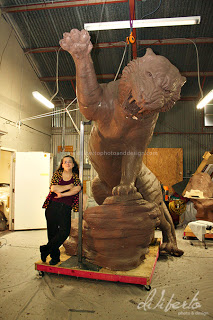
I could have done it without the use of CNC
milling. Oh yes, please note there is another
3 foot of rock that goes under this sculpture.
I have been compiling information and resources for a book that I am writing that talks about incorporating digital and traditional process in art. I call this marriage of the two -Tradigi art. I have been trying to educate others on the process of using 3D technology for a few years. Mike de la Flor and I wrote Digital Sculpting With Mudbox Essential Tools and Techniques and spent a chapter talking about 3D scanning, printing and milling. Our book, I believe, was one of the first that talks about how to get virtual pieces out of the computer and into a physical form. When I first started to do this, many CG people would ask, “Why do you want to get your designs out of the computer?” These are people who use the computer generated designs in movies, video, gaming etc. Without bringing virtual pieces into a physical world my designs are pretty much worthless to me.
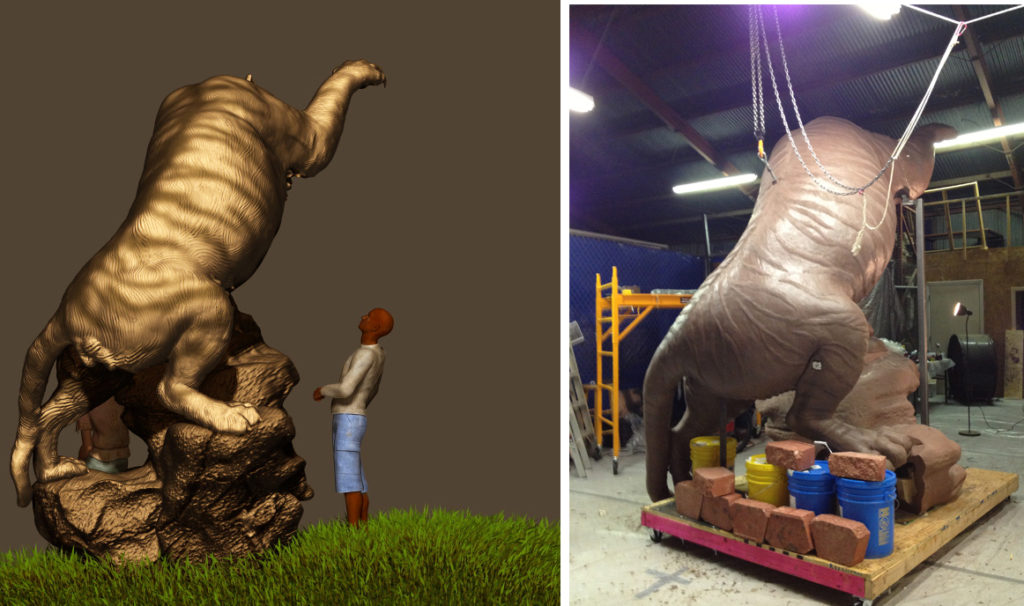
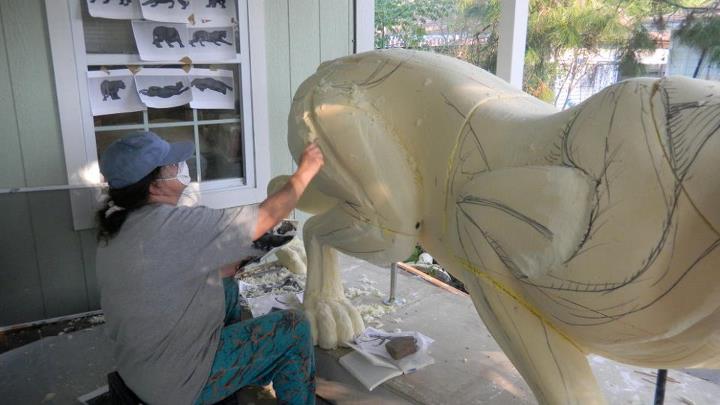
created in the computer and the milled out foam
covered with a fine layer of clay.
Once the client approves the clay the sculpture
is taken into the lost wax method of bronze casting.
I am inspired to educate others on how to do these things and the possibilities of incorporating this type of work into their traditional studios. Here is a pdf of a 2008 article in Sculptural Review that I wrote about the process of CNC milling in art.

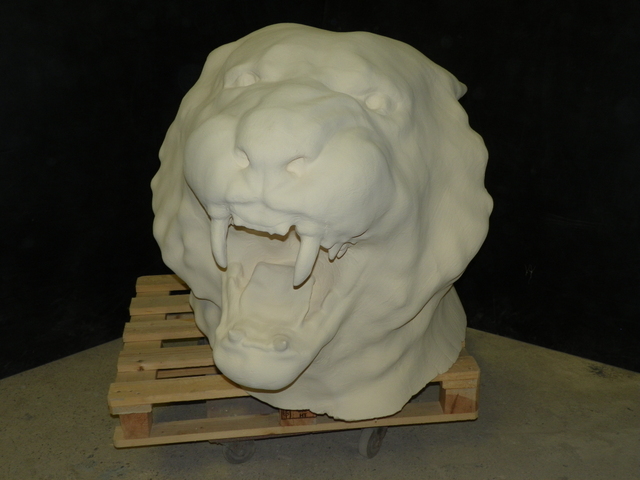
I have been using CNC milling of foam for a few years now. My two primary vendors are Synappsys in Oklahoma and Across the Board Creations in Canada. I have described some of my processes in a You tube video on the subject. I also have project blogs for the last several projects that talk about using the CNC milling of foam with my designs. I used CNC Milling on the Prairie View Panther, the Evelyn Rubenstein Sculpture for the Jewish Community Center and most recently on this enormous sculpture of the Tiger for Grambling State University.
I have also watched in fascination and excitement about the CNC Milling in Stone. All of these tools expand my tool set and save a sculptor’s hands from very damaging wear and tear.
Steven Ramirez of Smash Designs introduced me to the CarveWright . He was one of our speakers last year at 3DCAMP Houston. Once I saw the CarveWright and it’s possibilities I was very, very intrigued. I had been looking for a vendor that might mill my work. I’m still looking for this type of vendor. I had also been searching for others who had been using CNC milling in their artwork. I wanted to feature them in the book, and yes, I am entertaining getting a CarveWright of my own.
3DCAMP is a 3D symposium on everything 3D. It is hosted this year by the department of Architecture at the University of Houston. The date is October 5, 2013. The cost last year was only $15. and this year will be raised to $30 for professionals and $15 for students. A great prices for so much information and resources in one space. We had hoped that CarveWright might be a sponsor for last years 3DCAMP event, and would be able to discuss more about milling at 3DCAMP.
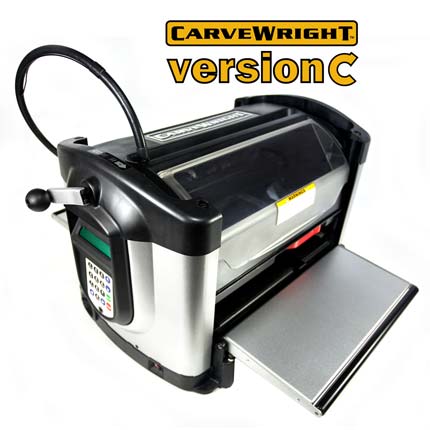
What is a CarveWright? It is an affordable consumer CNC milling machine that gives you the opportunity to design your own patterns, or use patterns provided with the machine and mill them out in many different materials. When learning about the CarveWright Conference, I was intrigued, not only because of my desire to try this machine, but also because I really wanted to gather more information for the book.
I learned many things from attending the CarveWright conference and was intrigued by the many people that I met. Of course, I’m looking at this tool and thinking, how can I push it like no one has ever pushed it before. How can I sculpt using this tool? I’m not the only one thinking about pushing the boundaries as Joe Lovchik, one of the owners of CarveWright was displaying how to use the tool to not only carve wood, but carve other things like foam, plastic and even wax. He showed how he used the CarveWright to make a pattern for pouring concrete, stamping leather, creating incredible lithophanes. The possibilities really made your head spin.
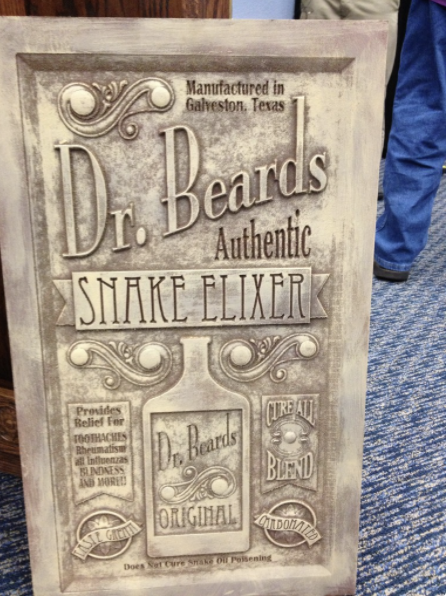
Besides learning the software that comes with the program, some of which I hear is some of the best for CNC milling, we heard what others were doing with the CarveWright. Michael Tyler displayed some of his creations and talked about inspiration. I loved learning about the stains and patinas he is using called Sculpture Nouveau. They are breathtaking! Joe Ragsdale talked about carving photos in wood. The feature that I think would be easily applicable to my own studio process is the carving of letters. I often get asked to incorporate type into my sculptures. This is not an easy task and takes a great deal of handwork. For example, the newspaper that the newsboy holds has copy that is individualized for each client that purchases this bronze. I have to change out the headline and subhead so that it is pertinent to those who are purchasing this bronze. You can be sure that the next time this happens I’ll be scanning this newspaper and carving it with a CarveWright. Oh, yes, I failed to mention, the CarveWright has a point scanner that you can purchase as well.
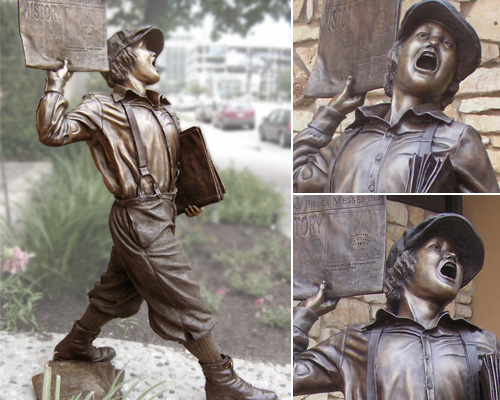
The possibilities and relationship between me and CNC and me and CarveWright are just beginning. I hope they will help me to push the limits of their product with my designs and look forward to working with them on this. I can’t wait to see what I come up with for the book. My head is already thinking in that strange 3D way. Thanks CarveWright for the information and the inspiration.
_______________________________________________

Bridgette Mongeon is a sculptor, writer, illustrator and educator as well as a public speaker.
Her blog can be found at https://creativesculpture.com.
She is the vice chair of the planning committee for 3DCAMP Houston 2012 http://www.3dcamphouston.com
She is also the owner and creator of the God’s Word Collectible Sculpture series http://www.godsword.net
Follow the artists on twitter twitter.com/Sculptorwriter and twitter.com/creategodsword
Listen to The Creative Christian Podcast or the Inspiration/Generation Podcast
Click on Podcast Host Bios for a list of all podcasts.
Shipping Artwork
I’m learning more and more about shipping of artwork. I have to say, as with any vendor, great customer service means the world to me. I have worked with Lace for years. She has shipped my artwork from one edge of the United States to the other, and this year gave me quotes on getting the Neil Armstrong sculpture to Moscow. When I found out she left the freight company I was using, I was painfully aware of how important it was to have someone you could call and would make sure everything was o.k. I was so excited to hear her call me from her new company.
Lace, I will follow you wherever you go. I am a fan of your customer service!
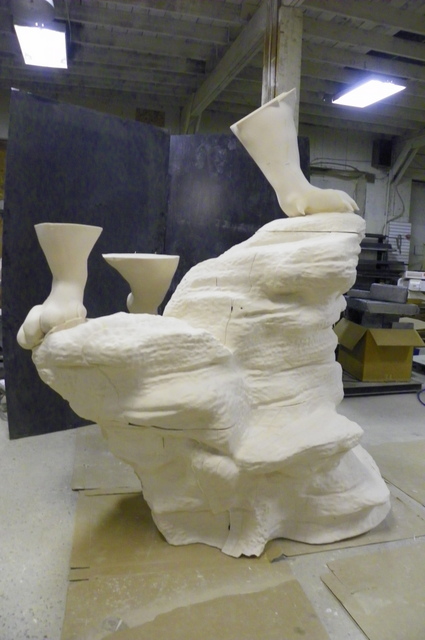
This time I’m not shipping artwork off, I’m receiving some very large piece of armature from a company in Idaho. You will see some more on that project very soon, 9 working days from tomorrow actually. As that is how long it will take to get it from Idaho to Houston.
Anytime I work on a job I learn things. For example, when crating something and needing a lift gate. A lift gate is important for me as my studio is not in a warehouse. My shipping and receiving is my home driveway – my studio is behind my home. Anyway, to use a lift gate you really should not crate up a piece any wider than 87″ or it will not fit in the doorway of the truck.
Sometimes you have to think about delivery when you are creating projects. We did this with the tiger. After I get these pieces from Idaho I’m going to have to get the entire bronze to Louisiana. lace offered some suggestions in the width of the project so that it could fit nicely on a flat bed. I hope I revised the design accordingly. I know I will count on Lace to do a good job in shipping. So, if you need something shipped, give Lace a call.
If you need to reach Lase for an estimate here is her contact information.
Acts Crating & Transportation Services
crating@actsintl.com
Lace
Acts Crating & Transportation Services
7207 B Wynnwood Ln
Houston TX 77008
713-869-2BOX (2269) work
713-969-9009 cell
713-880-3389 fax
You May Lose Your Copyrights And Not Even Know It
I wrote this post a while back and it was brought to my attention again as I saw a post by the Association of Medical Illustrators. I can’t say I have new information to post on this subject. If others find links and want to send them I would be happy to add them to this posts update. I am so busy I can’t research it. But for any artist, writer etc who makes money from their work this is a HUGE deal! Please pay attention. Here is the old article from my blog.
_____________________________
I know that the digital world is changing how we read and how we distribute books. I have a few problems with this. The first one is… my general mistrust of Google. Why should this lovable company who changes their artwork every day to make my searching enjoyable, be mistrusted?
I think they are getting too big for their britches.

belong to them. Artists and writers beware.
Left and right artists are making waves about what Google is trying to do. According to my research they are infringing on the rights of artists and photographers as indicated in this recent article By Larry Neumeister
“Artists Sue Google Over Copyright Infringement.” They are also the backers behind the Orphans Work Act. If you do not know about this and are an artist, you absolutely must learn. I mean it. Stop what you are doing and research this. What happens with this will change your income for the rest of your life. I have written about it before in an article for Best of Artists and Artisans, and there are links in the article for further information. If we are not careful, Google will become the God and keeper of all.
In a nutshell, Google wants to take the books that are out of print and make them available. Sounds real sweet, but watch out for that wolves teeth. As my southern friend says, “Katy bar the door.”
First of all, if I write a book, and it is out of print, what gives them the rights to reproduce that book without permission? They are also proposing that this be done with artwork, have a depository of artwork that people can come and browse and use. If artists do not claim their artwork and step up and say, “No, you can not use it, or this belongs to me,” then well tough poop for you. This puts the burden of copyright ownership on the artists. As it stands right now, artwork is copyrighted the moment it is created. I don’t have to search for my artwork all over the place. I don’t have to go to a Goggle provided website and pay to have my work protected and say it is mine. It is mine. PERIOD! For more information on this please read the article that I wrote for Best of Artists and Artisans 2008.
I may be lulled to enter blindly into the idea of digital books lovingly created and made affordable and accessible through Google, but I have a genuine mistrust of them. And what is sad is that I feel like they are my own child. I nurtured them. I still do. They are a part of my everyday life. Yet, they have too much control.
I am never one to spread discontent. However, in this case, I will stand on my soap box, behind my artists table and computer. I’ll give a very suspicious glance at Google as the writer/artist in me speaks, no shouts loudly. “ARTISTS AND WRITERS BEWARE! There is a wolf in sheep’s clothing!”
So what are your thoughts?
______________________________________________________________________________
Bridgette Mongeon is a sculptor, writer and educator as well as a public speaker. Her blog can be found at https://creativesculpture.com. She is also the owner and creator of the God’s Word Collectible Sculpture series Follow the artists on twitter twitter.com/Sculptorwriter twitter.com/creategodsword Facebook http://www.facebook.com/bridgette.mongeon Listen to The Creative Christian Podcast or the Inspiration/Generation Podcast Click on Podcast Host Bios for a listing of all podcasts Listen to the Art and Technology Podcast
Measuring Tape in ZBrush
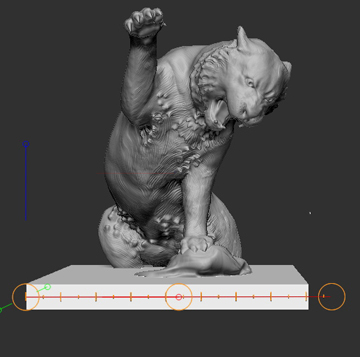
Recently I posted about my need for a measuring tape in ZBrush,. I created an entire post about my need. I have to say, this is not my first time requesting this from ZBrush, but it is the first time that someone replied and said, “hey, they finally gave us one and this is how you use it.” Apparently the transpose line can be made into a measuring tape. The transpose line is the line that comes up when you are trying to move, scale or rotate an object. To create the calibrations of the transpose line find “preferences” in your menu and scroll down to “transpose line” and then indicate your units of measurements.
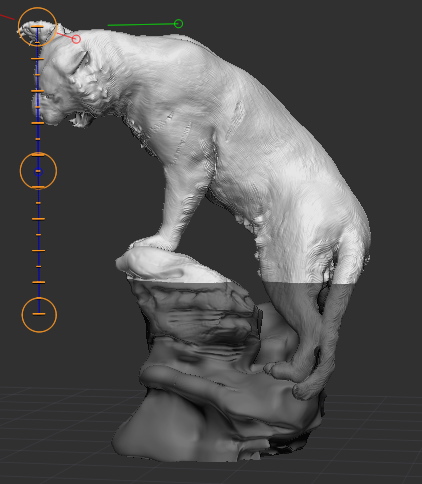
Thanks to the guys on the Pixologic forum for sharing as well as the ZBrush, group on Facebook. I get all of my answers from these guys.
Thanks also to Pixologic for hearing my request for all of these years. I do find that I actually still have to count the units as I’m working. Don’t make the mistake like I did, If you want 13 feet you need 15 tick marks. I would suggest to set your measurements and then count the units to be sure it is correct. Missing a foot on my sculpture or even a 1/2 a foot would be tragic.
It would be great if all of the measurements actually appeared in a box when you used the transpose line. For example, after using the transpose line I could look ,and see if what I have drawn is actually the amount of feet I need? In the case of the tiger I have decided to sculpt him in two parts and I need to be sure those two parts will fit in the 9 foot clearing of the studio. I’m working through this, and ZBrush, is helping considerably not only in figuring out the perfect division for the tigers parts, but also to know how big to make my base and and how that all fits together. Maybe these measurements appear somewhere that I don’t know about but my further request for Pixolboic would be if these measurements showed up and as I use the transpose tool I could check myself. IE… Ah yes, that is 15′ 3″ and the width then this is……
NOTE: the way I separated my tiger into two subtools
1. I made a mask over the area I wanted to divide ( control, click and drag)
2. I split those polygroups to make individual subtools here is how.
FYI HERE IS THE ANSWER?
Someone suggested I try these calipers. Why have I not heard about Screen Calipers from Ionico sooner? With all of my posts and rantings about a sculptor needing calipers you would have thought this would be brought to my attention sooner. I checked… they work on PC and Mac. Well, I’m going to contact the company to see if I can review these calibers and if they work post some tutorials about how I use them. I’ll let you know.
_______________________________________________
Bridgette Mongeon is a sculptor, writer, illustrator and educator as well as a public speaker.
Her blog can be found at https://creativesculpture.com.
She is the vice chair of the planning committee for 3DCAMP Houston 2012 http://www.3dcamphouston.com
She is also the owner and creator of the God’s Word Collectible Sculpture series http://www.godsword.net
Follow the artists on twitter twitter.com/Sculptorwriter and twitter.com/creategodsword
Listen to The Creative Christian Podcast or the Inspiration/Generation Podcast
Click on Podcast Host Bios for a list of all podcasts.
I Really Need A Measuring Tape in ZBrush or Mudbox
When I started in ZBrush and Mudbox years ago, the computer graphics world ( CG) would often say, “Why do you want to get things out of the computer?” I felt like I was just told I had purple spots on my face. I am a traditional sculptor who uses digital process to create sculpture in the physical form. I have a variety of things that I do that incorporate both traditional and digital or what I call tra-digi art. I know my use of these digital processes is not the way others use them, but it is how I make my living. Oh, and by the way, if you ever want to bring me in to lecture on this subject I would be happy to do so.
When I was at the ZBrush booth at SIGGRAPH last year I saw that someone mentioned that others were translating their designs into the real world. So, I’m not alone.
PIXOLOGIC>>>>GIVE ME A MEASURING TAPE.. PLEASE!
Over the years I have found one thing is a constant – I need a measuring tape! The hard part about this is that in the computer your sculpture is not really any size. It lives in a virtual world with virtual coordinates. However, to get this virtual sculpture to live in a real world I need to compare it to the real world. Over the years this problem has come up again and again.
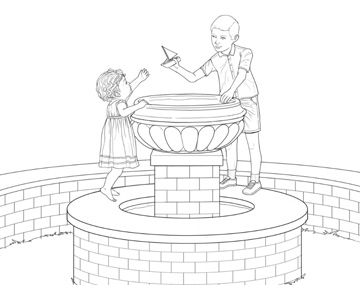
I would still need to create this digitally.
PRESENTATIONS- Comparison to what is there.
This usually happens when I’m working out the design, For example the landscape architect gives me blue prints and I need to come up with something. In the case of the fountain I could go and take pictures of what was created on the job site. The client wanted two children, and I was to incorporate the fountain base, and another piece that would sit on top. I would have loved to create this in ZBrush, but I opted for a simple sketch because of the limitations of measuring.
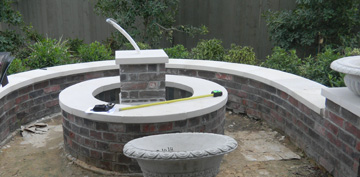
CAN I SHIP IT?
I know that someone working in the computer may not be thinking about shipping their final product. But I ship bronze sculptures all of the time. In many cases this is something I work out in the design process. If I can figure out how to modify the sculpture sometimes, it can save thousands of dollars. For example, I modified the design of the floor of the sculpture of the praying man to be able to fit the width of my van and still be life-size. I was able to do this in the sculpting process when in my traditional studio but there are other times I need this as well. Shipping the Tiger sculpture from my studio in Houston, Texas to Louisiana is a massive investment 7,000- 10,000. The tiger will have to ship on its side. However, I need to be sure that it can do so and fit on the flat bed trailer with packing.
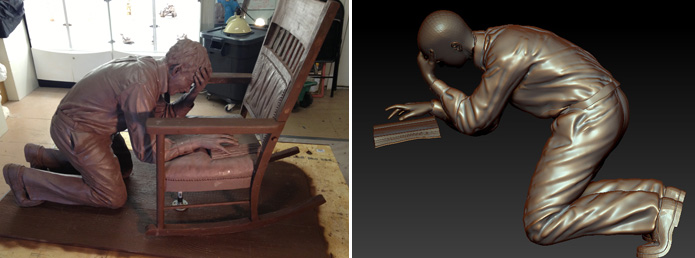
MILLING?
Most of my sculptures, once created and revised in the computer are enlarged digitally in foam. This takes the place of doing the traditional armature of welding and pointing up as done in the past. Synappsys Digital Services does most of my enlarging. They figure out the mass if I give them the height, but it is often necessary to figure measurements out in the design. In
Often in the design stage it would help to be able to say, if it is this height,
what is the width at this place in the sculpture.
the case of the Tiger sculpture I lowered the head and the arm of the tiger, mostly because I could not find a warehouse big enough to allow me to sculpt that size piece. Subtracting a foot, by lowering the hand/head helped the design, but also give me a little more room to work. I would not have known to do that had I not measured in advance.
ARMATURE?
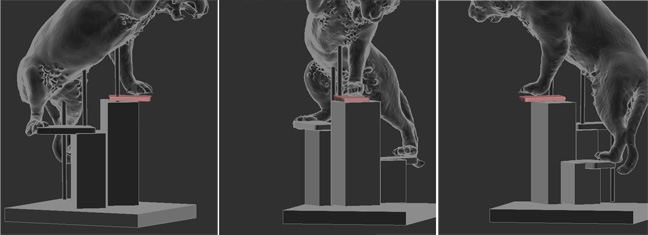
I’m taking time to write this post as I work diligently on trying to figure out the armature for the 13+ foot tiger. Though I can twirl the image around in my computer by pressing certain keys, in the real world this sculpture will have gravity and weight to deal with. The foam of the tiger, once togther will probably weight about 170 lbs. Then we add a layer of wax and a fine layer of clay. This will probably add about 400+ lbs to the tiger alone. Having the proper armature to hold this tiger up is imperative. Without it I could have the entire thing fall and, God forbid, be under it when it does. If I had a measuring tape in zbrush I could be making a schematic for my carpenter to build my base and armatures. I am also looking at a way to create the sculpture separately cutting the pieces in 1/2 so that I don’ t have to carve 15 feet in the air. Oh I wish I had a measuring tape.
Work around.
Yes there are probably ways to work around this. For example, I know the man in the scene if 6 feet, I can make a long flat piece that measures 6 feet and work with that. But being able to give one element a size, the man is 6 feet—and then able to click anywhere else on the sculpture to see what that size is in relation to the given size of the man- this would make my life a lot easier. So how about it Pixologic? Can I please have a measuring tape in the next version?
These are only a quick few ways I can see that having a measuring tape in a program like ZBrush or Mudbox would really help my work flow, and might even help to extend the buyers of these programs. In my speaking engagements I often tell my audience that I turned to the use of digital tools to extend my career. Pushing around clay with my hands has caused some great aches and pains over the years. Most of my audience wants to learn these processes as well, for just these reasons. Please give a listen Pixologic and Autodesk lets see how you measure up!
_______________________________________________
Bridgette Mongeon is a sculptor, writer, illustrator and educator as well as a public speaker.
Her blog can be found at https://creativesculpture.com.
She is the vice chair of the planning committee for 3DCAMP Houston 2012 http://www.3dcamphouston.com
She is also the owner and creator of the God’s Word Collectible Sculpture series http://www.godsword.net
Follow the artists on twitter twitter.com/Sculptorwriter and twitter.com/creategodsword
Listen to The Creative Christian Podcast or the Inspiration/Generation Podcast
Click on Podcast Host Bios for a list of all podcasts.
Figuring Challenges, Both Digitally and Traditionally
Here is the challenge
I’m trying to create quite a bit of text in a sculpture. Traditionally I prefer when text is created in a sculpture is is recessed as apposed to sticking out of the clay. Usually I create this type of affect with the following steps.
TRADITIONAL WAY
1. Set the text in a program on the computer. The kerning or the spacing between the letters must be a lot as you want the words to translate to the clay and not get cut apart in the steps that are to come up- the mold making, wax pouring and bronze casting.
2. Text also must be a good text for this process. Having small white space in the middle of a P is hard to keep through this process. I usually go with a Futura or Helvetica type face and make it bold. In this case all upper case will translate better through the process.
3. Print out the properly kerned text and then lay it over the clay. Very carefully scribe each letter into the clay. Then when the paper is lifted off you must carefully cut each letter with an exacto knife, holding the knife on an angel so you get the “chiseled” look and the mold will pull easily.
The difficulty with this traditional way, even though I have already paid an intern to scribe every letter, is that it is taking me about 1 hour per 3 lines and I don’t really like the way it looks. So I’m exploring digital processes.

with these “cut out letters” www.godsword.net
WHAT THIS IS FOR?
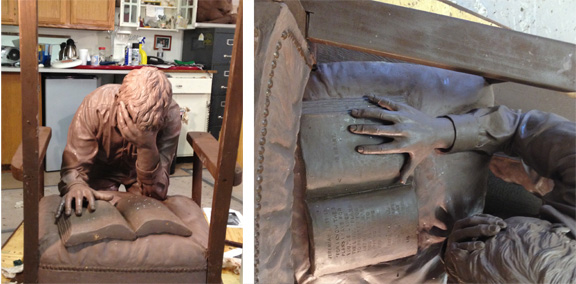
This is for a life size bronze sculpture. The bible that sits on the seat and is already roughed in. The client wants text in the bible so a scripture will be read. It will set into the bible, not come out of it. I started hand carving it but it is not crisp enough and taking forever.
POSSIBILITIES?
I have in the past had rubber stamps made for a sculpture, but remember these are in reverse. A vendor suggested using this company in Houston. They have done a lot of work for my other vendor American Collectors Studio
Lobue’s Rubber stamps# is 713-652-0031 ,1228 McGowen at Caroline

I also own a variety of “press in letters” for clay. But when you press in letters the clay has to go somewhere and so you get this bumpy look. It also is a fine art to make all of your words line up and not be bouncing all over the place. And finally will they have a good type face at the right size that you need? That is the hardest part. I will try to list these press in type letters at a later date. Some sculptors might find it useful.
DIGITAL WAY
I know that there are 3d printed materials that are flexible like rubber. So I am looking for this to be printed as a flexible material. Crisp text. That way, I can cut away the top layer of this clay page and set this into the clay. Because the bible is created with a dip the flexible material will allow me to creatively put it on the bible with the wave that it needs. So I’m presently searching local vendors that can do this in Houston. I know that I could probably go to imaterialze or Shapeways, but they do this out of the country and I’m on a deadline.
Jose at the University of Houston 3d printing department made a suggestion- more on that later.
BUT WHAT ABOUT YOUR FILE?
We needed an stl file. That is what is used for 3d printing. I tired doing this simple project of insetting copy in zbrush and did not have much success. I was disappointed. I love the program but really wish some things were not so hard. My 3d super hero husband created outlines in illustrator and brought it into 3ds max using Boolean to extract the type. We estimated it to be 1/4 inch thick with a 1/8 inset. I know that the more material the print the bigger the cost. I’m waiting to see if I need to revise the files. More on this later. Lets see what company saves the day, with as little cost and quick turn around!
MORE TO COME!
and the winner is…. Loboue’s! they are charging $80 a page, certainly worth it. Having it set digitally was 500-1,000. Sometimes the old way is the best way.
Bridgette Mongeon created this sculpture for Dallas Baptist University. If you would like to read the entire process on the artists project blog for this project visit http://prayingmansculpture.blogspot.com/ .
Sculptor Bridgette Mongeon Awarded The Grambling Tiger
Sculptor Bridgette Mongeon has been awarded a contract to create a sculpture of the Grambling State University mascot. The sculpture, measuring nearly 15 feet, will consist of a monumental tiger climbing on rocks. The sculpture will be completed and placed at Grambling State University in Grambling Louisiana in the fall of 2013.
The sculpture process on this monumental piece of art is more than just sculpting. It means that the artist must move her entire studio to a temporary location- a warehouse that is large enough to accomodate the big cat.
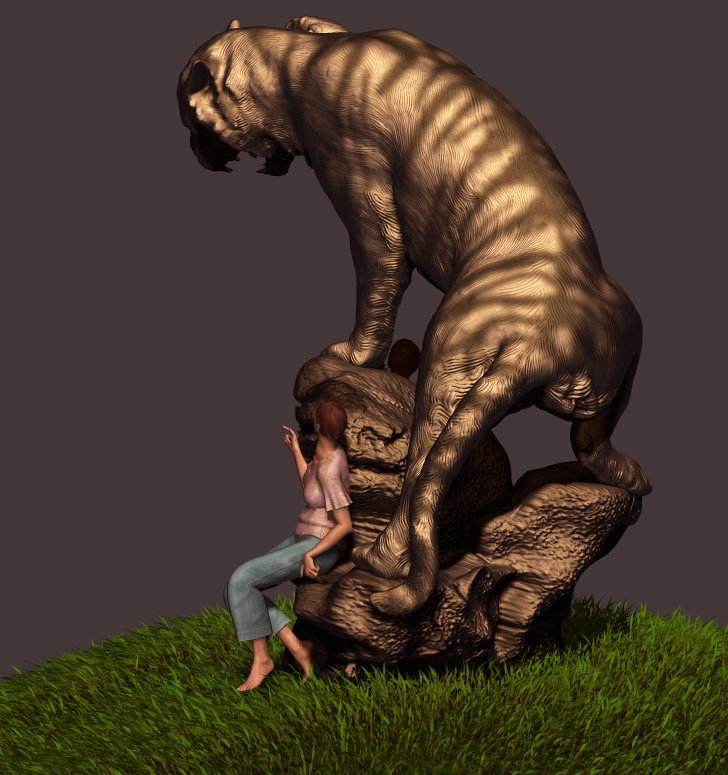
The artist is presently searching for interns in the Houston area that would like to learn the fine art of sculpting, mold making and bronze casting of a larger than life-size sculpture. If you are interested visit her website at https://creativesculpture.com and fill out the contact form.
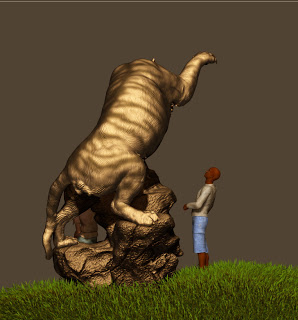
Bridgette Mongeon is creating this sculpture for Grambling State University. To watch the entire process you can use the categories on this blog or visit the project blog she created for the client at http://gramblingtiger.blogspot.com/
Looking For Interns-ASAP

I have several projects coming up, and one in house right now. I’m looking for interns to work in the studio. Can work evenings or daytime.
I have tried to outline what the process of being an intern in my sculpting studio consists of. I have also given links to projects so students can become more familiar with the process.
I have a large Internet presence and often create “project blogs” for my clients to follow along with the sculptures as I create them. They are also a great educational tool. I’ll list some posts below, but if students are interested they can visit the project blogs to see how I work.
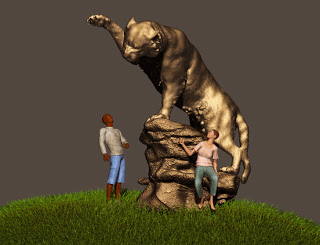
This is a digital model of the intended sculpture.
- My personal blog is https://creativesculpture.com
Some of the project blogs are
- http://www.erjcc.blogspot.com/
- http://www.gramblingtiger.blogspot.com/ This is on of the projects we will be working on
- http://www.prairieviewpanther.blogspot.com/
- http://www.dickhathaway.blogspot.com/
- https://creativesculpture.com/texaspress.html
- http://unitedinspace.com/ This is one of the projects we may be working on
What I need:
* Physically capable bodies to work on sculpting two projects, possibly three. The first is a life-size praying man, the second is a 15 foot tiger that is climbing on rocks. I’m including a digital sketch of what that looks like. I may also have a sculpture of Neil Armstrong for Russia. All of these are bronze that are created in traditional process of sculpting with clay. This is very physical work.
* Knowledge of figurative sculpting is not essential. I will take passion over knowledge any day!
* I would like atleast 20 hours of work per intern, but if they need to do less I will use more interns working less hours. I just need to be sure that I can schedule them.
* I AM READY TO GO TODAY! NEED HELP ASAP!
* A commitment. Please- I have deadlines and need to have people who can honor those deadlines. The internship needs to be important to them.
What the students receives:
* Interns will be educated in the process of figurative sculpting. They will also learn about the lost wax method of bronze casting. I am also open to talking to students about working as a commissioned artist, and the digital process in the traditional studio. All of my interns love the encouragement that they receive working in my studio.
* I can use students for possibly the holiday break and the next semester. If they are interested in a longer relationship that is a possibility.
* I’m happy to provide documents for school credit or letters of recommendation for the interns.
* A paid internship is a possibility. However, I need to see the students abilities first. I also would rather work on a bonus system- payment at the end of a project rather than an hourly wage, but if payment is necessary for the internship with the school let me know. I can work this out.
Here is what students will be doing.
PUTTING TOGETHER ARMATURES
The clay I use is a wax based clay that needs to be melted and put on the foam armature that we put together. Here is a blog post about armature building for the Prairie View A & M Panther http://www.prairieviewpanther.blogspot.com/2011/09/update-countdown-begins.html Or the Evelyn Rubenstein Sculpture for the Evelyn Rubenstein Jewish Community center. http://www.erjcc.blogspot.com/2012/02/pulling-pieces-together.html
ADDING WAX AND CLAY
The sculpture is covered in foundry wax and then wax based clay. The clay is heated up in crock pots and applied. It is a bugger to smooth and interns are often smoothing this out with torches and tools. Some more blog posts about this process http://www.prairieviewpanther.blogspot.com/2011/09/update-sculpting-like-mad-woman-day-4.html http://www.erjcc.blogspot.com/2012/03/working-diligently-thumbs-up-and.html
ONCE APPROVED- THE SCULPTURE ENTERS THE FOUNDRY STAGE
If an intern feels like the above is grueling work then they have not seen anything. The mold making process is brutal. Many foundries actually do this part of the process, but artists must learn this as it can save quite a bit of money. The interns will be taken through the entire mold making process. Because we are working on different pieces, different types of mold making will be used for different parts of the sculptures. The sculpture, once perfected and approved, must be cut up into many, many different sections. You can read about the mold making process on some of my project blogs. The panther had over 32 mold pieces. Here are some of the many posts about mold making.
WAXES
Though this is often another part of the foundry process I use interns to help me clean waxes. This expedites the projects and helps me to be sure the bronze will turn out how I want it. Cleaning up waxes for the foundry processes is an art. Each intern will learn how to use the tools and be working with me and the foundry to create these pieces. The foundry is local and I will introduce the students to the foundry and their process. When they are available they can come to the foundry with me for approvals and to see how the job is coming along.
That is about it.
If a student is interested they should let me know their intent and availability through e mail. I can be reached at this bridgette ( the at sign) creativesuclpture.com. Please put INTERN in the subject line.
Thanks for passing the word I hope we can find some students as I believe this will be a great experience for them.
Bridgette Mongeon
There are also some links on my blog about interns
A Dog Bookmarks Your Life RIP- EMMY

Our animals grow with us, experience joy with us and even mourn with us. Today we celebrate the life of Emmy a mutt that we found at the SPCA back in 1998. She was a gift to our family upon our return from our wedding that year.
My daughter was 13 back then. She cried when she saw her and begged us, “I want this one,” even though Emmy was so nervous and peed on the floor during our visit. My son was a couple of years younger. Emmy would get so excited when I would tell her that her “boy” was coming for a visit. Both of my children are now grown, living in their own homes and having children of their own.
It is interesting to look back on your life and see the bookmark of a family pet in so many important events.
Emmy journeyed with us as we tried to figure out how to raise teenagers. She watched our children leave, and return for visits. She never judged, she just simply loved. It was Emmy who would walk with me and stayed right by my side when I was pregnant 12 years ago. It was also Emmy’s behavior that warned me that something was wrong with the twins in utero. Maybe they are playing with her now in heaven. Her connection to all of us was very deep
Emmy has bonded with human loved ones who have since passed on. Others that watch over her are my mom, my dad, my father-in-law, Chas, our retriever and Kittiana our family cat.
Our lives are still changing. Emmy seemed to embrace and tolerate the hugs of a toddler a new granddaughter, even though Emmy suffered greatly from pain of arthritis and rarely liked to be touched. She seemed to know the importance of this new family member. Emmy understood her role in nurture the pretend babies as the grandchild laid them on Emmy’s bed.
The house feels empty, my journey to and from the studio a little less exciting. But my heart is thankful for the companionship and for the nurturing love of a spirit covered in fur.
Rest in peace, my friend, and thank you. You will be missed.
Back To A Panther Sculpture
I have recently been asked about the possibilities of taking the panther that I created for Prairie View A & M and making it into a smaller version or perhaps even jewelry. Of course the traditional process of sculpting a smaller version of the panther is always possible. But that process means a mold and casting and as a table top version the cost of this process can run a couple thousand dollars. I’m open to exploring other options.
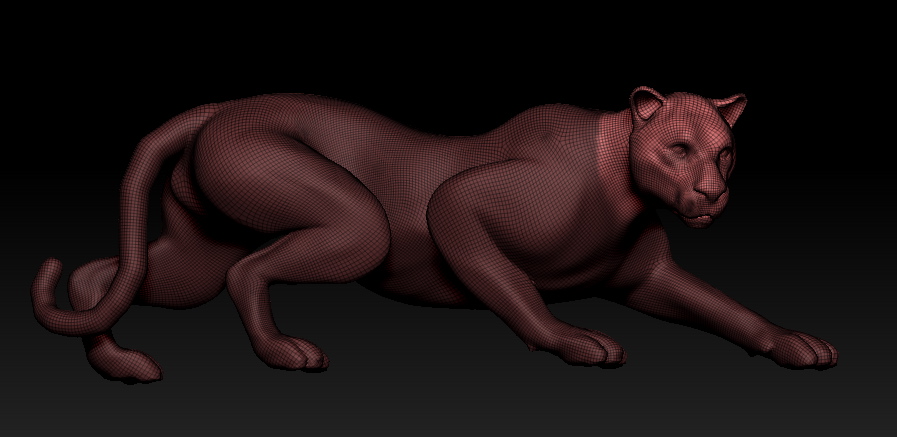
With the melding of digital technology in my traditional sculpture studio optional technology is definitely a possibility that I am curious to explore. If you follow the blog on the Panther Project you know that the original panther design was created in the computer, and enlarged by SNYAPPSYS Digital services in foam. Clay was added to the foam for the final version. It was then put through the traditional mold making process for bronze casting.

This digital process of enlarging expedites my work tremendously. The difficulty is that digital models, as seen in the computer, rarely translate well to real life. There were many modifications that I did on the large panther. As the blog shows, I carved on the foam, accentuated muscles and features so that it would translate well into bronze and in some places even lengthened or added to the figure. I also modified the pose.
So, I’m back to the digital drawing board. I am opening the original file of the panther and comparing it to my traditional bronze piece. My goal will be to do more work on the digital version and experiment with printing it using the 3D printing process.
The program that I am sculpting in is ZBrush. I’m exploring the new features that are available in Zbrush 4R4 that were not available when I created the panther just a year ago. Features like QRemesher that helps me to retopologize the panther, or fix the geometry, so that I can create a better digital sculpture. I’ll report back on how the digital sculpting progresses, as well as how the 3D printing process comes along.
Project blog for the Prairie View Panther can be found at https://prairieviewpanther.blogspot.com/