
Newsboy-Correcting The Metal
April 12th-May, 2005
Sculptor Bridgette Mongeon has documented the entire process of creating a figurine of a newsboy and a life-size bronze sculpture. Watch the artist work through these posts. In this blog, she has also included information for students and teachers. In the previous post, we watched the foundry put the metal together.
If you are lost and want to go back to the chronological running list of posts, follow this link.
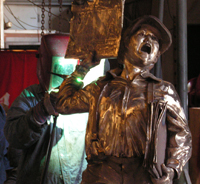
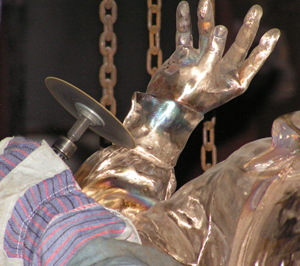
We have just seen how the metal was made, and how it was put together. Time to correct the metal. The newsboy is all together, or almost together. I am making several trips to the foundry to be sure that everything is the way it should be. Walking around the sculpture I circle different areas with a marker. The foundry then can be sure to look more carefully at these areas. We did have one major change. After looking at the sculpture with the newspaper in his right hand I did not feel that the hand was positioned in the way that I sculpted it. Maybe something changed in the wax or when attaching the many pieces. So, they cut off the arm at the cuff and turned it. Then welded it back on again. It amazes me what these guys can do.
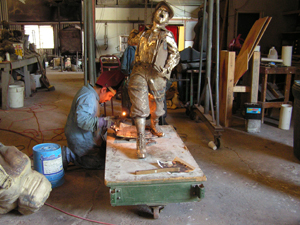
Once the arm was welded on we went to the newspapers at his feet. The newspapers were created so that they would balance tech heavy metal sculpture. They waited for me to position the papers and the carefully welded them to his back foot.Now that the sculpture is approved and together they will sandblast him one more time and we are on to the final process. The patina!
Don’t stop now, watch the next part of the process and the Completion of the life-size Newsboy sculpture.
Newsboy-Putting The Metal Together
March 16-April 30, 2005
Sculptor Bridgette Mongeon has documented the entire process of creating a figurine of a newsboy and a life-size bronze sculpture. Watch the artist work through these posts. In this blog, she has also included information for students and teachers. In the previous post, we watched a bronze pour.
If you are lost and want to go back to the chronological running list of posts, follow this link.
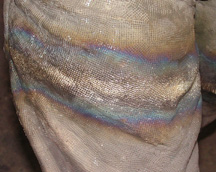
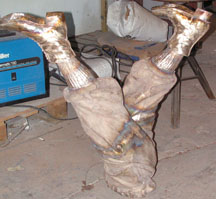
It is so much fun to pop in at the foundry and see the newsboy come together. The first day that I came to see how the metal was coming along I was greeted by these upside down legs. It made me giggle. Miguel, the foundry craftsman was working diligently on the metal. Each piece of the sculpture, once the ceramic shell is broken off of it, and it is sandblasted, is gone over very carefully by the craftsman.
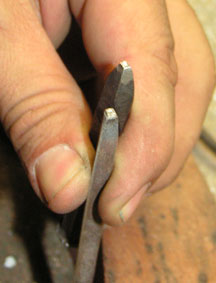
copy the artist’s texture.
I was quite concerned when they cut up the legs of the newsboy the way that they did, so they wax could be dipped and then it could go to metal. I knew they would have to weld these pieces together and I had put texture in the knickers. If they welded the legs together they would have to match my texture. Miguel, the foundry craftsman is absolutely incredible. He made his own tools and then painstakingly pounded the texture into the legs. Amazing!
Piece by piece the sculpture is being welded together. You can see that things are really coming along. With cutting and piecing at so many different steps in the process, it is a relief to see the newsboy back together and that everything is fitting. The newsboy has a handle on his head. This handle is to be able to keep the sculpture standing when they are fitting the pieces together. We are getting closer and closer to finishing.
Time to move on. There is more to do with putting the metal together and Whoops! There was an error that needs correction.
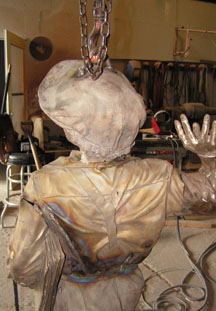
the newsboy’s head. This helps to hold him
up while the foundry works.
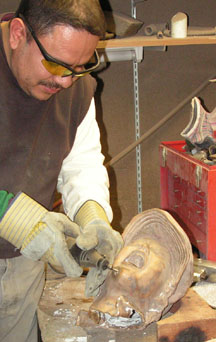
Life is Full of Change- In Memory of My Art Studio at 1048 W 25th.
Houston Tribune
April 2005
Bridgette Mongeon © 2005
It is interesting how inanimate objects and memories of them can reflect the changes that have happened in your life. Finding and having a place to create is imperative to all artists.
There comes a point, especially for a sculptor, when having space outside of your home is not only needed, it is necessary. This was first displayed to me many years ago when I tried to pour a terracotta slip mold in my formal living room that was then dubbed “studio space.” My daughter was all of six or seven at the time. First, let me explain that slip has the consistency of cake batter. This is poured very carefully into a heavy, multiple piece, plaster mold that is securely fastened with rubber bands or straps. The operable word is securely fastened. It was my first time pouring a slip mold, and those straps were not as secure as I would have liked them to be. Brown slip came gushing out of the unsecured crevices, pouring all over the hardwood floor. My daughter looked on in horror as she tried desperately to help me collect what had come out. Both of us were laughing, our hands caked with the batter. I seem to remember that somehow brown splatters ended up on the cream-colored drapes and walls. When it was all done, my daughter in her incredible childlike wisdom that would often blow me away said, “Momma, this seems like something you should pay someone else to do.”
The demise of hardwood floors and drapes were not the only thing that suffered from my lack of an appropriate space. I’ll never forget taking the fax machine in to be repaired. It seemed extremely temperamental and was always breaking down. The service man opened her up and replied, “Lady what are you faxing through here anyway? There is a terracotta dust everywhere.”
It was over 15 years ago that I drove through the Heights area searching for studio space. I would look at old buildings like most women my age would look at a potential boyfriend. My heart would beat a little faster; my gaze would be with longing and desire. I had to be close, see all there was, explore all possibilities of developing a long-term relationship.
I examined many buildings. The old house that used to stand behind the paper mill and the seed bins on Montrose. It was torn down years ago. I examined the clock tower behind Fiesta and the second floor of what was then Grace Equipment. It was an enormous space and a little creepy. Oh, that time of searching was filled with a lot of fence hopping and pleading for audience with property owners.
It was my good friend Harry Shepherd that led me to my present landlord. Apparently both the landlord and I had a fondness for jazz and for Harry’s awesome playing. My landlord Don Shaw was a long time painter and artist of Houston, and he told me about the studio space. It had been his painting studio for years. I could not wait to see a space that might be called my own.
The old shotgun house sat back within the property; no curtains were on the windows, and I could get a good glimpse of the potential space. The fenced yard housed two large oaks that seemed to nestle over the building like a mother bird’s wings over her young. The yard looked ominous with abstract sculptures and found items strategically spread about. Standing along the back fence was a wooden cutout of a figure with what looked like matted hair blowing in the wind. There are also large sharp metal sculptures with piercing pieces threaded through them; these sculptures have a foreboding look of teeth. All of the yard art seem to keep intruders away. People seem to have both an intrigue and a fear of the property.
I was glad to move in to the place and call it my own.
All those years ago, the studio seemed so big, and my daughter seemed so small. I painted the kitchen a salmon color with teal accents and had Christina paint her small palm print and stamp the wall and the door. Intentional drips of alternating colors fell from her delicate little hand.
Chris’ handprints were not the only ones in the studio. Any visitor that I could entice marked the bathroom door; the palm print was always accompanied by a personal signature and message, “May all your dreams come true, let your heart soar, here is to making money with your art” and many more.
So many memories happened at that studio. My daughter would come there with me late at night, shower in the shower, and take a nap on the cot in the kitchen while momma worked. Often we would have First Thursday Art shows always accompanied by a creative endeavor, a creative event that all attendees could participate in. For one show there was “shoot the sheet.” All participants would shoot the hanging sheet with water pistols filled with fabric dye. For another event there were the sculptures of found yard objects. There were paper airplanes at yet another event, and there is still a paper airplane caught in the rafters from that escapade. The mud pie contest never went over big. I was surprised at how many people do not like to get their hands dirty, but there were a few strong contenders for first prize.
There were visiting artists at each show, usually painters that would hang their work on the back wall. Each of us would invite our own set of friends and pitch in for the wine and cheese. My daughter would dutifully monitor the serving table, great hostess that she is.
I think everyone’s favorite event was the upside down Christmas party. Each year I would hang a Christmas tree upside down from the ceiling of the studio. It was strung with lights and the tree skirt was tacked to the ceiling. Every person coming to that art show was asked to hang an ornament on the tree, but it had to be something that was on their person or in their car. Amazingly, we have quite a few Halloween decorations on the Christmas tree. Each year I saved the ones from the year before, except for the few pieces of paper money that were folded into origami patterns. They made a wonderful decoration, but I admit that they were also appreciated for the financial worth by a single mom who was an artist trying to make ends meet.
I have met incredible people at 1048, the relationship of students that would take several articles to report. There were also multiple interviews with reporters. I’ll never forget the day that PBS did the special about me back in 1990. Producer Manny Santos went to all lengths to get exactly what he wanted. He even brought in a smoke machine to give some mystery to the sculptures. The studio was so filled with smoke that we had to exit the building for air as we watched the billowing smoke gush out the door and up to the mothering trees. The special effects apparently worked, for that artist documentary won an award for PBS and Manny Santos.
My dogs, Emmy and Chas, often came with me to the studio. It was a welcome play date for the current neighboring dog that shared the property with their master and myself. There were several of those dogs. Maggie, a black chow, was a fence hopper nothing we could do could stop her. Maggie seemed to come with the property, being adopted by the Mike when the prior neighbors moved out. She is gone, but there is a wonderful marker created by artist Mike Robins in her memory. There was also Nina, a chocolate lab, weimaraner mix. Though she and her master have moved, we still get to see them both and often baby-sit for Nina whenever possible. Then there was Max, a stately black lab, who I am told has a wonderful new home in the country. He too was another fence hopper. Presently it is Coffee, a chow and Violet who is a mutt.
My work has changed, as have the years. My sculptures have gotten larger, and I am happy to say in more demand. The studio has served me well, though it has grown weary with its age, and the dampness seems to affect us both. It now goes the way of the rest of 25th and the Heights. It will soon be scheduled for demolition. Torn down for newer homes. I have watched the back hoes come through tearing down everything in sight, snapping trees like toothpicks and pulling them up from their roots. All in the name of progress. I do hope they save the oak trees at 1048; they must be over 100 years old. It is one thing to move away from a place and be able to come back to it. It is an entirely different thing to see it demolished. I’m sad to see it go. When I move, I will take a few things. I plan on cutting my daughters palm prints out of the sheet rock, taking the hand print door, and keeping Maggie’s memorial.
As sad as change can be, it can also be good. Since that first day of moving in nearly 15 years ago the studio has grown increasingly smaller, and my daughter has grown into a woman. I’m planning my new space and happy to report that there is plenty of work that is already contracted to be created in the space. Remember that six year old little girl who napped and created and played hostess? Her wedding is scheduled for 2007, and I know that not long after that I’ll have other children, grandchildren to entertain and create with in my new studio space.
The space at 1048 West 25th has always been about creating art. I am very blessed to have had it. It is, however, amazing to think of the many, many memories that were also created along the way.
All written work is copyrighted and cannot be used, whole or impart,
without the written consent of the author.
Newsboy-The Metal Pour
March 8-15, 2005
Sculptor Bridgette Mongeon has documented the entire process of creating a figurine of a newsboy and a life-size bronze sculpture. Watch the artist work through these posts. In this blog, she has also included information for students and teachers. In the previous post, we learned about the dip and making a ceramic shell.
If you are lost and want to go back to the chronological running list of posts, follow this link.
It was exciting to get a call from the foundry, “We are going to pour tomorrow, if you want pictures come on by.”
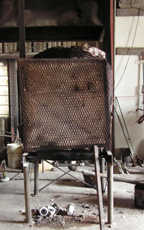
oven so that the wax can
burn out. In this cavity the
metal will be poured.
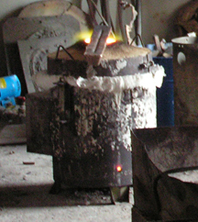
The foundry was a buzz with activity. The furnace roared in the corner announcing the event. The craftsmen had just poured one set of bronzes, which were glowing red on the pouring table. I shot some pictures of the glowing bronzes and then spoke with Scott, the foundry owner, about the rest of the process.
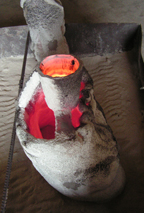
Wax is melted out and
it is ready to receive
the molten bronze.
The furnace is heated up to 1,950-2,150 degrees. Everdure bronze ingots consisting of copper 95.0%, manganese 1. %, silicon 4%, and other trace elements were resting on top of the lid of the furnace. I was told that it was important to heat them up and make sure there was not any moisture in the ingots. If there happened to be any moisture in an ingot when it was added to the molten bronze, a steam explosion could happen causing molten bronze to go everywhere. We had to wait a good 45 minutes for more bronze to melt before we could see the second pour.
Meanwhile, remember our dipped pieces of wax that were covered in a shell? The wax is burned out of the shell in a furnace, thus the term “lost wax method” of bronze casting. Once the shells are heated up again (the 1,200 degree furnace is shown to the left) they are ready to receive the molten bronze.
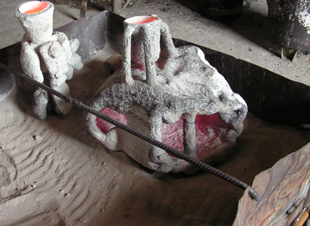
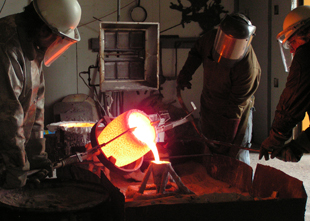
The heated shells are poured while they are balanced in a pouring table. This table, filled with sand, helps to contain any bronze that should come out of cracks, should our shell have some problems.The crucible holds about 140 pounds of molten metal. Scott tells me that it is not just the heat of the process that is tiring but also the lifting of the heavy crucible. For safety reasons they only pour 3-4 crucibles a day. It takes three people to pour. Someone guides the crucible – the lead pourer, while the second person helps with balance- the deadman. A third person is there for safety and skims the crucible of impurities before it is poured.Before we knew it the pour was done! Our shells had no problems and held all of the bronze quite nicely. After an hour or so the pieces are removed from the sand pit for devesting. With hammers and chisels the shells are carefully broken off of the newly cast bronze pieces. All of the gates and cups that poured with the bronze art will need to be removed and the pieces will be sandblasted.
Now that all of the pieces are poured the foundry brings our Newsboy to the next step- welding him together.
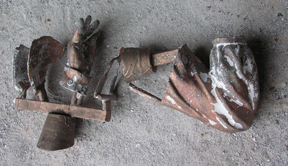
breaks off the ceramic shell.
STUDENTS AND TEACHERS
If you would like to know more about the bronze casting process watch this video from another one of Bridgette Mongeon’s projects. Want to know more about the making of metal over time? Check out this website that includes a wonderful infographic on the metals over time.
Returning To College
Houston Tribune March 2005
Bridgette Mongeon © 2005
When entering the movie theater these days, I receive two dollars off of my ticket. Often the attendant examines me with a little disbelief, demanding some proof of identification. Its not because I am a senior citizen, instead I show my student ID.
In the past a stereotypical image that most hold of a college student is a young person 18-20 years of age, with a non declared major, who is more excited about the social aspects of college than the educational aspects. However this image is quickly changing. Students are entering college in their 30’s, 40’s, 50’s, and even later in life.
Categorized as “non-traditional student,” older students face their own set of circumstances that are different from the stereotypical college student. Sure, we may have to learn how to focus and take notes, all while looking through our progressive lenses, but there are other circumstances that younger students do not have to deal with. Older students have the emotional and financial responsibility of ailing parents and they may also have their own children in college. Most have established careers and full time jobs. They have many years of experience in the field of their choice, but many are concerned about losing their jobs because of a younger, degreed person coming up in the ranks. Many people are finding that as the job market becomes more selective and age becomes a factor in the decision of placement, a degree and sometimes advanced degrees are essential.
DISTANCE DEGREES
There has been a rise in adult learners in higher educational learning of 41% since 1998 according to the National Center for Education statistics. Many nontraditional students are getting these degrees and never taking a step into a physical building. With online education and the help of a computer you can study from the comfort of your own home at your convenience.
By logging into a virtual classroom with other students, distance education makes learning convenient. For mothers with children, they can put the children down for a nap, put a load of clothes in the dryer, and log into English class.
DON’T GET SCAMMED
Many people are worried about getting duped by diploma mills, spending hours of work for a bogus degree. Mark Wilson, author of Distance Degrees, has made the college search much easier. The book is filled with 400 accredited colleges that offer distance learning for many different degree programs, and the resources are growing every year.
When searching for a college the question you want to ask is “are you regionally accredited?” The United States Department of Education has divided the country up into 6 regions. There is an accrediting agency for each area. The Secretary of Education has procedures and criteria that are followed by each of the accrediting agencies. For example The University of Houston has received its accreditation from Southern Association of Colleges and Schools, Vermont College by the North Central Association of Colleges and Schools and Thomas Edison by the Middle States Association of Colleges and Schools. Some college diploma mills will state they are accredited, but you must find who does the accreditation. If it is not one of the 6 regions then the college may not be worth your time. If you are unsure if the college you are interested in is accredited, you can check out the department of Education Website www.ed.gov . Mark Wilson in Distance Degrees has also listed each college’s accreditation and listed a link to the associations that do the accrediting in the 6 regions as well.
CREDITS FOR EXPERIENCE
Colleges offering class for non-traditional students realize that life experience is an important element of education for older students. Many colleges offer credits for the experience that an individual has attained through their life times. This doesn’t have to be experience in things as elaborate as business or science, in fact many times homemakers can find experience that can apply to college credits. Thomas Edison State College http://www.tesc.edu/ has a resource section to help determine if your past experiences can apply as credit. Each college handles Prior Learning Assessment (P LA) differently, some accepting portfolios, others requiring essays or individual interviews. Many colleges offer up to 30 credits for PLA.
CREDITS FOR WORKSHOPS
If you have attended workshops in your field, even if it was learning that was acquired through a non-accredited institution, it may apply to credits toward your degree. You may; however, need signed documentation from the instructor. Contact the university that you are interested in to discuss the possibility of accepting these credits. And if becoming a returning student is in your near future, be sure to ask for documentation from any non- accredited workshops that you are presently taking.
CLEP (College Level Examination Program)
There is a variety of CLEP test that you can take for a nominal fee. Often one CLEP test can constitute the credits of two classes. The credits will then apply to your degree program. CLEP study books can be purchased from any bookstore. Each book is filled with sample tests and information on what to study for a CLEP. Up to thirty additional credits can be obtained through CLEP examination.
TRANSFER CREDITS
Even if you went to college 20 years ago and did not finish your degree, many colleges will accept these credits toward your degree program. You may need official transcripts sent to the college of your choice; however having unofficial transcripts on hand will help you to obtain and remember, the number of credits you have. To receive your old transcripts, contact the college that you attended. There may be a small fee involved in receiving transcripts.
ACCELERATED LEARNING
Colleges understand that non-traditional students are professional, experienced, and disciplined individuals and many offer accelerated programs offering degrees at both bachelors, masters, and some even offer PhD’s in a shorter amount of time and less “in class time.” For example, a bachelors degree may take you 4 years at a traditional college as a traditional student but can be obtained at some universities in half the a mount of time.
A DIFFERENT WAY TO LEARN
When you think of going back to school you may be visualizing yourself in a class with many young students, some who are one-third your age. Or if you have a sense for computers, you may be able to comprehend an online course and distance education. Some colleges such as Vermont College Union Institute offer an even better way to obtain your degree. If you are a highly motivated individual you might think about working for your degree doing what you already do and love. Instead of trying to fit student’s into developed classes and degree programs, Vermont College designs a program around what the students passion is or the direction they want to go. This enables “learners” to be able to receive their degrees without having to change their focus.
After taking several online courses myself, through Houston Community College, I am presently transferring my credits to Vermont College. Through their program, they will be able to take the articles I write for the Houston Tribune, the books that I am working on, as well as the sculpting that I am presently doing, and with the help of a mentor, develop and use my work as the main portion of my degree program. I will have to travel to Vermont twice a year for a week each semester. This type of learning has been dubbed “click and brick”. A portion of time spent at the college and the rest on the computer. I can think of worse things than traveling to Vermont during maple syrup time and again in the fall to watch the leaves change. I’ll be staying in the dorms like a traditional student would. (Which my own college student daughter says is “really weird.”) In my week visit, I’ll meet with my mentor to discuss my degree plan (work load), visit with other students, and attend workshops, all the while meeting other highly motivated individuals in an academic setting.
NEVER TOO OLD
It is normal for non-traditional students to think they are too old to go back to college. However, Hazel Thompson was Houston Community College’s oldest person, graduating at 82. Her credits were 50 years old and transferred into the program. Vermont College Union Institute tells me that the demographics of the students attending their bachelors program is 35-38 and for the masters degree programs 48-50. However they had a woman receive her bachelor’s degree at 77 and another who received her PhD at 92.
And, remember going back to college just may be good for your health and mind. Current advances in brain research by AARP states, “ Exercising your mind may forestall mental decline by strengthening connections between brain cells. Intellectual challenge seems to be crucial.”
You are never too old and it is never too late. Non-traditional students not only have much to gain from attending college and receiving their degrees, they have much to offer the institutions that teach them and the work force that utilizes their education.
Though we non-traditional students may not be having dorm parties like traditional students do, perhaps one day all of us older students can get together for a college night a the movies and use our student ID’s. For the record, if you are a senior and a student there is no additional amount taken off of your movie ticket. I have already asked!
Distance Degrees– Mark Wilson http://www.collegeathome.com/
Thomas Edison State College http://www.tesc.edu/ (888) 442-8372
Vermont College Union Institute http://www.tui.edu/VC/ 800.336.6794
Houston Community College http://www.hccs.edu distance education 713-718-5275 de.counseling@hccs.edu
Bridgette Mongeon is a writer, sculptor and soon to be student of Vermont College Union Institute.
All written work is copyrighted and cannot be used, whole or impart,
without the written consent of the author.
Newsboy- The Dip
March 1-7, 2005
Sculptor Bridgette Mongeon has documented the entire process of creating a figurine of a newsboy and a life-size bronze sculpture. Watch the artist work through these posts. In this blog, she has also included information for students and teachers. In the previous post, we learned a little about cleaning the waxes that we got from the foundry.
If you are lost and want to go back to the chronological running list of posts, follow this link.
The sculptor went through great
pains to create an entire sculpture
and it is cut into pieces for bronze casting.
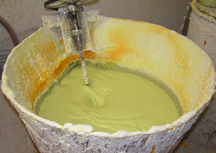
Now that the waxes that we worked on have been gated up by the foundry, and degreased, they are ready for the dip. There are two slurries, a thick and a thin one. The first dip is in the thick slurry. The color of the slurry is just something that is added to help the foundry craftsmen see the drying process of each dip. Once the piece is dipped in this liquid it is then sprayed with fine sand. These first two coats of dip and sand are to hold the detail of the piece. The dip room is kept at a certain temperature. If the temperature fluctuates in the dip room it could affect the shell that is being built, and then when they try to pour metal into this shell it could crack. You can only imagine what a problem that would be, molten bronze going everywhere.
Two coats are not enough; there must be several more coats of shell. The latter coats are for strength and have stucco in them. There are a total of 5-12 coats with 1-2 dips per day. It took a week to dip our entire sculpture.
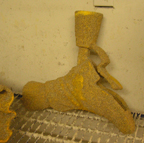
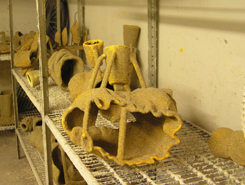
shows the pouring cup.
Each of the wax pieces
has gates that help
the gases escape and
the metal pour properly.
To the left you can see the upper torso and several pieces of the newsboy on the shelf. These photos give you a good look at the pour cups and the gating. Do you see the shoe? You can see how the bottom of the shoe has been cut as well. The photo to the left shows the upper torso. It appears they have cut off the newsboy’s head and arms as well. These photos show only the beginning of the dip. Once these dip pieces are ready. They will go to the furnace to be burned out and the metal will be poured.
Newsboy- Working the Waxes
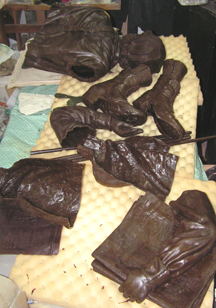
All of these will be made into metal.
February 22-28, 2005
Sculptor Bridgette Mongeon has documented the entire process of creating a figurine of a newsboy and a life-size bronze sculpture. Watch the artist work through these posts. In this blog, she has also included information for students and teachers. In the previous post, we learned a little about pouring the wax at the foundry.
If you are lost and want to go back to the chronological running list of posts, follow this link.
The steps to the bronze process never cease to amaze me. Here are some of the many waxes that came from the molds, of the newsboy sculpture. Over the years, whenever I pour in bronze, I have always worked my waxes. Not all artists do this. Many times the foundry will do the basic work. Now I have my assistant do that part, but I always like to add my own touches to each wax. You can imagine that even though this life size newsboy is an edition of 10 and the smaller newsboy sculptures are editions of 100, each number sculpture in the edition may be a little different. Because there are many pieces to put together for each finished bronze the finished sculpture will have its own nuances to it.
My assistant, Miguel, and myself spent hours making sure that each wax seam was cleaned up and that each piece not only fit to the other wax piece, i.e., front to back but also to each other, i.e,. leg to foot. Though we do a lot of fitting in the wax, some fitting will also be done in the metal.
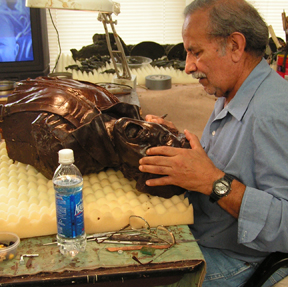
the studio. We need to clean up all of the waxes.
You can see by the many pieces placed upon the egg crate foam, the lower torso was cut up into several smaller pieces. This is done for several reasons. You will see later that the foundry will cut up the sculpture even more. It is important that these pieces should not be too cumbersome through the next steps of the process. Weight and ease of handling will be an issue when the pieces are being dipped or when the metal is being poured.
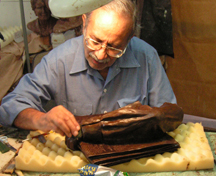
When I finish this part of the wax I will bring the many body parts back to the foundry for the foundry to gate up. Gating up is the process of adding wax vents and pour cups. The master foundry craftsmen want the molten metal to pour very smoothly so they add these vents to facilitate that process.
So, it is back to the foundry for gating up and making the shells.
Newsboy- Pouring The Wax In The Mold
mold and rolled around.
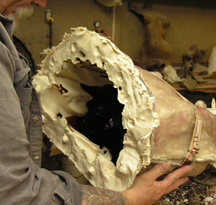
A thin layer of wax is
all that is needed
for the sculpture.
February 15-21, 2005
Sculptor Bridgette Mongeon has documented the entire process of creating a figurine of a newsboy and a life-size bronze sculpture. Watch the artist work through these posts. In this blog, she has also included information for students and teachers. In the previous post, we learned a little about the making of the mother mold in fiberglass.
If you are lost and want to go back to the chronological running list of posts, follow this link.
It is taking us some time to make all of the mold for the Newsboy. We took several of the mold pieces to the foundry to pour waxes. Once they are poured, we will be able to take these waxes back to the studio to work on them a bit more. Within the next few weeks the entire wax will be at the foundry, and at that point it will be ready to go into metal.
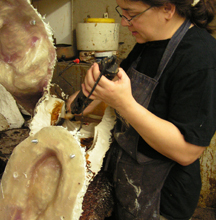
Here we are at the foundry pouring the wax into the upper torso. The wax is very hot. It is poured into the mold and carefully turned to cover the entire upper section. It must be just the right thickness. Any excess wax is poured out before it cools. Not only do we have to pour the wax upper torso, but we also have to pour the right arm, the paper that the newsboy holds in the right hand, the left arm and paper, the brim of the hat, and the papers that will sit on the ground. The lower part of the body will not be poured; instead it will be brushed on. Once the sections, front and back of the lower half, have cooled they will need to be put together.
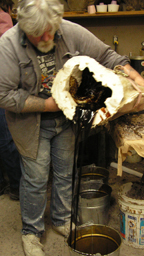
into the mold and swirls
it around and pours it out.
They will do this several
times to get the right
thickness of the wax.
The metal will be as thick
as the wax.
Now that the waxes are poured, it is time to clean up the studio. That way we can be ready to bring the waxes back to work on them. The platform was taken off the floor this week, and it felt so good to be able to have a little more space. I danced through the area. What is left of the newsboy sculpture is lying in a heap on the floor. The original sculpture is lost in the mold making process. I’ll soon disassemble him. The clay body parts will be going into a big bin to be melted down for the next projects, a six year old ballerina a two year old little boy holding his truck or Patsy a woman sitting on a park bench. Yes it is a little strange to see a hand melting in the crock-pot, but it is always good to be able to reuse material.
With everything cleaned up in the studio we are ready for the next step, to get the waxes from the foundry so we can make them perfect.
Newsboy- Rubber and Fiberglass
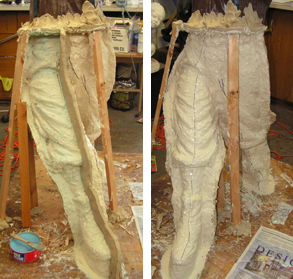
fiberglass mother mold is added
to the mold. It is created in parts.
February 8-14, 2005
Sculptor Bridgette Mongeon has documented the entire process of creating a figurine of a newsboy and a life-size bronze sculpture. Watch the artist work through these posts. In this blog, she has also included information for students and teachers. In the previous post, we learned the first part of the mold making process.
If you are lost and want to go back to the chronological running list of posts, follow this link.
Making molds is grueling work. We have just finished doing the rubber. Now on to the next stage of the mother mold. The days have been long and the nights even longer. Many nights I have worked until 1:00 a.m. I am glad the difficult part of this sculpture is almost over. I am exhausted, and I am finding that I need to rest my hands every few days.
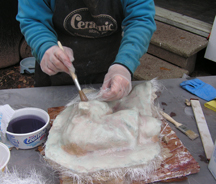
fiberglass. This is called the
mother mold.
The mold is complete now; however, there are a few things for which I am working to make it perfect. Here is a little more about how the process went.
THE PROCESS CONTINUES
To the right you can see the rubber on the front of the mold. After the rubber, the fiberglass mother mold is applied.
Making a fiberglass mother mold is an itchy, smelly process. Remember I have decided to create a fiberglass mother mold because it will store easier and will be lighter. I had to complete the front part of the rubber and create the mother mold section in several pieces. The photo in the upper right shows my marks on the rubber where I am going to make the fiberglass seams.
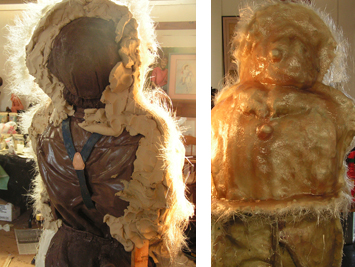
Soon that will harden and the seams will
be taken off so we can do rubber and clay on the back.
When creating the mother mold, sometimes it needs to be divided up into sections, as you can see with the front of the mold. These sections are so that the mother mold can be pulled from the rubber without hurting the wax that will be poured inside.
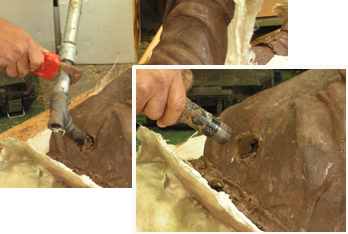
support out of the sculpture. Then the area will be
sculpted before the artist makes the rubber
mold with a fiberglass mother mold.
I worked on the entire front of the newsboy. Here you can see the fiberglass mother mold from the front and back before the edges are trimmed up.
Once the front of the sculpture was done, it was sturdy enough for me to lay the sculpture down. You might remember there was a pipe armature in the newsboy’s back. This was to hold up the entire sculpture while I sculpted. I could not make the mold around this pipe so we unscrewed the pipe from the base, laid him down and the unscrewed it from his back. Then I filled in the hole before we preceded with the lower half of rubber and mother mold.
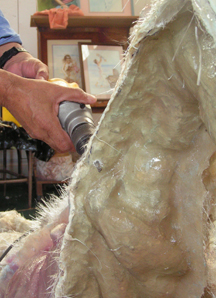
Once all of the rubber was brushed on the sculpture, and then each piece of the mother mold applied over the rubber then we had to drill holes in the seams. That connected the pieces. Later nuts and bolts will hold the sculpture together. These will not only secure the sculpture, holding it together, but will assist in quick demolding. Trying to pull apart the mold for the first time, after all the rubber and fiberglass are done, is a job that requires some muscles. My fancy white suit protects me from the pieces of fiberglass.When all of the pieces are off the original sculpture, the edges are ground down to form a smooth edge and each piece is sanded. The rubber needs to be cleaned before wax can be poured into it. Everything is reassembled for our trip to the foundry and to pour the waxes. The original sculpture is lost in the demolding process.
On to the foundry and pouring the waxes.
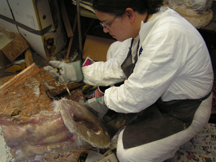
to work in fiberglass.
Newsboy- The Mold Making Process
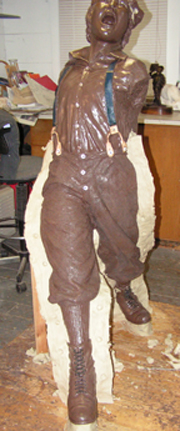
pieces and a mold is made.
Clay seams are put up each
side to divide the sculpture in half.
January-31-February 7, 2005
Sculptor Bridgette Mongeon has documented the entire process of creating a figurine of a newsboy and a life-size bronze sculpture. Watch the artist work through these posts. In this blog, she has also included information for students and teachers. In the previous post, we rejoiced that the sculpting is complete.
If you are lost and want to go back to the chronological running list of posts, follow this link.
Now that the sculpting is complete, let’s move onto the next portion of this process. The mold-making portion of the sculpture is underway. It is a lot of work and very physical. First, we cut off both of Dusty’s arms. This will enable us to pull the mold off of the sculpture. I also cut off the brim of his hat. I probably could have left it on, but I felt more comfortable cutting it off.
The process of making this mold is similar to the small newsboy sculpture mold. We are making a mold so that we can pour a hollow wax newsboy. To do this we sprayed the sculpture with a sealant, and then with a mold release agent. Layers of rubber are carefully painted on the sculpture. When they are dry, an outer mold called the mother mold is placed over the rubber. It is called a mother mold because it holds the rubber in place. If we just had rubber, then when we pour wax into the mold it would become distorted. The mother mold helps to keep the form.
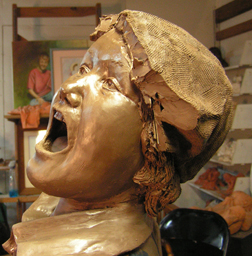
This will make it easier for the
artist to get a good mold of his face.
The head is prepared to go
into the mold making process.
I have documented another mold making process on my web site. The Kipper Mease mold is different than this one. Kipper’s mold was done with a plaster mother mold. This newsboy mold will be done with a fiberglass mother mold. Fiberglass mother molds are difficult to make, but they are lightweight and easy to store.
Once I have the mold, I will take it to the foundry and together we will pour waxes. I still don’t like to let go of the project yet. I will take the waxes back to the studio and work on them as well. When I am sure they are ready, they will go back to the foundry, and then my workload and long days will slow down for a bit. But just a little while. I still have some commissions that I have not been able to finish in the rush of completing the newsboy, and I have two more life size pieces that need to be started in the next few weeks.
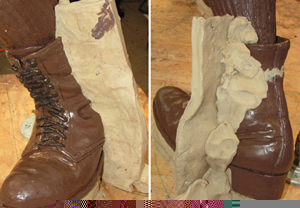
THE PROCESS
The sculpture is divided up into sections by what is called “claying up.” The the clay is carefully put on the sculpture. The front of the sculpture is what we are going to focus on first. You can see most of the seams of the lower half in the photo above. It does not; however, show the seam that will divide the torso in half.
Once the claying up process is done, I will coat this first section with coats of rubber. Each layer of rubber must cure to the correct consistency before another layer is put on. There is a total of 4-5 layers of rubber.
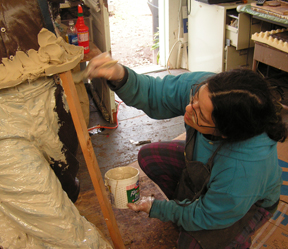
The rubber on the main sculpture is divided up into 4 pieces- front lower torso, front upper torso, back upper torso, and back lower torso. Each front section must be clayed up, and sprayed with mold release. Rubber must be painted on and then finally a section of mother mold applied to the top of that. Once one section is complete, then I can start on another section. It is a long process. While the rubber cures, I will work on other parts of the sculpture. The stick next to the sculpture, in the photo to the right is to help hold up the seam of clay.
Remember, I have several pieces that I have cut off the sculpture. Each of these needs to be clayed up and then rubber painted on each side. The left arm with the newspapers is shown in the photo to the left. Knowing how to clay up a piece takes a lot of thought and practice. You must be able to think ahead to the next steps that the piece will go through— the wax, dip and casting. Now, let’s move along in our process of making this sculpture into a bronze. On to making a mother mold with fiberglass.
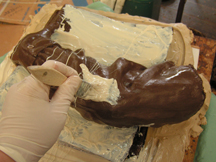
clay. And a mold is made of both
newspaper and arm