
Deadlines Postponed- Sculpture Is In Pieces!
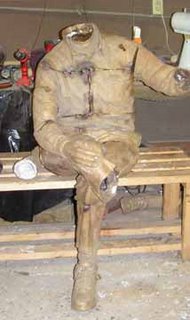
The sculpture unveiling is rescheduled for the end of September. Which will be a great time to visit Vermont, where Dick Hathaway is going. We figured a September unveiling would bring more people. While visiting the foundry the other day I took this picture. I’m creating a video on the casting process and will post it soon. It is hard to believe that the sculpture is cut into so many pieces and put back together again.
Every Creative Person Should Read This Article!

Here is the new article at Best of Artist and Artisans “You Could Lose your Rights” Please do not take my word for what the government is about to do to our rights as an artist, writer etc. Check out the links in this article. I have included many resources.
Mold Making and Bronze Casting- Part II
Created for Best of Artists and Artisans Website
By Bridgette Mongeon © 2008
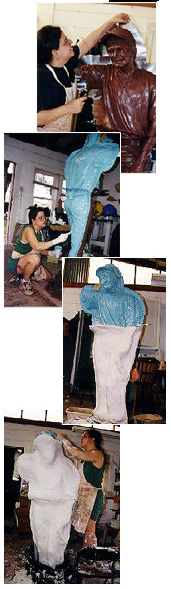
THE MOTHER MOLD
In the previous article Mold Making and Bronze Casting-Part I, we learned about preparing your sculpture for the mold making process and painting rubber on the sculpture. If you want to see a mold being made please refer to the video, The Casting of the Dick Hathaway Memorial. The video has been embedded in the online article Part 1. I will refer to this video often in this article. In Part II, I would like to talk about the process of creating a mother mold. Once this portion of the mold making process is complete, your molds can be cleaned, sent to the foundry, and waxes can be poured into the molds. Your artwork then begins its journey through the foundry process and through the lost wax method of bronze casting.
Mother molds are called mother molds because they hold the rubber in place. Your rubber may have been created in two or more pieces or sometimes one piece with a seam up one side, but a mother mold must be able to be pulled off the artwork, and it will not have the flexibility that rubber has. To be able to take the mother mold off the sculpture, it may entail visually dividing your sculpture up into more sections for the mother mold so that the pieces can be pulled off without any force or prying that may destroy the wax that will be poured into the mold later at the foundry. Drawing with a marker on the cured rubberhelps to define the mother mold sections. You will “clay up” seams, just as with the rubber portion discussed in Part I, claying up the sculpture along these marker lines in preparation for the plaster.
NOTE: You must “clay up” before putting on the mold release, or the Klean Klay will not adhere to the rubber. To make the Klean Klay adhere warm it up in a microwave as in the rubber stage and push it onto the dry rubber. Thicker “clayed up” seams are preferred over thin seams in both the rubber stage as well as making the mother mold seams. There is nothing worse than having a clayed up seam break loose while making the mold.
Mother molds can be made in a variety of different products. Most artist use a type of plaster called Hydrastone. Hydrastone is much stronger than Potter’s Plaster. You may be able to purchase Hydrastone from your art dealer, but most likely it will cost more than getting it from a supplier. I purchase mine from Circle Supply in Houston, Texas. A 100-pound bag of Hydrastone at Circle Supply costs $32.89. I went through three-100 pound bags on the Dick Hathaway sculpture featured in the video.
Mother molds can also be made in fiberglass. If I know I will be creating many pieces in an edition and I will need to obtain many waxes from a mold, I consider the extra effort of using fiberglass. You will be quite surprised how heavy a small mold can be with a mother mold of plaster. Fiberglass has its advantages for larger molds as well, because upon completion the mold is lighter. Fiberglass is, however, I believe, difficult to work with and toxic to use.
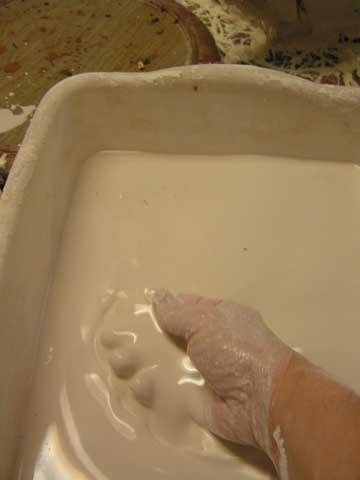
The plaster portion of the mold making process is the messiest part. In the past, I have fooled myself into thinking, “Just let the plaster fall on the floor and it will dry and scrape up easily.” This is just not so, and preparation of my space for making the mother mold is just as important as the rubber. It also makes clean up so much easier.
I usually like the rubber to cure a day before putting on the plaster, and often the plaster is done in conjunction with rubber. For example, if a mold is done in two pieces like the leg or arms in the video, I will paint rubber on one side then put the mother mold of plaster on top of that, and then flip the sculpture to do rubber and a mother mold on the other side.
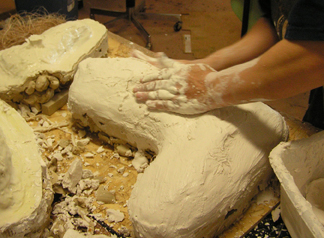
Before beginning to put the plaster on the rubber, you must note there is a process of preparing the rubber so that the mother mold can be pulled off the rubber. I mentioned this in Part I. This step is done in the rubber stage. This part of the process is not shown in the video and is a bit tricky to describe. Pieces of foam, the kind of foam that is in your sofa cushions, have been stuck to the rubber in areas of deep undercuts. Then a skin of painted rubber is put over the foam. The foam offers the “give” that the rubber mold needs to fold back on itself as it is taken off the wax that will be poured into the mold. It also gives a flatter surface with no undercuts for the plaster mother mold to be put on top. I will try to make a video or take detailed photographs of this the next time I make a mold.
Before applying plaster you should cover your rubber with a mold-releasing agent. An inexpensive source for this is simply using shortening such as Crisco or a store brand purchased from your local grocery store. Rub this over the entire surface. Putting your hand inside a plastic bag first helps to coat the rubber without making your hands gooey, an old cooking tip.
I usually have four plastic buckets, one that I am mixing in, one that holds a bit of hemp soaking in water, another that has extra plaster, should I need it, and another for washing my hands.
Mixing plaster is tricky, and you must watch it closely because when it activates there is little time to work. Working on smaller areas is much easier than a very large area. Be prepared to get dirty.
HINT:The Hydrastone makes these containers weak. I figure it must be a chemical reaction. Plus, I will often bang on them with a rubber mallet to get the hardened plaster out. When using the last bit of mixed plaster in the container, or if there is excess, try to scrape to the bottom in the center of the container. Then after the Hydrastone cures in the bottom of the plastic bucket, I can bang on the container freeing the two pieces into the trash can outside my studio and offering me a clean container to use for the next part of the mold. You will have to find just the right spot to bang on the container to loosen the plaster form the container without plunging through and breaking the increasingly brittle plastic. I prefer the rounded edge of the bottom.
HEMP: I purchased a bale of hemp, which will probably last me a lifetime. I might suggest you talk to your foundry or another artist and see if you can purchase some of their hemp from them. Be careful, if you buy a bale and clip those metal straps around the bale, the thing will explode, and you will be trying to figure out where to store all that hemp.
DO NOT MAKE A MOTHER MOLD WITHOUT HEMP. If you break your mother mold you have lost your piece. Hemp increases the strength of your mold, and if you are in a hurry, like I usually am, you are going to want to get this mold pulled and into production as quickly as possible. Molds, just after their completion, can be quite fragile.
Fill your plastic bucket with water to the amount needed for the amount of Hydrastone mixture you will want to use. I am not sure how to tell you how much to use; this knowledge will come with practice. Always mix the Hydrastone into the water. I start by making mounds of Hydrastone and letting them soak. You can get ratios from your Hydrastone supplier, but I really do this part by sight. Usually I add a bit more Hydrastone as I impatiently wait for the bucket to begin to “kick”. I mix all my plaster by hand and don’t use any mixers. This really helps me know the different stages of the plaster. It is something I do by feel. While the Hydrastone is soaking, I’ll take some of the hemp that has been soaking in water and arrange it over the rubber section that I am about to cover in Hydrastone, being sure to put some on the seam area. Then I will take this hemp off and dip it into the Hydrastone mixture and lay it back on the rubber. As the mixture begins to “kick”, I must work quickly, putting the plaster on the sculpture, forcing it into the hemp and building the areas that I need, including the seams. I strive to make the entire mold an inch thick or less.
When you are finishing the Hydrastone mother mold section and the Hydrastone is curing—you will know this is happening because it becomes increasingly warm, go over the section one last time with a wet hand to “polish” the outside surface of the mold, making it smooth.
HINT: When creating a section of mother mold next to another section of mother mold, I also rub the Crisco or cooking shortening on the edge of the completed Hydrastone piece. This will help in separating the pieces and keep splashes of Hydrastone from being stuck to the already hardened plaster.
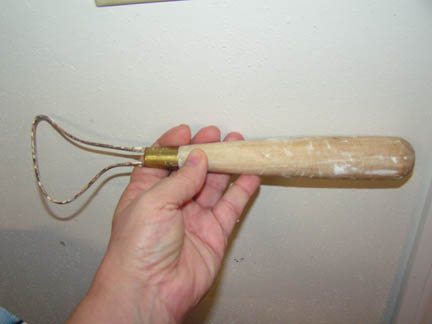
There are a couple of tools that I think are necessary to create the plaster. For example, I love having this large loop tool around when creating my Hydrastone mother mold. It is great when you want to clean up your Hydrastone seams and not make them jagged. This tool also cuts through the Hydrastone, even after it begins to cure, which is helpful, if I feel I have too much Hydrastone in one place.
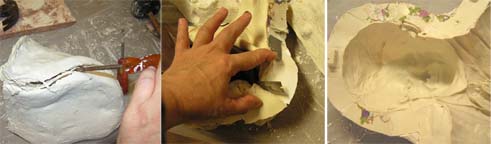
Once all parts of the plaster are made you will want to separate the mold. Waiting a day or two for the Hydrastone to cure is helpful. It will take longer in high humidity. As the water evaporates from the Hydrastone, it will strengthen and will become a bit lighter.
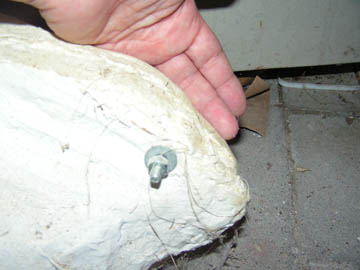
HINT: Small molds are often held together with rubber bands, larger molds may require bolts. Making a seam that comes up at the edge provides room for bolts. These bolt holes can be drilled before pulling apart the mold. Be careful not to jeopardize the rubber underneath. Often there is so much rubber and plaster, it is sometimes hard for me to make out where the sculpture actually lies underneath.
Separating the shell can sometimes feel like an impossible endeavor. I have several screwdrivers that I can shimmy into the seam. Once one is in a seam, I’ll try to move it down a bit and put another in, doing the same thing all of the way down the seam, being careful not to puncture the rubber underneath. More than once I have to struggle with a seam, only to flip the mold over and try another one. As a l ast resort, I may try to scoop out the clay from the open section where the wax will be poured, giving me something to hold on to, and I use this to pry the pieces apart. It takes practice to know when and where to apply pressure and when not to. This part of the process can take a good deal of strength.
NOTE: Be very careful if you are prying one piece of Hydrastone off another. It is easy to shatter a corner or an edge. Go slow and steady, and if you feel frustrated walk away, get lunch, and come back later.
Once the mother mold is separated, you can pull the rubber away from the original art. You will lose the integrity of your original art, but I keep the sections, especially the face. Should the wax come back to me and not look right, it gives me something to compare the wax against. Before sending these molds to the foundry, the rubber will need to be washed both inside an out. This can be done with kitchen soap and a good brush. Sometimes a toothbrush helps to clean small textured areas. When cleaning the inside, be sure that all the clay debris is out of the crevices and details, as this will be picked up by the wax, rendering the wax unusable.
The Crisco should also be washed off the outside of the rubber. Then the rubber is dried and placed back into the mother mold.
HINT: Do not leave the rubber in a heap. Instead let the mother mold do what she is supposed to do, cradle and hold the rubber. Rubber can have a “memory”, and leaving the rubber tossed about outside the mother mold may distort its shape and cause it not to fit back into the mother mold securely.
I would suggest that anyone who is wanting to learn to make molds for his or her own bronze casting, watch the process being done under a master mold maker. Contact a local foundry or artist and ask them if you can intern or apprentice under them to learn this process. They will most likely appreciate your eagerness and the help, especially if you can do it in their time frame. Remember they are on a deadline.
I might also suggest you take your education a bit further and ask the foundry if they will teach you to pour and pull your rubber molds. There is no better education in knowing if you created the mold properly than experiencing how the mold pulls from a wax. Though the process of creating a mold for bronze casting can feel daunting, with a little practice it is possible to begin to create your own molds, and in turn, save yourself a great deal of money in the process of bronze casting.
Pulling My Hair Out

One to one are classes that Apple offers. They are great just $90.00 a year and you can go in and meet with a mac person about anything one to one for an hour. I have learned a lot in the last year, as shown by the former post. Just thought I would give you a photo montage of my session. Notice the sign over my head in the las photograph says, “No pain, all gain.”


Always Learning

Besides sculpting, writing and working on the many different contracts, I have been learning. For seven months now I have been working on putting podcasts together. It is incredible to think of all that I have done. There will be two different podcasts, one for my line called Inspirations and the other on art called, what else Creative Endeavors. I keep thinking, “ I feel like I have done so much.” After making this list it is hard to believe I could do all of this and work on such tight deadlines downstairs in the sculpting studio. You probably can tell that my husband and I work all of the time. It is great to love what you do and have a studio near our home.
I am thrilled that this is almost together. Maybe If I put some links then it might help others who are wanting to do a podcast.
• Learned what a podcast was
• Found Adam Weiss page and bought an old iriver on ebay to use while I was waiting for new equipment
• Tried to learn I river, recorded a few things while waiting for new equipment
• Bought a new mac computer
• Scheduled several one to one sessions with Apple to learn audio,
• Learned Garage band, Free audio editing software that comes with a Mac. ( it is funny I have had this for years and I thought it was a game or something. )
• Reviewed microphones
• Purchased the Samson C01U, and pop filter (actually requested it as a gift from husband, thanks hubby)
• Tried to use my own boom arm, didn’t work, tried to make a boom arm that would attach to desk, didn’t work, bought a HEIL boom arm it also came with a spider mount. I am a happy camper
• Tried to figure out how to do a podcast with three people via phone
• Got a skype account
• Purchased Audio Hijack Pro(AHP) ( found this guys post about doing podcasts using sKype and AHP
Posted a bunch of questions, as I was trying to figure it out.
• Still working with AHP techs trying to get better sound
• Scheduled advanced audio sessions with apple
• Studied how to market podcasts
• Recorded 9 podcasts for God’s Word Collectibles
• Edited all of those podcasts
• Tried to find music for podcasts
• Was rejected by one artist but got something even better from Harry Sheppard
• Needed voiceover for commercial begged one person, waited a month and again Harry Sheppard came to my rescue.
• Researched servers for podcast hosting, along with learning about bandwidth etc. Settled on Libsyn, designed libsyn page, figured out how to make two separate podcasts under one libsyn account, complete with rss feed.
• Purchased the url Spotonradio.com
• Paid someone to make a blogger page look like my merchants account page at the God’s Word website http://www.godsword.net so no one would know they were off of the site, unless they look at the url
• Tried to upload podcasts to review sound
• Needed to learn how to make podcasts into CD format so those not having a computer could listen to them.
• Created art for cover of podcast
• Created art and CD sleeve
• Purchased CD labels and created them
• Learned about meta data
• Have had to tell 3 publications that were interested in promoting the God’s Word podcast, It will be up soon.
• Prepare press releases for podcasts
There are still things I need to do, of course promotion of the podcasts once they are up. The copy is going to the proofreader tomorrow, and the podcasts for the God’s Word website are in the hands of my co-hosts, or soon will be for their approval. This is a technicality that we will do away with once we get going with these.
• Learn how to bring them from libsyn and put them on my God’s Word site
• Learn how to make these easy for download
• Get an I tunes account and put the podcast on their through I tunes
Thrilled about learning and absolutely thrilled about these podcasts. It is a great marketing tool for God’s Word, and a wonderful way to share art related information with others.
Bridgette
Who Is Coming Up With Richard Hathaway?
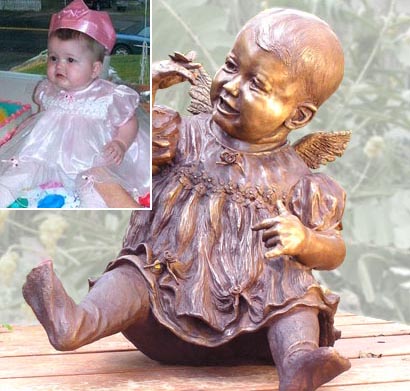
I thought I would introduce you to Jenna, she is a sculpture that will be traveling on the road from Houston, Texas to Vermont. I need to deliver her to Main. Jenna’s mom is coming to the opening to pick up “her little angel.” I love the idea that we will be coming up to Vermont with an angel. I wonder if Jenna and Dick have met in heaven?
Artist’s Copyrights Are In Danger
For those of you watching the video below and wanting to take action here is a link to a site that will allow you to send a message directly to your state representative. It is put together by the Illustrators Partnership of America
And the professional quilters blog has some other links on the subject.
here is a wonderful resource of articles about this bill
Follow the link above for comprehensive bill descriptions that describe the impact on visual artists:
Writing An Article About This
I’m writing an article about this subject right now. I thought I would post this video to explain the topic. VIDEO NO LONGER AVAILABLE
It is about something called the Orphan Works Bill. This bill is not supported by most artists and will really be detrimental to our lively hood. I can hardly believe that it is being considered. If anyone reads this and would like to help please e-mailyour senator and tell the you do not support the Bill S.2913
Update on Jenna, and Other Things
When I was at the foundry last week I had hoped to see Jenna. “She is in the dip room” said Miguel. The lights are usually off in there so I figured she was taking a nap and did not want to disturb her. Being that Dick was in pieces was difficult enough. I yearn to see everything back together the way they should be.
My apprentice has been diligently working on a second wax of Jenna for me. I had hoped to get that completed and together to have it ready for my meeting today. But Alas she sat there in pieces.
As stated I prepared for a meeting with a potential new client. I hope the job comes through. It is a sweet story and will be a fun commission. The studio was all clean- that is about the only time it gets clean. Once the new projects begin it is back to the mess.
My daughter’s boyfriend, is now fiance ( he proposed in a photo booth at the 59 diner, on Thursday, after asking the parents for her hand in marriage. The 59 diner photo booth is a perfect place for a person into photography ). Bill stayed in the studio while visiting last week. My son asked, “Does it freak you out sleeping in there?” I’m glad it did not. It does make my son a little weary, don’t know if it is the sculptures or because after the sculptures are done there are a lot of body parts. You see I can reuse the clay, so the clay that was used on Dick Hathaway and Jeanna has been used on Patsy, Lucas, and others. Lots of creative energy in that clay. But I have to get the clay off of the pieces. Right now Dick Hathaway is piled, in pieces in the corner. My apprentices will help take the clay off after he is complete.
After the week-long visit, the kids are gone, and the big meeting is over. Wish I could take time to sit and be still, but there is still a lot of work to do in the studio and office. I will post more photographs of the sculptures soon.
Bridgette
Mold Making And Bronze Casting- Part 1
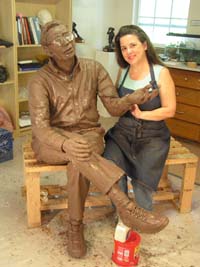
Created for Best of Artists and Artisans web site By Bridgette Mongeon © 2008
There is one question that I receive on a regular basis, “How do you make a mold for bronze casting, or how can I make my clay artwork into bronze?”
Though the process is quite detailed, I have recently made this video of the Dick Hathaway mold and bronze casting. It is not instructional but it does show the process. Watch the video and I’ll share some hints, and tips as well as some of my resources for materials that I use. Mold making and bronze casting is much too much to cover in one article, so check back next month for part two.
I have been making molds for years; however, I still find myself saying, “I could have done this one better.” I learn from each process. Attempting to make your first mold will feel overwhelming, but start with something simple. The one thing I have found that keeps me from beginning a project is not just the learning process, but also the daunting task of finding all the materials and tools I need. So for this months article I thought I would give you a list of my tools and materials used in the mold process, some of which you will see in the video If you proceed with a mold and need any further assistance or have any questions just go to my forum on my website, https://creativesculpture.com/forum and post your question. I’d prefer to answer your question on a forum. Then others might find our conversation at a later date and gain some knowledge. I’ll list the contact information of my suppliers at the end of this article, though I do encourage you to research suppliers in your own area.
TOOLS
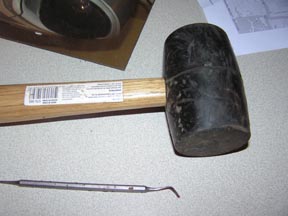
When I am claying up seams, I heat the clay up in a microwave, bang it out into thick slabs with a rubber mallet, and then put it on the sculpture while it is warm. Often I search around the studio for jars, cans, and other items to hold up this seam. Pressing hot Klean Klay against the base of a jar will help to hold it in place, and the jar helps hold up the seam. If I need to clean up a seam, I’ll use my favorite dental tool. I use a round ribbon tool to carve the groove in the Klean Klay. This creates the “key” to keep the two pieces of rubber together. Kitchen knives come in handy to cut the clay to make a clean edge.
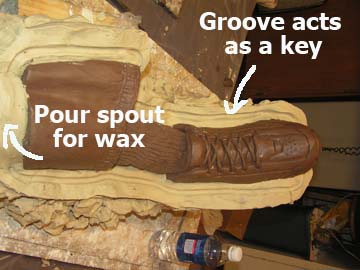
As you can tell, making the seams and preparing each piece can take a lot of time. It probably took me three days to cut and prepare the entire sculpture.
Don’t forget to leave an area to pour your wax into the mold. This can be the cut area. For example, where the arm was cut. Sometimes I create a clay spout, adding it to the cut areas to give me a good pour. If you look at the lower torso in the video, I put rubber over the entire cut section, between waist and lower torso, and poured the wax into the rear area.
I love power tools. It is a reciprocating saw that I use for cutting apart the sculpture. Using this tool is something I learned from the foundry.
The metal shims used in creating the seams on the upper torso and head are from Wholesale Tool and they are taped together with scotch tape. I have also seen other sculptors use plastic for shims. One of my cans of shims says the size is .0005. The shims should be thin enough so as not to make too big a gap when the rubber pieces are put together and not too thin so that it bends when you push it into the clay.
HINT
Be careful when using metal shims. Throughout the process, the shims disappear after being covered with rubber and plaster, you may have an edge stick out that can slice your hand.
MOLD RELEASE
Each sculpture piece is sprayed with a couple of coats of mold release agent. I never seem to have enough of this around. Be sure to keep a few cans on hand. Universal Mold Release costs about $11.30 a can and is purchased from Reynolds.
RUBBER
RUBBER
I have tried several different rubbers, but right now I am using Reynolds Rubber Brush- On 40, gallon kit. It costs around $120.00. It took about four of these to do the Dick Hathaway sculpture, a big investment. Remember though, a foundry would charge you about $7,000 to make a mold this size. I’m open to investigating less expensive rubbers, but dependability and longevity of a rubber is something to consider when comparing rubbers and I know this rubber fits that bill.
RUBBER Mold making is messy. I put paper, plastic, or cardboard around the mixing area. Save all of your large plastic yogurt and sour cream containers. These can be used over and over again for mixing rubber. This entire process is not very earth friendly and reusing containers helps ease my conscience a bit.
Mixing sticks. I use a lot of these, so I try to pick them up from the hardware store whenever I go. Usually they give them when you buy paint. I also look for anyone throwing away old shutters or shutter doors. The slats work perfectly for stirring sticks. Yes, the word is out, I garbage pick.
HINT
Be sure to keep the catalyst (yellow container) of your rubber covered while working with it, it can go bad.
HINT
Keep a stick to scoop out Part A and a separate stick for Part B and then another clean mixing stick. You don’t want to get any of part A into part B until you are ready to mix. You will notice in the video that I save my containers from sushi to set the cups in so they don’t drip all over the work area.
HINT
You must have equal parts. You must also be sure to mix thoroughly. If you are using yogurt containers be careful of the groves in the bottom of the container. You will want to be sure to mix every bit of it from the bottom. If you falter on these two hints, you will lose your mold and maybe your original.
GLOVES
Have plenty of gloves on hand. Mold making is very wasteful, but working without rubber gloves is maddening. I usually try to keep both vinyl and latex, just in case an apprentice prefers one to the other.
PAINT BRUSHES
You will use quite a few paintbrushes. I change out paintbrushes after each coat of rubber. One inch chip brushes work best for me, and I get mine from Montalbano Lumber, $14.04 a box Even though this is a little item, I suggest looking around for a good price per piece on these. You will use a lot.
HINT
When applying the first coat of rubber, be sure to dab the rubber into all crevices. The second and third coat will go much faster than the first. I like to have several pieces to work on to keep the flow going. That way I am not waiting around a long time for something to cure for the next coat. If you touch the rubber and it feels sticky but kind of leaves a fingerprint, it is ready for the next coat.
UNDERCUT PREPARATION
This is a step that is not covered in the video. The video does not show how to make sure a mother mold will come off of the rubber. It is a vital step. Please contact me and I’ll explain this or I’ll be sure to video tape it in detail the next time I make a mold.
NEXT MONTH – Making the mother mold
SUPPLIES AND SUPPLIERS
Paper or plastic to cover floor
Recipricating saw
Klean Klay
Rubber
Mold Release
Stiring Sticks
Yogurt Containers
Gloves
Microwave
Rubber mallet and tools to clean up seams
Large garbage can for disposing of gloves and brushes
Paper towels
Ceramic Store Tools and water base clay
1002 West 11th St.
Houston TX 77008
1-800 290-8990
http://www.ceramicstoreinc.com/
Circle Supply in Houston Hydrastone
6401 Long Point Rd # 506
Houston, TX 77055
(713) 688-9803
http://circle-supply.com/
Fine Art Foundry of Texas wax and bronze casting
6107 W34th
Houston, TX 77092
713-686-5567
http://www.fineartsfoundrytexas.com/
Klean Klay Clay for claying up the seams
P.O. Box 678
1019 Salamonie Ave.
Huntington, IN 46750
260-356-2328
http://www.kleanklay.com/
Montalbano Lumber Chip brushes
5850 N Shepherd Dr
Houston, TX 77091
Phone: 713-691-6611
http://www.montalbanolumber.com/
Reynolds Advanced Material Rubber, clay, mold release
5 locations 1-800-421-4378
http://www.reynoldsam.com/
Wholesale Tool Shims
Several locations
1-800-521-3420
http://www.wttool.com/