
Frankensteinian Art?
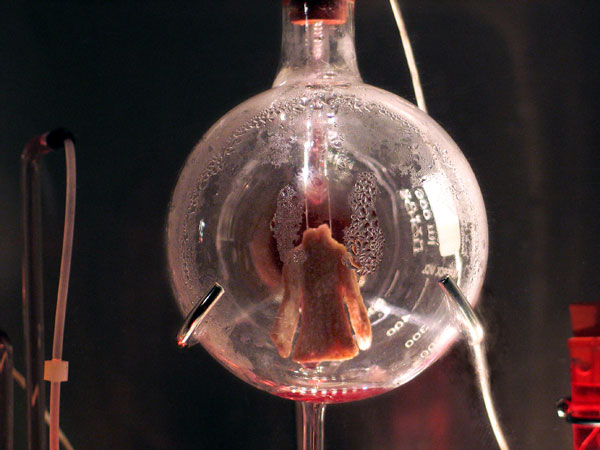
My studies of researching digital technology and incorporating it into my traditional sculpting processes is part of what I am doing for my graduate degree at Goddard. It has taken me to places I would have never dreamed of going. Several months ago while researching 3d printers I began to realize that individuals were pushing anything they could through the printers to see what would happen, metal, ceramic, even glass. It was then that I wondered about biology. And I was certainly thrown for a loop when I found that they were printing bone, skin and now even organs. I wrote about this and had several links to articles about the subject in the October 28th blog article, I’m a genius! 3D Printing of the Human Organs?
I did, at that time, however, happen upon another artist’s work that after finding and reading I quickly clicked off of. The project has haunted me since then. There was such uneasiness when I first happened upon it that I didn’t even put it in my college bibliography. I am wondering now, why. Why am I so uneasy? It was exciting for me to find that science is now printing biology, and that someday, if I need a kidney I might be able to have my own kidney printed. But incorporating this other type of biology into art left me feeling uncomfortable. The topic has come up more than once since this first encounter with Stelarc’s art piece The Partial Head. The Partial Head is a prosthetic portrait of the artist that is computer generated and can talk to the viewer. This portrait is digitally printed and then seeded with living cells. Of course, the artwork needed a bioreactor/incubator circulatory system to survive. It only lived a week before becoming contaminated and “died.”
The Partial Head website acknowledges the collaboration of, The Tissue Culture & Arts Project (TC&A). http://www.tca.uwa.edu.au/ In a Leonardo Journal, article entitled, Growing Semi-Living Sculpture: The Tissue Culture & Art Project by Oron Catts and Ionat Zurr it state that they use “living tissue to create/grow semi-living object/sculptures and to research the technologies involved in such a task.” I need to examine, in my own mind, why creating organs to extend life, and using living cells to create art feels so different to me. Though both remind me of the scene from the movie Frankenstein.
Victor Moritz: Henry – In the name of God!
Henry Frankenstein: Oh, in the name of God! Now I know what it feels like to be God!
Is it my cultural upbringing that makes me uneasy about this? I have warned myself to be careful. Some fear is healthy; it does keep us from danger, however, it can also keep us from exploration. The difficulty is in knowing when have we gone too far.
Doctor Waldman: You have created a monster, and it will destroy you!
Another Sterlarc’s project consists of growing a 1 /2 scale ear. In another piece of art titled. Victimless Leather The TC&A project works at initiating a discomfort in the viewer as they digitally print a miniature coat over scaffolding with tissue that looks like — human skin.
Of course, growing things can be found everywhere. How is this technology any different than growing a topiary over a metal structure that becomes a living thing that will grow and I must tend? There are many ethical questions raised with TC&A ‘s project. For example, “Do these entities contribute to the objectification of living organisms?” In my previous comparison I honestly don’t feel that I am objectifying the ivy on the topiary. Nor do I feel I am killing portions of it when I prune the art. How is this different? Are we enthused with our control over the living material? This Frankensteinian idea towards art was also expressed in a recent Art and Technology podcast that I conducted with Robert Michael Smith. It appears these questions will continue to be raised and that artists that are presented with tools to push their creative limits and to initiate a reaction in the viewer will do so. It has certainly initiated a reaction from me. It will continue, and we just may see more art that for lack of a better word, can be referred to as Frankensteinian.
TC&A also examines, “the gap between the fast pace of development in science and technology and the slower pace of cultural understanding and adaptation.” They are indeed pushing the limits of acceptance both socially and culturally. They hope that the term “semi living object/products and sculptures” will make the art more palatable. “Our art challenges many people to examine their perception of the boundary between the living and the inanimate:” Their goal is get these projects to a point where the art can live out of their contained environment and provide tactile interaction with the viewer. I’m sure this will not be the last you hear about this subject on this blog, or the Art and Technology podcast. But I’m interested in knowing what other people feel about these works of… “art?”
Look! It’s moving. It’s alive. It’s alive… It’s alive, it’s moving, it’s alive, it’s alive, it’s alive, it’s alive, IT’S ALIVE!
Henry Frankenstein
( Oron Catts will be one of my up and coming interviews ( INTERVIEW) on the Art and Technology Podcast listen from the Digital Sculpting.net website or Subscribe to the podcast in itunes ) This podcast was recorded May 23, 2010 and will be up at the http://www.digitalsculpting.net website by May29th.
If you are reading this blog post from facebook and do not see the videos and or photographs visit https://creativesculpture.com/blog
Antiquities, Masterpiece, Rights of Ownership and 3D Scanning
I have been spending some time looking at historical artifacts and the copyright and ownership issues surrounding them. The reason why this topic has created some interest to me is that I’m curious about the advancement and tremendous increase in 3D scanning of artifacts.
It seems there are benefits in the 3d scanning of these precious items. There may be information captured by the scanner that will help scientist know more about the item. It offers an opportunity to document and make accessible the information. For example, the tomb of Tutankhamun is being scanned in hopes of preserving it so that the experience and information can be made available to those interested without actually having to make it accessible for individuals to experience it. This is important because the experiencing of some artifacts causes more damage to them. And it can be an asset in the restoration of an artifact.
Recording the tomb of Tutankhamun from factum-arte on Vimeo.
I have been cautioned not to just embrace all of this new technology without trying to thoroughly examine it. So, I must ask myself, what are the cons of having the artifacts scanned in 3D? Before I answer that, I thought it would be appropriate to look at some of the issues and questions revolving around the artifacts themselves.
For example:
- Is it ownership that is important or access?
- If I own land and I dig something up on my land. To whom does it belong? It will depend on the country you are in and the laws within that country. The antiquity may not belong to you. If it did not, would I report it or would I be more inclined to cherish my treasure without saying a word ?
- Many laws are developed in hopes of preventing looting of antiquities. Do they actually accomplish this? How do these laws effect poorer countries?
- How do I feel about cultural property?
- If something is taken or looted what happens to “the loss of context?” Having a coin but knowing where it was found or what the people who had this coin did, ate, where they slept, is important. It is not just the object that is researched, but where it was found.
How important is it for individuals to be exposed to the cultures and antiquities of those around the world? Should countries horde their antiquities? If antiquities can be distributed through trade, what happens with countries that have nothing to trade? How do they expose their people to the cultures around the world?
According to an article that I read, if I happened upon a stolen or found object and it ended up on the desk of an archeologist and it had something of importance on it, that information cannot be published. How difficult it must be for the archeologist who happens upon this. The reason— it has no legitimate provenance and the Archeological Institute of America forbids it. Why? If the archeologists should transcribe it and publish it, then they would be determining its authentication and making it more valuable.
Identity, self esteem, illicit digging, artifacts, private/market all of these words initiate a tremendous amount of passionate opinion in the information that I was reading about this subject.
Should there be a cultural common? Shared information and artifacts between countries, museums and collectors. The Brooklyn museum is making some of their artifacts, for which they hold the copyright, available on a Creative Commons License. Those who want to use them for non commercial use can do so. But, how is this policed?
I would suppose that the same questions and concerns that are found with traditional masterpieces and antiquities will apply to 3D scanned artifacts. Who owns them? Should they be reproduced? And my biggest thought is, that it is much easier to steal a data file than it is a physical dated fossil.
I also wonder about the artists who might use these artifacts as part of their own work. In the case of artists Barry X Ball, whose work I absolutely love, I have questioned this. Ball has taken digital scans of two Braoque pieces, “Masterpieces in the permanent collection of Ca’Rezzonico, Venice— La Purità (Dama Velata), by Antonio Corradini, and La Invidia by Orazio Marinali, as well as Hermaphrodite Endormi from the Louvre, Paris.” and he has digitally scanned them. Then he recreates them using digital milling in another substance. Does he sell these? Can he sell these? Is this art? Can he copyright this as his own?
So I ask the question, What are the pro’s and con’s and more importantly, what are the questions I should be asking when looking at this new technology of 3D scanning as it pertains to masterpieces and artifacts?
( I do hope to cover more podcasts on this subject. Looking for lawyers working with antiquities)
If you are reading this blog post from facebook and do not see the videos and or photographs visit https://creativesculpture.com/blog
Art And Technology Podcast – Foundry of The Future
talk about the
foundry of
the future.
An Interview with Paul Effinger – Foundry of the Future Art and Technology 0005
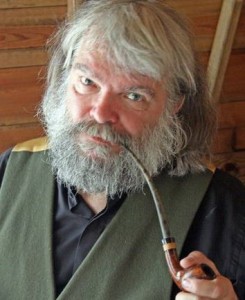
Paul Effinger is a digital sculptor who is exploring different methods of bronze casting other than the lost wax method of bronze casting. He is exploring z corp printing in a cellulose powder, infiltrates and others.
Effinger worked 13 years in the gaming industry creating for published titles as lead Character Artists and Animator and contributed to many others as an independent contractor. He strives to see some of his creations into physical forms and loves the feel of bronze. This has caused him to explore in different areas of 3d printing and investment casting. The processes and pitfalls of 3d printing are featured in chapter 7 of the Mudbox book.
( Paul is featured in my 2015 book 3D Technology In Fine Art and Craft: Exploring 3D Printing, Scanning, Sculpting, and Milling.

his sculpture shows the stair stepping.
LISTEN NOW from your browser
* Listen to the podcast from our podcast player on the nav bar at Digital Sculpting.net
* The direct link to this podcast segment- should you want to put it on your website or blog
____________________________________________________________________
The New Podcast Art and Technology is Up- Feel Free To Use Them On Your Site
“A fire side chat where innovation, creativity, technology and science meet.”
Art and Technology Podcast
The art and technology podcasts are up. And you are welcome to include them on your site. Check out the link at the end of each post here. You can listen to the podcast at http://www.digitalsculpting.net. Once there, press on the link in the upper nav bar that says “podcasts.”
The podcast has been submitted to iTunes and we will let you know when you can subscribe to it in iTunes. We would, however like to have you stop by digital sculpting.net to listen and reply on the forum threads for each post. It is a great way to create a dialogue on these topics.
I’ll also put a direct link to the new podcasts below so you can listen right from your browser.
You can see a player and listen from this website at Videos and Podcast page of this website.
Here are the podcasts that have been recorded to date:
____________________________________________________________________

and Technology
Podcasts and
author of Digital
Technology in Fine
Art and Craft:
Exploring 3D Printing,
Scanning, Sculpting,
And Milling.
Art and Technology 001- Introduction
LISTEN NOW from your browser
An introduction to the Art and Technology Podcast. Host Bridgette Mongeon and illustrator/writer Mike de la Flor talk about their hopes for digital sculpting.net, the Art and Technology podcast and the new book Digital Sculpting with Mudbox: Essential Tools and Techniques for Artist.
A bit about the host Bridgette Mongeon
Bridgette is a traditional sculptor and a writer. She has been creating podcasts for two years on various topics and looks forward to exploring art and technology with the community at DigitalSculpting.net. Her passion for this subject is fueled by her ongoing graduate studies. She is also coauthor of the new Mudbox book and co-administrator for the digitalsculpting.net website
Interview with Mike de la Flor
Mike is a medical, illustrator/animator, instructor and writer. He is the author of several CG titles including the popular The Digital Biomedical Illustration Handbook. He has written dozens of articles for 3DWorld, Computer Arts, and MacWorld among other magazines. Mike is also the co-administrator of the DigitalSculpting.net website.
* Listen to the podcast from our podcast player on the nav bar at Digital Sculpting.net
* The forum for this topic. You may add your comments and thoughts
* The direct link to this podcast segment- should you want to put it on your website or blog
http://media.libsyn.com/media/artandtechnology/Art_technology_001.mp3
____________________________________________________________________
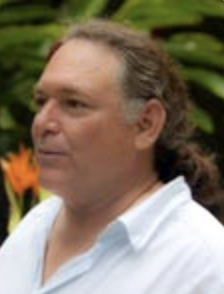
An Interview with sculptor Robert Michael Smith. Art and Technology 0002
Please see previous post for more information about Robert Michael Smith
LISTEN NOW from your browser
* Listen to the podcast from our podcast player on the nav bar at Digital Sculpting.net
* The forum for this topic. You may add your comments and thoughts
* The direct link to this podcast segment- should you want to put it on your website or blog
http://media.libsyn.com/media/artandtechnology/Art_technology_002.mp3
____________________________________________________________________
An Interview with Joris Debo from Materialise .MGX Art and Technology 0003
LISTEN NOW from your browser

An Interview with Joris Debo from Materialise .MGX discussing some of the highest quality of 3d Printing.
Joris Debo from .MGX, a division of Materialise talks about the technology of large scale 3d printing and investment casting that their company is offering to the traditional and digital studio. .MGX works with 3D printing technologies and some of the top designers in the world.
Check out the .MGX catalog for some very inspiring artwork
This link lets you download both catalogs
* Listen to the podcast from our podcast player on the nav bar at Digital Sculpting.net
* The forum for this topic. You may add your comments and thoughts
* The direct link to this podcast segment- should you want to put it on your website or blog
http://media.libsyn.com/media/artandtechnology/Art_technology_003-_Interview_with_Joris_Debo.mp3
____________________________________________________________________
Interview with Kevin Gillespie Art and Technology 0004
LISTEN NOW from your browser

Kevin Gillespie pioneer in CG, talks with Host Bridgette Mongeon about 3d technology and copyrights- from a personal viewpoint. How can we protect ourselves as artists? How can we be more aware? Copyright in 3D is an emotionally charged issue.
For more information on this case, copyright issues and other information as well as a discussion of this topic please visit the digitalsculpting.net website. We would love to hear what you think about this heated topic.
* Listen to the podcast from our podcast player on the nav bar at Digital Sculpting.net
* The forum for this topic. You may add your comments and thoughts
* The direct link to this podcast segment- should you want to put it on your website or blog
http://media.libsyn.com/media/artandtechnology/Art_technology_004_Interview_with_Kevin_Gillespie_on_Copyright_and_3D.mp3
MORE INFORMATION ON THIS TOPIC
Article Not a Model Decision a wonderful blog article by a lawyer
Article Important Case ( maybe): 10th Circuit on Copyrightability of Digital Model
____________________________________________________________________
So who is next?
Some great guests are planned:
Andrew Silke– From the Guerilla CG project
Adrian Bowyer– the developer of the REP RAP
Next Engine– digital scanning
Oron Catts– The Tissue Culture & Arts Project ( this is a strange one, you must listen)
____________________________________________________________________
I Am So Excited. I Just Scored Two More Interviews For The Art And Technology Podcast!
Each person I ask is because I am very interested in what they are doing, researching, or their place in this field. Do you want to know the two? Yes, more global interviews courtesy of Skype!
Adrian Bowyer- Bath
From Mr Bowyers website. “I am a senior lecturer in the Department of Mechanical Engineering at the University of Bath working in the Biomimetics Research Group on the RepRap Project and the Bioaffinity Applications Laboratory.” I thrilled about this interview. I have posted some wonderful videos about this man and what he has been doing. I love the idea of the RepRap. For those of you who don’t know what that is, a Rep Rap is a printer that prints objects in 3d, but no one that you are going to spend hundreds of thousands of dollars on. It is an open source project. You could build one of these for your own office/studio. I want one! Oh yeah, Did I mention that the RepRap can print itself?
Andrew Silke- Sydney, Australia
Mr Silke’s webiste the Guerrilla Cg Project states, “Andrew Silke is a professional animator and founder of The GuerrillaCG Project. With over 8 years experience he has worked on major feature films such as Happy Feet, Scooby Doo, and James Cameron’s new movie Avatar as well as creating award winning short films like as ‘Cane-Toad’ (with David Clayton).”
“The GuerrillaCG Project is a free non for profit organisation that hopes to make it easier to learn high-end computer graphics. We are building a team of volunteers to create videos, that describe in an easy and understandable manner, the fundamental concepts of computer graphics. ” I love this site and Mr. Silke’s dedication to education. If you are new to digital technology or a traditional sculptor needing to begin to know about the process of digital technology this is a great place to start.
Subdivision Topology: Artifacts from The Guerrilla CG Project on Vimeo.
Going Global…
My next two podcast interviews are from Australia and UK. Wow going global. Can’t wait. They should both be very interesting.
PS saying good skype prayers to be sure the recordings sound o.k. Scheduling these podcasts now!
Just Bought a New Microphone, And Please Don’t Call Me Dumb!
I have been lusting after this microphone for a while. I know if I am going to lust after something I should probably lust after $800 mic and recording equipment instead of the MXL USB.007 But, I feel this is an upgrade from my Samson Co1U. Plus unlike the Samson this one is in stereo.
Adding the new podcast about Art and Technology on the digitalsculpting.net website made me feel a bit more comfortable about purchasing a new microphone.
I’m having some serious problems with sound quality and am hoping that this microphone will help to solve that.
PLEASE, DON’T CALL ME DUMB
I have been having trouble with my Heil boom arm. For those who don’t know what that is. It holds the mic so I can talk during podcasts. I’m not sure I would ever buy a Heil again and really, I think I might like to switch to a boom arm extension so it come up and over my screen. But anyway, I would set the mic up and it kept slowly moving down as I talked. It drove me crazy, to the point that I was holding it up by wedging scissors between the arm and a cabinet. Then today I looked at it closely… there is a weight on the end of the arm. Don’t call me dumb. I took the weight off and now it longer moves. Now in my defense, when I move this mic over to my area during podcasts, though it is in front of my nose, and in front of my eyes, I’m not looking at it. Usually, I’m looking at the screen or my notes or whatever. O.k. I feel a little stupid.
Some Wonderful Galveston Art Created From Devastation

Leave it to artists to take devastation and create art. I’m proud to be an artist when I see something like this. Not only are they wonderful pieces of art it is a way to encourage more tourism for our beloved Galveston. I can’t wait to see these. If anyone finds a map of where all of these are please forward me the link.

A little bit of information before the art:
On September 1, 2008 the Houston, Texas area received a blow from a Hurricane called Ike. The amount of devastation that happened in this area went pretty much unreported over the United States. As wiki says (… It also became the largest search-and-rescue operation in U.S. history) I know it was not covered at great extent because the week after the hurricane I was traveling up to deliver the Dick Hathaway memorial by car from Houston, Texas to Montpelier, Vermont. ( The link is my documentation of that sculpture as well as the travels as we delivered it. My September 2008 posts talk a bit also mention this trip along with our preparations for this hurricane. )

My traveling companion and I would check back home and on the internet to find out as much as we could about Houston, and our beloved Galveston. [ I’ll add this personal observation. Many people who did hear about the hurricane said, “Why didn’t those people leave?” For those not in a hurricane area I must tell you NO ONE realized the type of storm surge that was attached to this category 2 hurricane. For us a cat 2 is really not that big of a deal, but there was a storm surge of a category 5. I believe this storm and the devastation that was caused by it really caused those powers at be to think about the way they categorize these storms.

On to the art: Tree Stump Carvings In Galveston
What follows came into my inbox and I though I would share it. Photos are by Carlos Antonio Rios. It looks like this might be from an original article in the Chronicle By Lana Berkowitz. lana.berkowitz@chron.com.

Thank you Lana for sending this around. I definitely will be going to Galveston and checking these out. I have not asked permission to use this article , and hope there is no copyright infringement here, since it is distributed through e mail by a reputable source, I figure it is all right. If there are any problems please let me know and I will delete it.

Information provided through e-mail
The toad? The Tin Man? The Dalmatian?
It’s hard to choose a favorite among the tree sculptures that are carving a new beginning for Galveston Island .
The transformation of tree skeletons that were reminders of Hurricane Ike’s 2008 devastation is another sign of the island’s recovery. And tourists love the chain-saw and chisel artwork.

More than 20 tree-stump sculptures can be viewed from sidewalks and streets, and more are joining the list as commissions are completed. Many of the carvings are by Galveston artist Earl Jones, Houston artist Jim Phillips and Dayle Lewis of Richmond , Ind.
The artists have plenty of potential work. About 40,000 of the island’s trees died after they were swamped by storm waters. Contractors cut down the dead trees and left the stumps, which are becoming dogs, angels, dolphins, toads, mermaids and more.
Here’s a list of Galveston Island Tree Sculptures visible from the street, according to www.cityofgalveston.org: Need a map? download or print one of these Galvestohttps://galvestonislandguide.com/galveston-tree-sculptures/n maps to mark these works of art.

Geisha, 1717 Ball
Mermaid holding clam shell, 1428 Church
Large pelican, 1609 Post Office
Wildlife tree inside the castle playground at Schreiber Park, 83rd Street near Airport
Dalmatian and a fireplug at City Hall outside Central Fire Station, 823 25th
Toad, 1615 Ball
Angel cradling bunny, 511 17th
Sister angels, 1717 Ball
Squirrel with acorn, 1302 Ball
Tin Man from theWizard of Oz, 1702 Winnie
Monument to Galveston’s trees, 1028 Winnie
Yellow Lab, 1820 Winnie (inside chain-link fence)
Hand clutching diploma at Wright-Cuney Park, 718 41st
Two herons, 1316 Ball
Great Dane, 1228 Sealy (facing 13th)

Other tree sculptures in Galveston:
Wildlife totem pole, 1302 Ball
Dolphin, 828 Ball (facing Ninth)
Dolphin, eel and dorado, 1302 Ball
Owl, 1302 Ball
Pod of dolphins and mermaid, 902 Ball
Birds of Galveston, 1620 Sealy
Pelican sitting on piling, 1618 Church
Pelicans, 628 14th (behind the Mosquito Café)
If you would like a sculpture done from your tree stump.
I was able to track down the website of Jim phillips. Check out his work and give him a call.
If there are any other carvers that want me to list their web sites please feel free to contact me.
Map of the area
Here is a map of the locations of these tree stumps.
Other Articles on this subject
In Galveston, Dead trees see new life as art by Harvey Rice Houston Chronicle Aug 24, 2009
Dolphins and Sea Nymph- Glaveston, Texas
Galveston Dead tree sculptures
In Galveston, Texas, new Life for Dead trees This appears to be an interview with Donna Leibbert who starts a citizen led tree committee.
I’m Still Here
I have been preoccupied with putting up http://www.digitalsculpting.net and fixing problems which end up being bugs and causing me to pull my hair out. But…. It is coming along or I am learning. I remembered I had this picture and I wanted to use it on the web so I’m going to post it here.
If you get a chance check out the podcast player on the new site. So thrilled. I really need one of those for the other podcast.
Now to get the podcast registered with iTunes and get number two up. The one with Robert Michael Smith.
I’m Making A City!
At least that is what it feels like. My coauthor Mike de la flor, who also just happens to be my husband as well, and I have been working diligently to prepare another new website. But it is not just a place to go and look, it is a community site, where people can have their own blogs, comment on forums etc. It is a HUGE undertaking.
The entire project was prompted by our publisher Focal Press. Instead of having a CD in the back of the book they are moving to providing files to the book buyers online. So months ago we knew what we needed to do. INTRODUCING ….. Digital Sculpting.net
It has taken a tremendous amount of energy this weekend to get this up, but we are there. Still some tweaking and we will be adding a ton of content. So if you get a chance come on over, drop in, become a user, set up a blog and say hi! It will be great to have a legitimate post. I’m fighting spam bots!