
Art and Technology?
I have recently returned from the computer graphics convention called Siggraph in LA. My job was to focus on how technology was entering the art studio. I have been intrigued by this concept since writing about the digital milling and scanning process this past spring for Sculpture Review magazine. I do hope to create a few videos on the subject and am looking for a venue that would like to receive regular articles on both technology in the fine art studio and psychology and art/creativity. Two subjects that intrigue me. In the meantime please be sure to check out this blog as well as my online column at Best of Artists and Artisans and read about the wonderful things that I found at the convention. I can’t wait to share!



New Article- Best of Artists & Artisans
There is a new article posted at the Best of Artists and Artisans blog titled
Mold Making and Bronze Casting-Part I . For those interested I have listed suppliers and materials. The article goes along with the recent video created of the Richard Hathaway Memorial Sculpture.
New Video Created For The Richard Hathaway Memorial
I posted a new video on you tube and blip.tv about the bronze casting process in creating the Richard Hathaway Memorial project. Anyone interested in checking it out ? Here is the YouTube version. https://www.youtube.com/watch?v=VYgZZjcHCW4
The Thoughts of A Sculpture Judge
created for Best of Artists and Artisans web site
By Bridgette Mongeon © 2008
Seven Houston, Texas-area high school students were selected as grand-prize winners in the eighth annual Culture Shapers Visual Arts competition, winning $5,000 each. With more than 1,370 entries, the competition awarded $83,000 to 71 students at a January 31 ceremony held at Westfield High School. In addition to the grand-prize winners, dozens of other finalists received cash prizes ranging from $250 to $2,500.
The competition’s seven categories include Drawing, Electronic Media, Film, Mixed Media, Painting, Photography and Sculpture. Many of the students entered and placed in multiple categories.
I am one of the three sculptors that judge annually for the Culture Shapers Art contest. The sculpture category contains a variety of sculpture–clay, wire, welded bronze, glass, jewelry, and fabric, basically anything 3D that does not fit into the other categories. The two other judges that accompany me in the sculpture category are Richard Fielden and Ben Woitena. It is a good mix of judges, because our styles and background in sculpting are all quite different. When I come across a piece in the competition that is created in a different medium than what I am familiar with, such as carved alabaster or a welded abstract, I fall back on the expertise of these two men. I am not; however, bashful about sharing my own opinion and fighting for the pieces that I love.
It is important to have more than one judge and to have time to communicate with each other about the pieces. Often one judge may notice something about a piece that another will not. This is easy to do when you are looking at so many pieces of art. I am always reminded of the Esther Ruiz piece in 2003. Upon first glance it was easy to walk by this entry. I refer to it as “Baby in a box,” but the title is “Unbecoming Becoming”. Upon the initial viewing, you would think that this piece was nothing, but upon close investigating there was much more to this sculpture than met the eye. The other judges were glad that I pointed it out.
Judging for many years, I am still surprised at how subjective the process is. I try to express this to the students. Just because your piece did not make it into this show, does not mean it would not place in another show. It really depends on the judges and their likes and dislikes. I even overheard one judge state that they mark the student’s work lower if they have misspellings on their entry forms. I was appalled at this statement. We are not judging their spelling but their creative process, and as an artist and writer who struggled with spelling, I know these two are not the same.
There are, of course, pieces that you see where you know that the students did not push themselves as far as they could. Creating has that false point of abandonment. It gets difficult and often you must wrestle with it. But if you say, “I give up,” it shows in the work. It is said that artwork is never finished, only abandoned, but this “good” abandonment comes after a great deal of wrestling. Those who could not stay with the fight in their own creative process never make the cut to the finals.
This year there were no arguments between the judges when it came to the grand prize in the sculpture category. You can tell that Hung Pahm with the piece “Verbal Struggle” really wrestled to the final “good” abandonment. It was the artist’s description that made me think about this piece of art. The piece by Pahm was created after moving to America and reflects the struggle of not being able to speak the language. This is apparent in the sewn lips, but it had not occurred to me that it not only affects the speaking but the hearing, and this was cleverly displayed by this artist’s omission of ears!
These descriptions are so important to me as a judge. They give the piece meaning. My eyes glass over when I read a description that states, “I created this artwork because the teacher made us create in clay.” It is honest, but it lends nothing to the emotion of the piece. And I must say, I judge on emotion.
You can sense the uncertainty of the future in many of the young artists. Their own inner struggle with growing up, leaving home, and becoming what they should be. This is apparent in the 2nd Place winner’s piece by Anda Brown, “I am only Human.” Close observation shows the rocks have statements such as “great expectations, measure up, have it all, ugly.” The head turns on a base, amidst the wall of thoughts.
Often there are pieces that I become emotionally involved with. That was the case with “All that’s left,” by Merlene Robertson. I would have placed this piece much higher; however, there are other judges. Subjectivity is apparent when I explain my reasons, “My daughter recently graduated college and left home.” This sculpture depicts the empty nest. Certainly it is my own emotion that swayed my judging of this piece, but it was the artist’s work that brought that emotion to the surface, and that, in my opinion, should be accredited to the artist. Of course I love to look at the art in other categories. There was one painting on painting section of the Culture Shapers website that I thought was spectacular, and I could not wait to see it in person. In fact, it was one of the reasons I looked forward to the awards night. It was Ahra Cho’s Self- Portrait. I was very disappointed because it only received honorable mention and it was not displayed at the awards ceremony.
I cannot look at the finalist on the sculpting section of the Culture Shaper website without noticing that Teacher Bob Mosier from The John Cooper School had four students in the finals and two students in honorable mention, along with Terri Fotz-Fox from Clear Creek High School who was the teacher behind this years first and second place winners. My hat goes off to all teachers who invest their time into coaxing out the creativity and encouraging the wrestling to continue until the final “good” abandonment of the student’s artwork.
Onward with our own creative wrestling! Remembering that the opinion of artwork is subjective, and our job is to push ourselves past wanting to give up and striving onward until the final “good” abandonment of our sculpted work.Here are a few of my favorites from other categories.
Here are a few of my favorites from other categories.
4th Place: Painting
“Diminuendo”
Lauren Laumbach
4th Place Drawing
“Abba, Father”
Autumn Farrell
8th Place Drawing
“Homework”
Abby Cho
Honorable mention
“Colors of an Enlightened World”
Meng Chen
A Review of New Technology For The Traditional Studio at the SIGGRAPH Convention
Writings by Ms. Mongeon
Created for Best of Artists and Artisans web site
By Bridgette Mongeon © 2008
Using technology in a traditional art studio can, at first, feel like cheating or it may bring a fear that the technology can somehow overtake the craft and creativity. I mentioned these fears and my introduction to this topic in a recent article titled Exploring Digital Technologies as Applied to Traditional Sculpting– Sculpture Review Winter 2007. In the article, I explored incorporating digital scanning and milling in the traditional sculpting studio. My research alleviated my original concerns and fears as I realized that digital enlargement, though a little intimidating at first, can be combined with traditional techniques offering another tool to use in my creative process, a tool that has the added benefit of providing me with more time to create.
I continued my research into utilizing technology in the traditional art studio while attending the 2008 Siggraph Convention this past August. Siggraph is short for Special Interest Group on Graphics and Interactive Techniques.
I once considered Siggraph as a convention for those working in graphics since it relates to illustration or computer generated special affects for movies. I have watched with curiosity over the years as the technology that has been introduced at Siggraph has infiltrated the 3D world outside the computer and into traditional sculpture studio. Those at Siggraph also seemed to be embracing the idea of bringing technology into the art studio. Three prime areas, besides the main floor of exhibitors, displayed this same exploration.
THE STUDIO
The Studio section hosted six established and emerging resident artists, along with hands on participation for learning and creating in 2d, 3d, and 4d (fourth dimension is time.) Though The Studio contained quite a bit of resources, two visiting artists captured my attention.
Matt Shlian calls himself a paper engineer, creating elaborate sculptures through the use of folded paper, which is not to be confused with true origami because he cuts and glues. My intrigue with the art was that many of the forms generate movement, changing shape with the interaction of the viewer.
It is interesting to point out that many of the artists I researched who were working with technology in their art also crossed over into the area of science. A segment of Matt’s website states this.
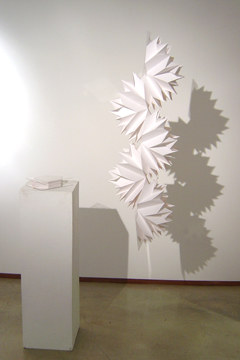
“As a paper engineer my work is rooted in print media, book arts and commercial design. Beginning with an initial fold, a single action causes a transfer of energy to subsequent folds, which ultimately manifest in drawings and three-dimensional forms. I use my engineering skills to create kinetic sculpture, which have lead to collaborations with scientists at the University of Michigan. We work on the nanoscale, translating paper structures to micro origami. Our investigations extend to visualizing cellular division and solar cell development. Researchers see paper engineering as a metaphor for scientific principals; I see their inquiry as basis for artistic inspiration.”
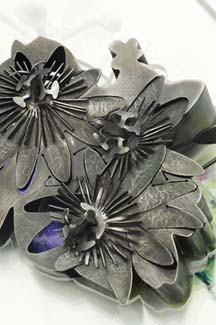
Another person that caught my eye was metal smith and jeweler, Sondra Sherman. I told Sondra that my goal as media at Siggraph was to find artists who were bringing technology into their studio, and she made sure that I knew that her present designs were created by hand, but that learning about the technology that would apply to her art studio was also her goal while at Siggraph. “I believe artists in craft media are always curious about means or materials which might enhance or facilitate their creative expression and which seduces the viewer to engage with the work. I am not interested in the ‘novelty for its own sake’ quality, which the use of technology might bring to my artwork. I am interested in how I might use the attention given to novel forms/materials to attract the viewer to consider what I might be trying to express with that form, as they would with work created in any media or by any means.”
SLOW ART
Slow Art was a juried exhibition. Artists were asked to “reconsider the paradigm of speed and instead consider the concept of “slow art.”’ The questions that were raised— how do you employ speed afforded by technology, how does it affect the work, and the process of creating slow art?
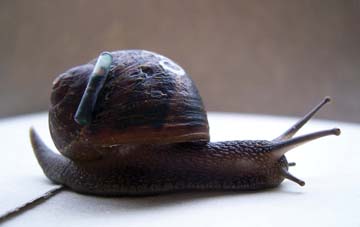
There were a variety of pieces of art in this section that peeked my interest. One of mention was an interactive piece that is the literal description of slow, titled —RealSnailMail. In this exhibit you send an e-mail on a designated computer in the slow art exhibit. It is then sent to a server in the UK. Here the e-mail is in a holding pattern along with the many other e-mails as it waits for a snail equipped with a transmitter in a tank at Bournemouth University, UK, to slide into range of a hot spot that can pick up your message. It then must move to another area of the tank to send it.
I could not help but wonder just how long my snail mail would take to get to a person. I emailed Bournemouth University in the UK using the regular fast e-mail and they quickly replied. “We have done a bit of calculating this morning. As of the 8th of Sept. 2008 we have 8,977 emails waiting. Based on this, if you sent an email today, it would take 24 years, 217 days before it gets to the front of the queue. It then may take a further 69.87 days (average snail transfer time) before being forwarded to its final destination. Therefore, a RealSnailMail sent today should arrive approximately by Thursday 16th of June 2033. Please note times may differ dependent on snail behavior and usage.” Now I am wondering how many people will have their same e-mail address twenty-four years from now.
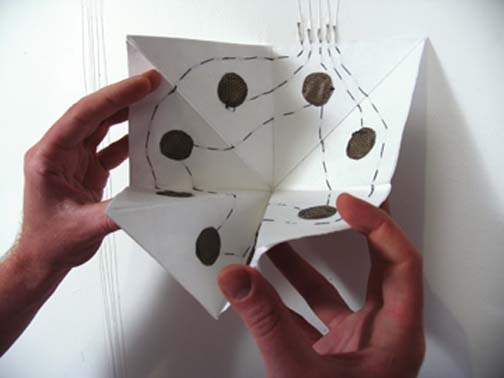
Interaction seemed to be the theme through the entire Siggraph convention. The question was, which sense was going to be stimulated or interacted with, by the art or new technology? Another one of my favorites in the Slow Art integrated vision, touch, and sound. Joo Youn Paek’s Fold Loud was a visual of large sections of tapestry incorporating origami shapes that could be folded, and in doing so, they opened circuits made of conductive material creating harmonic vocal sound.
It was difficult to truly appreciate the Taoist principles intended with this soothing art while standing in a noisy convention hall, and I was glad to see you could hear the work by visiting the Fold Loud website. I loved the opportunity to interact and touch the sculpture and while doing so to also create my own meditation.
DESIGN AND COMPUTATION
The third area depicting art and technology was the Design and Computation section of Siggraph. Here artists, designers, architects, and mathematicians created artwork, images and structures utilizing technology in both design and digital fabrication.
I had many favorites. The two pieces I choose to focus on were not figurative at all but instead were once again patterns and shapes.
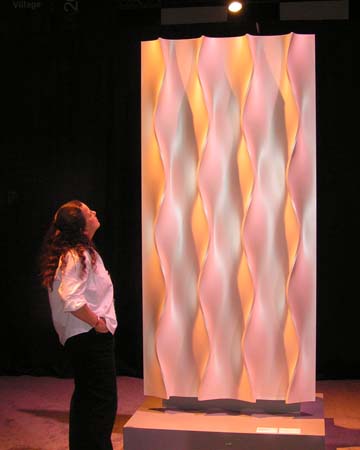
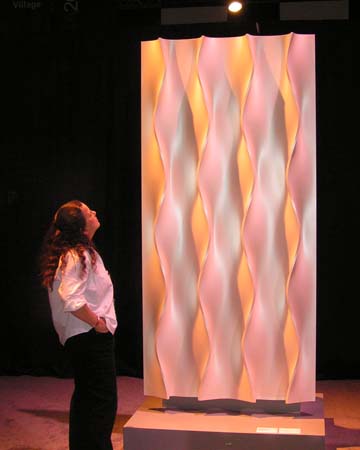
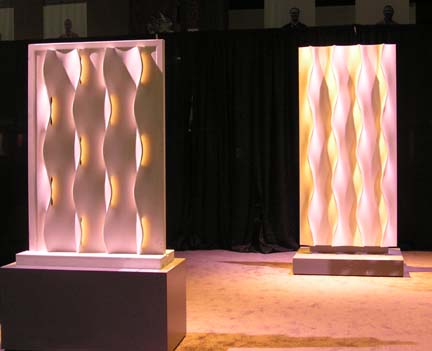
It might seem strange to see the work of a traditional veteran sculpture like Erwin Hauer in the technology exhibit at Siggraph. Hauer created works of modernism that began in 1950 and can be found, not only in museums and collections but also in architecture. The patterns in Hauer’s work held the same intrigue that Shlians paper cutting held for me in The Studio section of Siggraph. Each modular constructivism sculpture of looping forms change as the viewer interacts with the piece, light bouncing off form, shadows moving and blending, creating an entirely different piece of artwork from every angle.
A book of Hauer’s work titled CONTINUA was published in 2004, but it is said that by that time of publishing many of the existing screens had disappeared or were in disrepair, and the laborious task of making molds and casting these screens had not taken place in nearly 40 years. In 2003 computer technologist Enrique Rosado began working with Hauer creating digital files of Hauer’s original work, CONTINUA. Utilizing the new technology of digital files and Computer Numerically Controlled (CNC) milling machines, the team is working to recreate the works of this master.
The journey of translating the designs into the new technology was not easy for Rosado. He found what I have found in my research; often you must push the technology to do what you need it to do, and then wait until it can catch up and become affordable. In a wonderful magazine article about Hauer’s work in Metropolimag.com it states, “These subtleties of balance and proportion were difficult to translate into the software. ‘The computer wants to do what it wants to do,’ Rosado says. ‘And if you’re fastidious, you really have to beat it into submission.”’
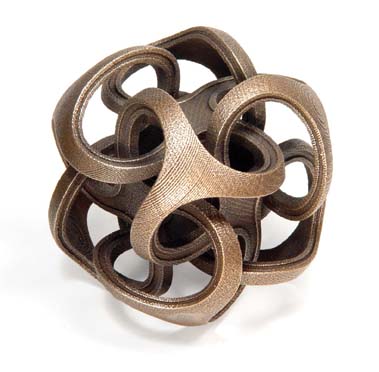
My other choice in Design and Computation was actually a student of Hauer. Bathsheba Grossman says that she was an undergraduate at Yale studying math when she first saw Hauer’s work. It was life changing; this is what she wanted to do. After graduating with a degree in math she went on to study sculpture at University of Pennsyvania. Bathsheba transfers math and science into wonderful sculptures utilizes 3D printing in metal and 3D laser etching as the output. She reports that her “traditional” studio has been reduced drastically, as she creates most of her work in the computer. It is because the complexity of her work cannot really be done any other way. She creates in a space that is inaccessible to traditional forms. Immersed in technology, for years she has watched as some traditional artists like jewelers begin to gravitate to working on screen instead of through tiny loops. It is not without its sacrifice, as she admits there is a tactile experience that is the reward of creating manually.
She waits patiently for technology to catch up to her needs as an artist. I learned that the “rough” texture created in the very intriguing process of digital printing in metal is a result of the technology and not part of her design. She is waiting for technology to improve. For those artists pursuing technology in the studio, it may sometimes feel like it progresses at the pace of RealSnailMail.
There were many more discoveries that I have found at Siggraph, which I hope to share in this column in the coming months, along with some wonderful tutorials on the advances in digital technologies as it pertains to the traditional artist. I myself have decided to embrace the technology and share it with as many creative people as I know. Maybe this will increase the snail’s pace and create the demand for the advances in technology that will assist us in our future creations. Though technology is improving and it will help us; in closing I would like to leave you with a quote from Hauer,
“It is an important token reminder for the younger generation and their tutors, that above and beyond the abundance of electronic marvels, the human vision and imagination remains the most important element and that its nurture should not be replaced by excessive reliance on devices.”
New You Tube Video – HARO
Sculptor Bridgette Mongeon shares a wonderful resource for marketing and the media. HARO- Help a Reporter Out. www.helpareporter.com
You are welcome to copy this you tube video to your site or blog. I might suggest instead you copy the blip.tv player. It is a better sound and better visuals, and I think the player is nicer. It also has a nice HARO graphic as the cover page for the video. It can be found on my home page. https://creativesculpture.com or on my blip tv site at www.creativeendeavors.blip.tv it is also on my Facebook page.
Or if you look to the left of this page you will see a list of my blip.tv videos and Haro is the first. Click on that icon and it takes you to the creativeendeavors.blip.tv site.
If you want to send someone someplace to view the video you are welcome to send them here. I’d love to have the traffic to my fine art web site!
What Is It Like To Sculpt The Famous?
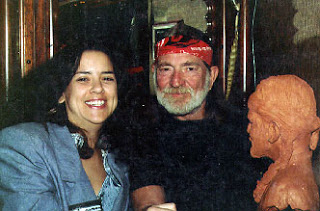 People often ask me what it was like to sculpt someone famous. Really it is the same as sculpting anyone else. Each subject adds their own nuances to the sculpture.
Many of those in the music industry have had people trying to take a piece of them their entire carriers, if that has hardened them to others then it will make my job much more difficult. Because remember, I am trying to capture much more than a likeness, I am trying to capture the essence of an individual.
For example B. B. King was wonderful to work with. Bill Monroe on the other hand was a harder nut to crack. I was able to soften him up a bit, even to the point where he hit me in the arm with his elbow as we were walking from the Grand Ole Opry.
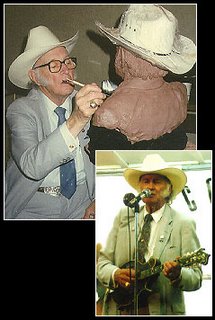
Minnie Pearl was approaching, and Bill said, “Tell er watcha doen, tell er wathcha doen.” It was the first time he showed real emotion over the sculpture.
I have enjoyed not only the sculpting of those who are famous, but also the research about them. I love history, and studying about an individual is a study in history. Especially if they have played roll in shaping that history, either politically, like Jesse Jones, or musically like B. B. King Willie Nelson, and Bill Monroe.
A funny story about B. B. King
I was a sitting, next to B. B. King, calipers in my lap and I said, “Mr. King, I will have to touch you in this sitting.”
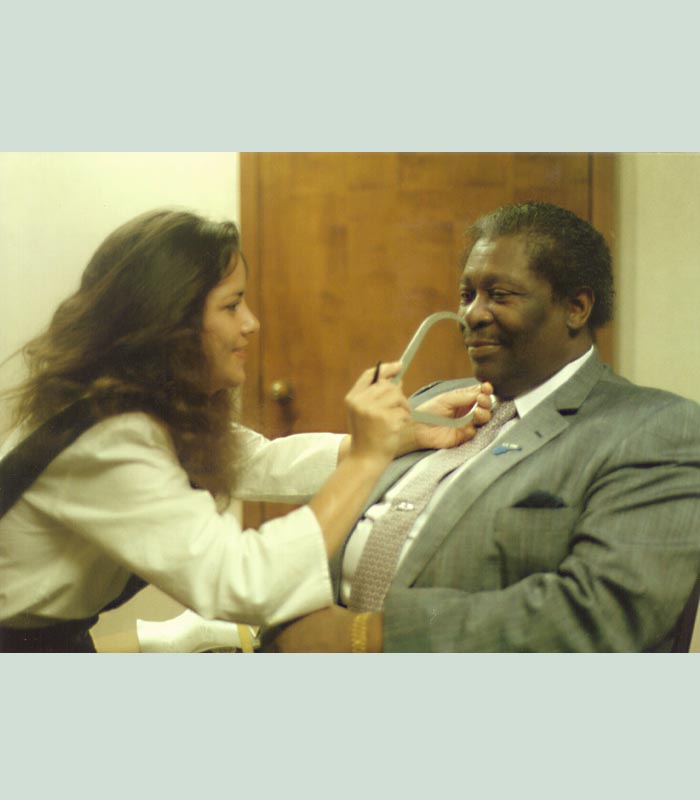
I know some people have a problem with people touching them especially their face, so I thought I should say something.
He replied, “Oh darling, you are already touching me!”
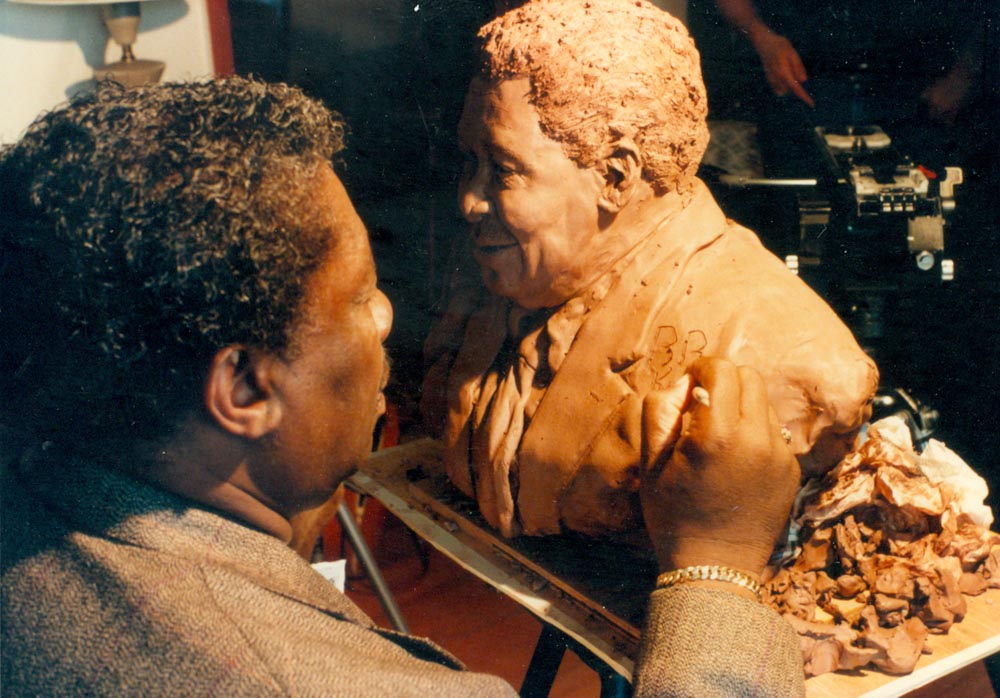
I looked at the calipers in my lap and him and said, “I don’t know what you mean.”
He said, “Your thigh is against my thigh and believe me the thrill is not gone!”
I love my stories about sculpting.
By the way, I equally enjoy sculpting for those people who just think their subject is a star!
Great Resource! Help A Reporter Out!
I have to tell you about this great resource. I’m about to release a video on it, but thought I would share a bit of the script here.
It is called HARO.
HARO? HARO? What the heck is a HARO?
It is simple it is an acronym for Help a Reporter Out. It is another great resource and definitely something to check out.
Peter Shankman, CEO, Entrepreneur, adventurist and cat lover started this simple Face Book page to help out some of his reporter and friends that were looking for sources. Instead of having to cull through his list of names he developed the Face Book page, and well it grew so quickly he moved it to http://www.helpareporter.com.
If you are writer working on a story, or have a podcast and are needing guests maybe you just have an online blog and want to get some real meat into your blogging. Then fill out the form on helpareporter.com.
Or maybe you are a PR firm that has many different clients that you represent. Then you can request to be added to the HARO mailing list and three times a day you will get requests for sources. All you need to do is find some that fit your clients.
Now I’m not a huge PR firm, I’m just a sculptor and writer work on my own public relations for my fine art sculpting, gift line, and speaking engagements that I do on marketing in the arts, and oh yes, I write articles. So I signed up. As of this date I have worked on both ends. I have given interviews on being a caregiver for an elderly parent, a female sculptor and entrepreneur, fostering animals in my home, being a women techy and of course art.
Three times a day I cull through the listings to see if anything fits, I want my reply to be on target. Can I really help this journalist? I need to be very careful. It is just good PR form not to send my stuff to everyone. And we all want to be very careful not to abuse this wonderful resource.
A few weeks ago I used HARO on the reverse end. I had a quick deadline on and article that I was writing and was looking for resources on a subject that I thought no one would be able to help me with. Writing an article about the Orphans work act. I went to the site and filled out the form and a very short time later I was inundated with sources, all in time for my next day deadline. Be prepared to file those resources. I’ll tell you they come fast. It made my job so much easier as a writer.
How much does all of this cost? FREE! Peter Shankman says that it is worth it for him to take time out of his day to put the list together, after all he gets a great deal of publicity out of it. Now if you want to donate remember he is an animal lover he has no problem with you sending a few bucks to such places as Best Friends Animal Sanctuary, or the National Dog Foundation. What a guy GO SHANKMAN! And thanks for HARO.
Pass the word and let others know about the resources. Having the list grow can only help both writer and source!
New Podcast Is Now Up! – Inspirations
As stated in an earlier post, I have been learning about creating podcasts. The podcast series has two channels, one called Creative Endeavors, featuring topics on art and another called Inspirations, about things of spiritual nature. ( creative endeavors podcast is not up yet, I’ll let you know)
I started the podcast for Inspirations to help other people and to help promote my collectible series God’s Word Collectibles. 
I have been focusing on the Inspirations channel which features a show called Generations. Three generations of Christian women sharing their thoughts about different issues and aspects of life. The women… My mom and my daughter, and myself. I has been a great deal of fun, and very interesting to hear what each generation thinks and is going through and how we compare. We have recorded our first 10, and have the first 4 up on the God’s Word Website. You can go to the main God’s Word Collectibles web site front page and click on blog/ forum. Or go directly to the blog
Sure would love to know what other think!
Giving Blood Can Make A Baby Dance!
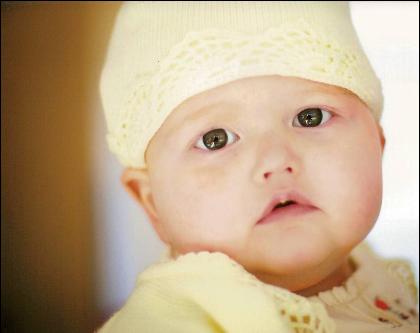
I guess I never had an example of what giving blood can do. It can make a baby giggle, and dance!
My client, in case you have forgotten about this commission, I’ll post another picture here
My client posted this short audio.
In it she describes the fight her little baby went through with childhood leukemia, and just how her receiving blood made a difference. Jenna passed away not long ago and I have created this sculpture that will sit at her grave site. If you have not thought about giving blood, this short audio may just change your mind. When you do give blood, maybe you will have a vision of a little baby, kicking his/her feet up in a dance, just like Jenna.