
A Few Questions Answered
Someone who was reading my posts and may be interested in Mudbox had a few questions. I thought I should probably answer them publicly. If he had a question than others may as well. The questions are as follows.
“You mentioned having problems with Mudbox and your Mac. You added RAM, changed the graphic board, and then said something about the problem was the OS version 10.5.7. Were all these necessary to have the program run correctly or was it just the OS? If so, were you able to go back to 10.5.6?”
I suppose I should mention some of the history of Mudbox. We should go back to late 2007 when Autodesk, one of the leaders in 2D and 3D design and engineering software purchased Mudbox from the New Zealand company Skymatter.
The biggest competition for Mudbox is Pixologic’s Zbrush.Z brush Demo came out in December 2002. It is a good program but in my opinion, not as intuitive or easy to learn as Mudbox. Even so, once I have tackled this book project I do intend to devour Z Brush as well.
Autodesk is a big company and having Autodesk behind a program is a huge thing. Both my co-author and myself feel that Mudbox is something to watch. I’m thrilled to be in on the ground floor with our book. Digital Sculpting with Mudbox: Essential Tools and Techniques For Artists Publisher Focal Press.
I have to give Mudbox commendations for quickly making a Mac version. It took Z brush a long time to come out with a Mac version. It was released in June of this year. Mudbox mac verions came out in May.
Needless to say there will probably be some bugs in a new version, but really there has been very little. My biggest difficulty was a graphics card. There seemed to be little suggestions offered on the Mudbox site concerning a desktop computer running mudbox. But finally, I changed my card and feel confident.
Unfortantely the biggest problem with my card seemed to have nothing to do with Mudbox. But may instead be something with the operating system, as another person reported that the same thing happens with him using different software. The problem when using another program, say photoshop or and clicking on that with my mouse, and then going back to Mudbox and turning my model which is a option>left mouse key, the model would flip upside down and my other program would hide. It was infuriating at first and when I got my new graphics card and it sill happened I was so mad. But the work around is simple. I just need to remember to tap on the Cintq tablet anywhere before pressing down the option key and turning my image. Once I do that, No problem!
Much has transpired in the last few months concerning this project and working in Mudbox. We have a deadline with the publisher and no software. That was frustrating. How do you write a book without software for the Mac? For a while I was able to run Mudbox on the PC side of a Mac using bootcamp, but it was a little frustrating for me. Different keys etc. So, yes Mudbox is running fine on my Mac with 10.5.7
When mudbox for the Mac began to ship in May, I was elated. I’m not sure how many Mac users there are but there are definitely some at Autodesk as I have been speaking to them.
RAM
I didn’t really need the extra ram that I bought to use Mudbox. The specs say that Mudbox can run on 1 gig but 2 is recommended. It is very important for both my co author and I to be able to write a book with instructions on a program that any one can use. Sure everyone would like to ramp up their computers and push the program to the limits. But we are keeping the average user in mind. Not the studio designer.
My basic reason for getting more ram is that I am also doing audio and video, and really wanted to begin to do video tutorials using such programs as Mudbox or zbrush. with that… well I needed a little more.
Graphics card
Here is a stickler and there does seem to be more cards for PC’s than Mac’s. But this new card was not terribly expensive, and I am glad I got it.
I do hope that has answered some of the questions. Be watching for what happens with Mudbox. Thanks for the questions, and keep them coming.
For those interested my present configurations are.
Mac Pro Mac OS X 10.5.7
2 x3 GHz Dual-Core Intel Xeon
12 GB 667 MH DDR2 FB-DIMM
Was using ATI Radeon X1900 XT- it was buggy
NOW WITH NEW CARD ATI radeon 4870
Dual displays
20 ” display
20″ Cintiq tablet
A Sneak Peek To What Is in Our New Book!
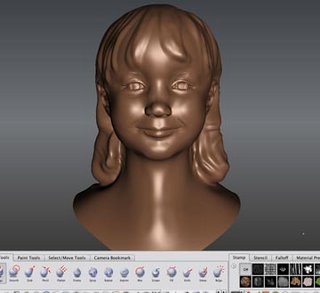
Most of you know that I am writing a book with Miguel de la Flor called Digital Sculpting with Mudbox: Essential Tools and Techniques For Artists.
We hope to make it a bit different than most digital sculpting books. I am so tired of seeing monsters and aliens in all of theses books and as one person recently wrote to me and said, “I am very excited to hear about your book and I definitely fills a gap. Most of the digital books I have found are for gamers creating characters.” That is so great to hear. I am thrilled about bridging this gap between digital and traditional and the new technology that is coming out is incredible.
So I thought I would share with you a little sneak peek of what is in the book. This is Amy. In the book I will be sculpting her both traditionally and digitally and giving the instructions on how to do this. Though she is not quite complete here she is.
Oh yes, and with this process you will be able to take any loved one and do the same thing. this is after all- portrait sculpting digitally!
Watch Out Digital Gamers- The Traditional Sculptors Have Arrived!
It is my personal quest to bridge the gap between digital and traditional sculpting. Technology is changing and new tools are available! Remember how photography used to be done? OK it is still done with film, but we all see the advantages to going digital. So it is with sculpting. That is why I am so excited about the book that we are writing. Digital Sculpting with Mudbox: Essential Tools and Techniques For Artists. We hope it is not just another digital book showing a software, but that it is an art book as well. That people will buy it not just because of Mudbox, but because they want to have the resources that are in the book to learn from and refer back to no matter what program they are working in.
It is grueling work, and the publisher is breathing down our necks to get more in quicker, but there have been so many setbacks, as you may know by my previous posts. For example Mudbox was not available for the Mac until just a few months ago, and for me that was a huge setback. Then my graphics card did not work with Mudbox once I got it.
I can’t wait until it is complete but for now— back to writing.
I Know It Looks Like I Fell Of The Face Of The Earth
Yes, the posts in my blog have been scarce. I am still here, and have not fallen off the face of the earth. I’m just focusing on getting my chapters into the publisher. That is taking all of my focus and concentration.
Of course I have had other distractions as well.
* Bidding on new sculpting jobs in the studio
* Taking care of jobs in house, or at the foundry
* Visiting with my daughter and new son-in- law, when they came into town
* Taking care of elderly relatives- it seems like that is my other job. Yes, I am at that stage in my life.
* Working on my house, or portions of it that seem to be crying for my attention, and just won’t wait anymore.
But mostly it has been the book. Hopefully this chapter will be out this next week and I’ll be able to see straight. Of course it will be on to the next chapter.
From the Book Shelf of Sculptor Bridgette Mongeon
Created for Best of Artists and Artisans Website.
By Bridgette Mongeon © 2009
When apprentices enter the studio it’s not long before they gravitate to my bookshelves searching for resources on further education, or books that will inspire. I am quick to pull a couple of favorite sculpture books from my bookshelf and comment, “You must look at this book,” or “Every sculptor should have this on their shelf.” Though I never have enough art books and am always open to reviewing new books, I thought I would take some time to share with you a few of my favorites, those that I share with my students and apprentices.
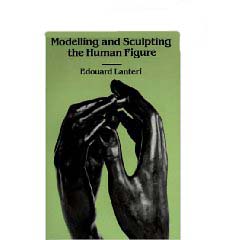
Modeling and Sculpting the Human Figure by Edouard Lanteri
Amazon $10.17
It is my opinion that no sculpture studio should be without Modeling and Sculpting the Human Figure by Edouard Lanteri. The author, Edouard Lanteri was a British sculptor 1848-1917. “The book is a gold mine of technical information, the kind of reference work that should be a lifelong studio companion to the figure sculptor,” as described in the introduction by sculptor, Nathon Cabot Hale. The first of the Lanteri volumes was printed in 1911, my copy is a reprint with a copyright notice of 1965.
Using this book as a study guide will offer the sculpting student a wealth of information that would only be attained in many years of study. Modeling and Sculpting the Human Figure covers portrait busts, full figures, measurements, building of armatures, scales and proportions, poses, and much more. I have especially appreciated the section on draping cloth. We all know that muslin, velvet and silk look different, but how does a sculptor portray the material in clay? No beginning sculpting student or established studio should be without this book.
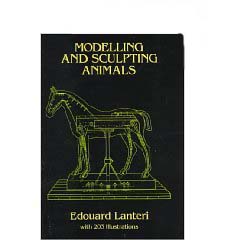
Modeling and Sculpting Animals by Eduard Lanteri
Amazon $11.65
Accompanying Lanteri’s book on Modeling and Sculpting the Human Figure is another book that was an original part of the 1911 edition—Modeling and Sculpting Animals. This book, with a forward written by friend and fellow sculptor Augusta Rodin covers what is in the Modeling and Sculpting the Human figure but in association with animals. Comparative measurements, construction, anatomy, armatures, and much more are featured with a bull, lion and horse as the subjects. Modeling and Sculpting the Human Animals is another book that should be on every sculptor’s shelf.
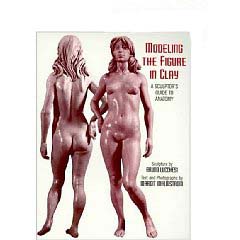
Modeling the figure in Clay by Brunno Luchessi
Amazon $14.93
For another self-taught study on the human form, a book that can’t be beat is Bruno Lucchesi’s Modeling the figure in Clay. In this book master sculptor Bruno Luchessi takes the artist through the entire process of creating a human form from skeleton to skin. Building the sculpture on a wire armature with bones, and then adding on the muscles and skin. I have often thought that this type of book and training would be of considerable importance to massage therapists as well. What better way to learn the anatomy and muscles of a client then to create the form from inside out in clay. A student wanting to hone their skills in artist anatomy would find this book a valuable resource.
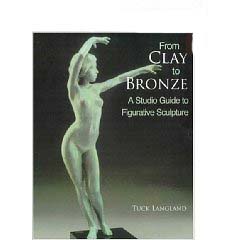
From Clay to Bronze by Tuck Langland
Amazon $21.45
For those sculptors who are working toward casting their artwork in bronze, and who may want to understand the process of bronze casting, Tuck Langland’s book From Clay to Bronze is another essential reference book for every sculptor’s bookshelf. Tuck takes us through every portion of bronze casting and even includes a section on the history of bronze casting. The idea that bronze casting has changed so little over such a long period of time, never ceases to amaze me.
Though Tuck does designate some chapters to such things as materials, armatures and modeling, most of the book focuses on the process of reproduction. In-depth segments on making molds, casting, and even using other materials besides bronze for casting your artwork are covered. Then Tuck takes the reader through the entire bronze process of waxes, investment, burning out, chasing, and even patinas and mounting. I especially appreciate the color pages on the process of creating patinas. Coloring a bronze using chemicals is called patination and is a true art in itself. With a copyright of 1999 you know that the resources that Tuck lists are problaby still available and his suggestions of further reading are a way to continue your sculpture library.
For the small investment of $60.00 from Amazon (this could be less if you are buying used books), and the commitment of time and study of these materials, a beginning sculptor could, upon completion know that their study was at the same level as working under a master in a four year university. The only thing missing is the feedback from the master.
Artist Interview- Camille Allen
Created for Best of Artists and Artisans web site
By Bridgette Mongeon © 2009

Camille Allen from British Columbia, Canada loves babies. She learned the art of making dolls from her husband’s grandmother, Clara Allen. Though her dolls are life-like, they certainly aren’t life-size. Instead, they are miniature babies created in clay.
Her first creation was so small she found it would fit inside an egg and now she has a line of “Egg Babies.” She says, “I think the fragile newborn baby is complimented by the egg shell, reminding us of how fragile new life is and how gently they must be treated and cared for.”
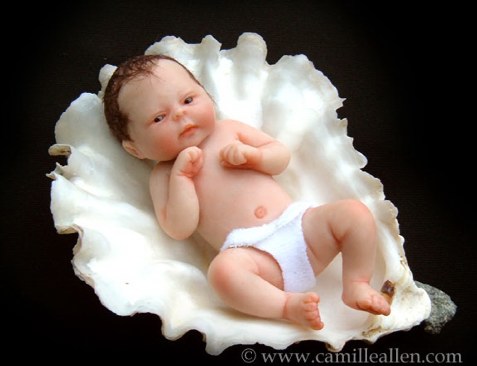
Later she put one of her miniature babies in a sea shell. “The shapes of and textures of different seashells either echo the soft curves of babies, or they provide an interesting contrast to emphasize them. Some “Shell Babies” have pearls in their navels or are holding a pearl, like two little treasures found in one shell,” states Camille.
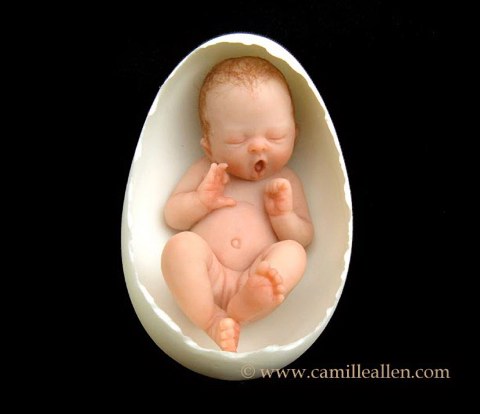
The miniatures babies are made of polymer clay. Camille explains, “It is soft, but it can hold the tiniest detail, even fingerprints. Once I have completed a sculpture, I then fire the clay with heat to harden it. Sometimes the babies are cast into a mold and made into other materials like Resin or Porcelain or Silicone.”
Camille does not take commissions, instead shesculpts limited edition or one of a kind miniature babies that come from her heart instead of a photo. She has sold to people all over the world, and has even had her babies featured on the Montel Williams television show.
Some babies are available for sale on her website: www.camilleallen.com. All babies vary in price, but here is a rough estimate of the price ranges: Resin Limited or Large Edition Babies: $99 – $400. One of a kind: $1500 – $4000+ (US dollars). She is expanding to different lines of babies that will be available in more price ranges. She also has an email list for anyone who would like to see photos of new babies as they are created.
I asked Camille for some tips on sculpting as well as more about the process.
“Starting from a lump of clay, and tiny tools including toothpicks, sculpting a life-size or miniature baby begins. It takes many, many hours of patient concentration to form a realistic baby and finish with fine details – including wrinkles and fingernails. The babies have soft English mohair to imitate fine baby hair and are blushed with paints for realism to enhance their tiny wrinkles and creases.
A life-size baby takes me months to complete. Miniature babies take several days to several weeks, depending on how complex the sculpture is. It depends on how patient I am feeling, and how long I can concentrate at a time. Sometimes my eyes get tired sculpting in miniature, so I take many breaks. It is very time-consuming work.

I work with “Prosculpt” almost exclusively now. It has a good consistency and blends well. I try not to overwork the clay’s “skin,” trying to push the masses instead of dragging the skin layer very much. This helps keep a nice smooth outer layer. I use a 3 in 1 tool from www.artdolls.com for almost everything, except the baby’s nostrils, which require a toothpick or a needle if the baby is very tiny.
Troubleshooting babies faces: If the baby looks “old man-ish” the eyes are too high up in the face, also probably the upper lip is too long. If it looks like an alien, the eyes are probably too far apart, or too big. If it looks like an animal/dinosaur – like it has a muzzle/snout – then the nose/under the nose area is too big or protruding.
That is the process in a nutshell or should we say an eggshell or seashell. Her work touches the heart and fascinates the eyes while evoking an element of awe.
It Is Strange But True- My Interview
It is strange but true. I thought I would share this podcast with you. I was interviewed by Strange But True Podcast out of UK. Please note:I ask my Christian friends please don’t freak out over my interview. I have prayed over this, and been prayed over. My minister knows and I do consider it a gift. Please be assured, I’m not possessed.
Besides creating fine artwork, most of my blog readers know that I sculpt deceased loved ones. I have written a book titled “Bringing to Life the Spirit of the Deceased- A Sculptor’s Journey.” Still looking for a publisher. It is about the science behind some of the “strange” things that happen during sculpting the deceased as well as my own experiences. I’m still searching for a publisher for the book. I an also writing another book titled “Kisses from Heaven” based on what others have said about their experiences. Now I am searching for more stories about others having different experiences when someone dies.
Anyway. It was a fun podcast. If for any other reason it is good to hear that UK accent from my interviewers. You will have to wade through some of the “strange” items before hand. Unless you forward to 1/2 past the hour or move your player curser to 38.40 to hear my interview.
PODCAST NO LONGER AVAILABLE
Twitter Answers?

I have been tweeting, which is a very short comments on different things that I post through the day. Most people twitter from their phones, I twitter on my computer. People can subscribe to your twitters. I have no idea exactly who subscribes to my twitters, but right now I assume they are anyone that is interested in sculpting, digital sculpting, art, marketing, and the like. My twitter name is sculptorwriter for my fine art and creategodsword for my gift line. Just incase anyone wants to subscribe.
My tweets appear on my facebook home page as well as on my blogs. Some people actually answer me through my twitter posts, giving me resources or answers to questions. This is really cool, but warning, I have no idea how to answer someone when they respond to my twitter post. But I’m not sure if that is really necessary.
When tweeting about my frustration with accounting and Quick Books I tweeted about wishing my accountant offered help with my Quick Books. there are just some things I don’t know how to figure out. So instead of trying to pose a twitter question on quick books in only 140 characters,( the max when tweeting) I’ll post it here.
QUICK BOOKS QUESTION NUMBER ONE
If I have a vendor- foundry that gives me an estimate on the project. It is awarded to them when I get the job and then I pay them in two installments, but I’m not sure how to set it up. You see right now I have to receive the item in QB before making a payment. That means I have to say ” received bronze newsboy cast” even though it may take up to two months and will have a couple of payments. So what is the best way to set up this vendor and the payments in Quick books?
There you have it. I’ll let you know what others say.
Wax Newspapers!

One of the things that needs to be prepared for the life size newsboy to go into bronze, is his newspapers. I offer, for an additional cost, a change of the masthead and above the fold headline. That means my client can recreate any headline in history. That is really cool when you think about it. What it entails for me is to carve all of these papers. Now, I could carve one and make a mold, but frankly that is almost as much trouble as carving the entire paper. Here is how I changed the first newspaper for the second one in the edition that went to the Tabor City Tribune. The paper is covered in wax and then the new headline will be hand carved. Now all of this would be o.k. if it were just one paper. But the newsboy holds one in his right hand, a bunch were tucked under his left hand, and there are a pile by his feet. So basically I have to recreate at least three papers.
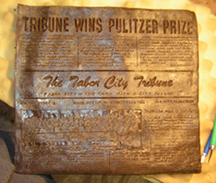
Of course the rest of the waxes also need to be cleaned. This is usually done by the foundry, but I like working my waxes and adding detail. The waxes are made from molds and where the molds come together there is often a seam of wax. Of course you also need to be sure that all of the pieces go together. It is much easier to put together waxes than it is metal.
ight: 240px;” src=”https://creativesculpture.com/blog/uploaded_images/waxpaper-b-760110.jpg” alt=””>Information on purchasing
a Newsboy – Life-Size or Figurine
Studio Is a Buzz!

The contract came in for the new newsboy. I’m not sure I can divulge where it is going. Something for which to look forward.
Meanwhile I’m reviewing and learning to use the Next Engine Scanner. Be prepared to see some video coming up on this process in the near future. Yes, the price tag looks hefty, however you must remember that sending one sculpture out for scanning can cost about $1,000.
This tool has so many applications for the studio. I just can’t wait to share it with everyone. I’m working on an article for my column at Best of Artists and Artisans website. I’ll let you know when it is up.